 Paola Tartakoff: "Between Christian and Jew. Conversion and Inquisition in the Crown of Aragon 1250-1391", Philadelphia: University of Pennsylvania Press 2012.
(1) S. 29 ("Chapter 1: Defending the Faith. Medieval Inquisitors and the Prosecution of Jews and Converts"): "In 1284, for instance, Dominican friars investigated the Jewish aljama of Barcelona for sheltering regretful converts. In 1313, the archbishop of Tarragona, Guillem de Rocabertí, and the inquisitor Joan Llotger prosecuted the Jewish aljama of Montblanc for helping a convert named Joan Ferrand return to Judaism. In 1315, the bishop of Barcelona, Ponç de Gualba, investigated charges that a Jew from Barcelona named Chaim Quiç had convinced a convert named Bonafos to return to Judaism. In 1323, the archbishop of Tarragona, Ximeno Martínez de Luna i Aragó, prosecuted a Jew from Valls named Isaach Necim for having sheltered a convert who had returned to Judaism.62".
―――――
Ann. / Anm.: 62. [Jean] Régné, History ['History of the Jews in Aragon. Regesta and Documents 1213-1327', ed. by Yom Tov Assis, Jerusalem: Thr Magnes Press 1978] 218-19 (#1206), 548 (#2966), 599 (#3259); Assis, "The Papal Inquisition", 401, 408-9 (#4, 5).
Tartakoff, a.a.O., S. 26: "Inquisitors' concern about converts returning to Judaism was no doubt heightened by the entry ino the Crown of Aragon of hundreds of Jews who had been expelled from France during the last decade of the thirteenth century and the first quarter of the fourteenth. A first wave of refugees arrived in 1293 and a much larger influx in 1306. Some of these refugees had been baptized north of the Pyrenees, and they sought to return to Judaism in Iberia. [...] In 1342, during his trial, Jucef de Quatorze specifically referenced to the proceedings as 'the inquisition against the French'" [Anm. 49: ACB = Barcelona, Arxiu de La Catedral de Barcelona, C126*, fol. 53r].
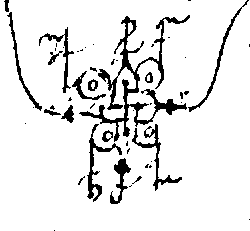 * vhmml.org 56886: Barcelona, Catedral de Barcelona Arxiu Capitular, Codex 126. Bibl.: Josep Oliveras Caminal, "Codicum in sanctae Barcinonensis ecclesiae segregatis asservatorum tabulae," Scrinium 7 (1952): 6-16; Julian Plante, "Checklist of Manuscripts Microfilmed for the Hill Museum & Manuscript Library", vol. 2, Spain, pt. 1 (1978), 1-14. HMML Proj. Num. 30395. 90 leaves. Title: "Inquisitionis haereticae pravitatis processus, 1340". Text endet Bl. 87[?]v, Notizen untere Hälfte Bl. 87v, obere Hälfte 88r mit Zeichnung (Abb.), Bl. 90r neuer Text, unterschrieben mit: "Goncalao ferrandi/ Capita da Armada [Kapitän der Marine] di S.R.".
(2) S. 81f. ("Chapter 4: Homeward Bound. The Fates of Jewish Converts"): "In the environs of the medieval Crown of Aragon, a handful of Jewish converts fared well after baptism, including several individuals who had been wealthy or learned as Jews. At least two converts rose in the ranks of the Dominican order. Pablo Christiani served as the Christian disputant at the Barcelona Disputation of 1263, and Ramon of Tàrrega, who converted in 1346 or 1347 at the age of eleven, became a theologian.2 Others received royal privileges. For example, the physician Vincenç Esteve and the son of the queen's treasurer, Juan Sánchez de Calatayud, were exempted, by Jaume II and Joan I, respectively, from having to renounce their material possessions.3 In addition, several converts were granted lucrative employment - often pertaining to Jewish affairs - by members of the royal family. In 1305, for instance, the convert Bertran of Jorba was granted a monopoly over the sale of meat to the Jews of Montblanc by Queen Blanca. This probably meant that Bertran received the earnings from the sale of meat to Jews and that he appointed the local shohet, or ritual slaughterer. In 1307, a convert named Joan Ferrand was appointed bailiff of Jews and Muslims in Teruel by Jaume II. The convert Romeu de Pal of Tàrrega served as a royal surgeon. In 1331, he was granted a monopoly over the sale of meat to the Jews of Cervera by King Alfons III and, in 1343, he accompanied Pere III on his campaign in Mallorca and received four hundred Barcelona sous as compensation".
―――――
Ann. / Anm.: 2. Jeremy Cohen, "The Mentality of the Medieval Jewish Apostate. Peter Alfonsi, Hermann of Cologne, and Pablo Christiani", in: "Jewish Apostasy in the Modern World", ed. Todd A. Endelman (New York, 1988), 35-41; José María Coll, "¿Ramon de Tárrega fue formalmente hereje?", Ilerda 6 (1948): 7-29. 3. Régné, History, 532 (#2881); Baer, Urkunden, 1:610 (#390.1).
Tartakoff, a.a.O. S. 81, Widmung: "'If you accept baptism, you will be called a dog, a son of a dog, both by Christians and also by Jews. You will live in poverty, and he who today will not give you a coin will not give you another in an entire year. And so you will suffer great privation and, out of despair, you may soon beg to die' - Inghetto Contardo, 1286 [Anm. 1: Ora Limor, ed., Die Disputationen zu Ceuta (1179) und Mallorca (1286). Zwei antijüdische Schriften aus dem mittelalterlichen Genua (Munich, 1994), 275. On the Mallorca Disputation, also see Ora Limor, 'Missionary Merchants. Three Medieval Anti-Jewish Works from Genua,' Journal of Medieval History 17 (1991): 35-51]".
S. 83: "In fact, travel was a hallmark of the existence of Jewish convert beggars across Western Europe, such that converts bridged regions not only by being baptized far from home, but also through their wayfaring after baptism. During the fourteenth century, convert beggard passed through the Crown of Aragon from as far afield as Lisbon, Toledo, Avignon, Toulouse, Paris, Saint Denis, and Rheims".
S. 94: "Rejected by Christians, many converts were relegated to a no man's land".
(3) S. 110f. ("Chapter 5: Apostasy as Scourge. Jews and the Repudiation of Apostates"): "On very rare occasions, Jews in the Crown of Aragon physically attacked apostates. During the first quarter of the fourteenth century, a Jew named Joan Ferrand, who previously had apostatized and then returned to Judaism, killed a recent apostate, and in 1363, the Jews of Puigcerdà were prosecuted for the murder of the apostate preacher Nicolau de Gràcia.31 We do not know what motivated these murders. Yet here again, evidence from north and southwest of the Crown of Aragon suggests a pattern. [...] In the words of an apostate from late thirteenth-century Ferrara, on account of persecution by Jews, apostates 'could not live without fear.'34"
―――――
Ann. / Anm.: 31. Baer, Urkunden, 1:207-8 (#168) (=Régné, History, 548 [#2966]); ACA = Barcelona, Arxiu de la Corona d'Aragó, Canc., Reg. 714, fol. 84r-v, cited in Riera i Sans, "Les llicències", 124. 34. Colorni, Judaica minora, 182-83 (#2).
Tartakoff, a.a.O., S. 117: "During the first quarter of the fourteenth century, for example, Jews in Catalonia referrered to the repentant apostate Joan Ferrand as a baal teshuvah - a 'repentant one' or 'returnee' - a title that suggests that the Jewish community had reaccepted this individual [Anm. 3: Baer, Urkunden, wie oben in Anm. 31 zu S. 110; siehe auch Joseph Shatzmiller, 'Converts and Judaizers in the Early Forteenth Century,' Harvard Theological Review 74 (1981): 63-77, hier 69]".
(4) S. 121 ("Chapter 6: Recruiting Repentance. The Re-Judaization of Apostates": "Most striking, perhaps, was the pièce de résistance of the evening of Thursday, January 4, 1341, namely, Jucef de Quatorze's narration of the anti-Christian satire, the Toledot Yeshu. Portraying Mary as an adulteress and Christ as an illegitimate child who stole the Shem ha-meforash - the ineffable name of God - from the Temple and tricked the world into worshipping him, this narrative lambasted Christianity. Whether or not Jucef de Quatorze* actually recounted the Toledot Yeshu** before Pere in January 1341, it is clear that the tale did circulate among Jucef's Jewish contemporaries".
―――――
 Notas. Annotations. Anmerkungen. Remarques
* Zu Jucef de Quatorze, ebenda, S. 28f.: "Inquisitors may also, however, have considered Jews to be more culpable than the converts whom they allegedly re-Judaized. Fra Bernat de Puigcercós, for example, noted in his draft of the final sentence for the Almulis and Jucef de Quatorze that Janto, Jamila, and Jucef 'were more guilty than he who was burned [that is, Pere], for they were the entire reason for which the burned one erred, and the reason for which he persevered in error to the point of death.' Janto, Jamila, and Jucef were, according to fra Bernat, 'makers, abettors, and defenders of heretics' who, according to canon law, 'deserved to be punished more than heretics.'".
Ebenda, S. 57: "We do not know for certain what became of Pere, Janto and Jamila Almuli, and Jucef de Quatorze. We know only that, during Pere's trial, most of whose transcript has not survived. [...] Janto and Jamila may have died in the tower of Castellnou. And, barring some development of which we have no record, on Monday, August 12, 1342, Jucef de Quatorze was tied living to a high post - with a chain around his neck and ropes under his arms, around his waist and groin, above and below his knees, and around his ankles - and consumed by the flames that he and the Almulis allegedly had recommended to Pere and Abadia [Fn. 7: This description is based on Lea, A History of the Inquisition of the Middle Ages, 1:551-52].".
Ebenda, S. 56: "Sunday, August 11 - at the cemetry of thr church of Santa Maria del Mar in Barcelona, the alleged crimes of the Almulis and Jucef de Quatorze were broadcast before a 'great multitude of people of both sexes' summoned by the town crier [...] [Fn. 5: ACB, C126, fols. 12v, 76v-78v, 86v, 91r, 93r-v]".
Ebenda, S. 15: "Pere portrayed Jucef de Quatorze as thr ringleader, and he testified that Jucef de Quatorze told him that he, along with Janto and several additional Jews, had re-Judaized Abadia in 1334 [Anm. 8: ACB, C126, fol. 50r]". Abadia "proclaimed his return to Judaism befor the justicia of Calatayud, [...] incur[ed] the death penalty and bec[a]me a Jewish matryr. [...] Abadia's soul was now 'safe with God'" (S. 14). "As it emerged later in the proceedings , fra Sancho [de Torralba] was convinced that Jucef de Quatorze had a history with the inquisition. According to fra Sancho, in 1326, the inquisitor fra Guillem Costa had arrested Jucef, together with other Jews from Calatayud, including two of Jucef's relatives, on charges of circumcising Christians and re-Judaizing converts. [...] Jucef was, then, a repeat offender, a particulary incorrigible and dangerous culpit who merited death at the stake" (S. 15).
Kristine T. Utterback: "Jewish Resistance to Conversion in the Late-Medieval Crown of Aragon", in: "Jews in Medieval Christendom. Slay them not", hrsg. von Cristine T. Utterback und Merrall L. Price, Leiden: Brill 2013, S. 163-176, insb. S. 164: "Janto and Jamila Almuli of La Almunia de godoña and Jucef de Quatorze of Calatayud***, in Aragon [Fn. 2: Barcelona, Archivo Capitular de la Catedral, MS 126, ACA 126]. These three Jews stood accused of rejudaizing two men, Abadia, who been executed aber he had rejudazided, and Pedro, formerly called Alatzar, who had been rescued from death by the inquisitor and some other Dominicans and who had turned 'state's evidence' against the three Jews on trial".
Tartakoff, a.a.O., S. 23f.: "During the first quarter of the fourteenth century, one century after Dominicans first burned Jewish books in Montpellier, inquisitors just north of the Crown did so again. In 1319, Bernard Gui ordered the public burning of the Talmud. In 1321, in response to Pope John XXII's bull, Dudum felicis recordationis, which required that Franciscan and Dominican friars examine Jewish books and destroy those containing offensive passages, the inquisitor and bishop of Pamiers, Jacques Fournier (later Pope Benedict XII), likewise called for the burning of volumes of the Talmud [...] In his draft of the final sentence for the Almulis and Jucef de Quatorze, fra Bernat de Puigcercós stressed the particulary reprehensible nature of public blasphemy. He explained that the Almulis and Jucef de Quatorze were blameworthy not only because they 'led certain Christians, who were previously Jews, to return to the Jewish perfidy in secret,' but also because they 'led them publicly to profess said perfidy, publicly to deny the faith of Christ, and publicly and with abominable words to blaspheme Christ and his mother and the laws of Christ' (emphasis mine) [Anm. 36: ACB, C126, fol. 83v]".
S. 36f.: "In 1319, for example, [king] Jaume II granted Jucef de Quatorze a royal remission for having wounded another Jew, in exchange for two thousand Jaca sous. In 1321, Jaume II granted Mosse Abenforna a royal remission for having wounded a relative of Jucef de Quatorze named Isaach, in exchange for three hundred Barcelona sous. Moreover in 1326, Jaume II revoked various inquisitorial fines and confiscations that had been imposed on Sulema and Ora de Quatorze, in exchange for ten thousand Jaca sous".
S. 39: "Jucef de Quatorze's son [is] Jaco [...]. One glaring inconcistency, however, suggest that at least one person may have been wrongly accused of involvement in Pere's re-Judaization. Miriam Navarro portrayed Jucef de Quatorze as a central player in Pere's re-Judaization, as did Pere in his second confession. But Salomon Navarro initially omitted any mention of Jucef and instead portrayed Janto Almuli as the lone ringleader, as did Pere in his first confession".
S. 119: "Jucef de Quatorze, whom Pere described in his second confession as having directed his re-Judaization and who allegedly was involved also in the circumcision of a Christian boy in 1326 and in Abadia's return to Judaism, was the son of Sanson de Quatorze, an adelantado, or executive officer, of the Jewish aljama of Catalayud, who was appointed to the important post of tax collector in 1286. In addition, in 1327, Jucef de Quatorze was chosen to represent the Jewish aljama of Catalayud before King Jaume II. [Anm. 16: Régné, History, 277 (#1519); ACA, Canc., CR, Jaume II, caixa 86, no. 7]".
S. 129ff.: "No other cases of apostate matyrdom [Abadia, Pere alias Alatzar] have come to light from this period in the Crown of Aragon [...]. Jewish-Christian relations had long been particularly volatile around Calatayud. [...] -Dring his trial, Jucef de Quatorze lamented that 'many men of his lineage lost all of their goods.' [...] These experiences may have led some Jews in Calatayud to take a particularly provocative and aggressive stance toward Christians and apostates".
"'With all due respect to the lord inquisitor, he should not have proceeded as he did', Jucef de Quatorze, 1342" (a.a.O., S. 33, Widmung, Anm. 1: ACB, C126, fol. 54r).
** Der zitierte Text des Toledot Yeshu (S. 103f.) steht laut Tartakoff, a.a.O., S. 164, Anm. 7, auf "ACB, C126, fols. 50r-51r. This attestation of the Toledot Yeshu was first brought to light by Riccardo Di Segni in 'Duo nuovi fonti sulle Toledoth Jesu,' La Rassegna Mensile di Israel 55 (1990): 127-32. Also see Yaacov Deutsch, 'Toledot Yeshu in Christian Eyes,' M.A. thesis, Hebrew University of Jerusalem, 1997; and Paola Tartakoff, 'The Toledot Yeshu and the Jewish-Christian Conflict in the Medieval Crown of Aragon,' in Toledot Yeshu ('The Life Story of Jesus') Revisited, ed. Peter Schaefer et al. (Berlin, 2011), 297-309, Samuel Krauss, Das Leben Jesu nach jüdischen Quellen (Berlin, 1902), remains the most comprehensive work on the Toledot Yeshu". Eine lateinische Übersetzung erscheint unter anderem im 17. Jahrhundert innerhalb der Sammlung Tela Ignea Satanae des christlichen Hebraisten Johann Christoph Wagenseil.
Tartakoff, a.a.O., S. 122: "Moreover, Salvadora [Salvat] explained that she heard this story from her father, and she believed it. Presumably, just as Salvadora claimed, the narrative was passed orally among Jews, from generation to generation. [...] Sources beyond the records of the trials of the Almulis and Jucef de Quatorze also suggest, however, that, in addition to serving as a form of internal Jewish anti-Christian polemic, the Toledot Yeshu was used in re-Judaization efforts. First, in his Vita Christi, Francesc Eiximenis remarked: 'I have heard that this book of the devil is [found] in the large aljamas of Spain and that it is read there among [jews] in order to bring back [to Judaism] those [Jews] who dare to make themselves Christians' [Anm. 25: Vic, Arxiu Episcopal de Vic, MS 172, fol. 34r]".
*** Zur Familie de Quatorze finden sich bei Alexandra Eni Paiva Guerson de Oliveira: "Coping with Crises. Christian-Jewish Relations in Catalonia and Aragon, 1380-1391", University of Toronto 2012, ein Isaac de Quatorze, "a Jew from Calatayud" (S. 41; ACA C 828: 39r-v, 11/06/1383), gerät 1383 in Gefangenschaft durch kastilische Truppen; "Juce de Quatorze from Calatayud, who fled to Zaragoza during the war", sollte 1381 bei der Rückkehr extra Steuern bezahlen (S. 42; ACA: C 822: 71r, 13/05/1381); zwei Juden gestehen 1377 unter Folter, dass sie Wirte an Salomo de Quatorze, Mosse Ambimax and Abraham Abolbaca aus Huesca verkauft hätten (S. 162f.; ACA C 1723: 46r-v, 11/12/1377, Miret i Sans, 66, n. 1). "Salomo managed to flee but the other two were arrested" (S. 163).
"Medicine Before the Plague. Practitioners and Their Patients in the Crown of Aragon, 1285-1345", hrsg. von Michael Rogers McVaugh, Michael R. McVaugh, Cambridge University Press 2002, S. 62, Fn. 97: "Çulema de Quatorze of Calatayud chose to travel to Xàtiva in the kingdom of Valencia to study medicine rather than stay at home in Aragon, in Calatayud or even Zaragoza, the Aragonese capital (Sept. 1347; C 645/141r-v)".
Máximo Diago Hernando: "La comunidad judía de Calatayud**** durante el siglo XIV. Introducción al estudio de su estructura social", in: "Sefarad. Revista de estudios hebraicos, sefardíes y de Oriente Próximo", 2007, Año 67, No. 2, pags. 327-365, dreht sich um "los nuncios de las de Zaragoza y Calatayud, Salamón Abenarrabí e Içach de Quatorze" 1383 [digital.csic.es].
Mark D. Meyerson: "A Jewish Renaissance in Fifteenth-Century Spain", Princeton: Princeton University Press 2021, S. 190 nennt für 1392 "Haluha, and her father Saçon de Quartorze of Teruel". Yom Tov Assis: "Jewish Economy in the Medieval Crown of Aragon, 1213-1327. Money and Power", Leiden: Brill 2023, S, 54, erwähnt einen "Samuel de Quartorze of Teruel accused of violating the interest law in 1310".
Eleazar Gutwirth: "Techne and Culture. Printers and Readers in Fifteenth-Century Hispano-Jewish Communities", in: "The Late Medieval Hebrew Book in the Western Mediterranean. Hebrew Manuscripts and Incunabula in Context", hrsg. von Javier del Barco, Leiden: Brill 2015, S. 338-369, insb. S. 358f.: "In 1324-1326, under Jaume II, there were Inquisition trials against Jews of Calatayud. Juceffus (Joseph) de Quatorze of Calatayud seems to have been affected and contacted the court [Anm. 57: Baer, Die Juden, 1:420, no. 292. See Josep Perarnau i Espelt, 'El procés Inquisitorial barceloní contra els jueus Janto Almuli, la seva muller Jamila i Jucef de Quatorze (1341-1342),' Revista Catalena de Teología 4, no. 2 (1979): 309-53]". On May 22, 1369, at San Mateo, the capitulations of the formerly Castilian town of Molina to the new Aragonese conquerors were drawn up. These are of interest to historians of the Jews for a number of reasons, but here the important point is the mention of a member of the Quatorze family, namely Doña Bellida, the widow of Mosse (Moses) Quatorze and mother of their son, Juceffus. According to the document, they had come frome Castile to Teruel. They are linked with Isaac Lapapa, who is also one of the correspondents of Ribash. [...]"; es folgen Nennungen von Mitgliedern der Familie Quatorze in "Ribash's responsa" bis 1492, S. 360: "So, even in this exchange of letters with Ribash - a type of documentation independent of the Christian archives - we see the connection of the family not only with members of the Jewish communities of Aragon, but also with the Christian notarial, legal, and other professional fields".
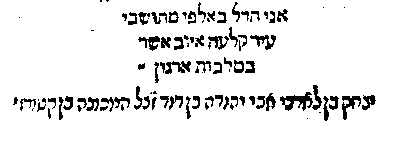 Gutwirths Interesse geht aus von dem Buchdrucker (bzw. Herausgeber) Isaac ben Judah ben David de Quatorze, siehe ISTC id00102740 = Goff Heb-40; Hain 6034 = David Kimhi [David ben Josef Qimchi; Radak]: "Sefer ha-Shorashim", Naples: Joshua Solomon Soncino, for Isaac ben Judah ben David de Quatorze?, 10 oder 11 Feb. 1491, "[k]nown with and without the name of Cattorzi (de Quatorze) in the colophon, who may have been the publisher or otherwise connected with the book", Blatt 1b laut Gesamtkatalog der Wiegendrucke, Nr. 08173: ספר השרשים / אמר דוד בן יוסף בן / קמחי הספרדי, "Das Buch der Wurzeln / sagte David ben Yosef ben / Kimchi der Sephardi", in einigen Exemplaren abweichend (unter den Digitalisaten Jerusalem, nicht Frankfurt) auf Blatt 167b, Zeile 31 (Abb. links): אני הדל באלפי מתושבי / עיר קלעה איוב אשר / במלכות ארגון / יצחק בן לאדני אבי יהודה בן דוד ז״צל המכונה בן קטורזי: "Ich bin die Minderheit unter Tausenden von Einwohnern / der Stadt Calatayud, die / im Königreich Aragon / Yitzchak, Sohn von Ladni, der Vater von Yehuda, Sohn von David, bekannt als Ben Katorzi"; ISTC im00866180 = Goff Heb-88; Hain 11671 = Moses ben Nahman [Nachmanides]: "Perush ha-Torah", [Naples: Joseph ben Jacob Ashkenazi Gunzenhauser], [Joshua Solomon Soncino], [Isaac ben Judah ben David Cattorzi (de Quatorze)], 2 Juli 1490. Im Jahr 1442 eroberte Alfons V. das Königreich Neapel und vereinigte Sizilien und Neapel als Dependenzen von Aragonien.
Ein Dionizio Rodrigues Catorze heiratete am 13. Februar 1831 in Ovar, Aveiro, Portugal Maria Clara Gomes, geb. 1818; ein Jean Baptiste Quatorze wurde am 4. Juni 1858 in Arancou, Pyrénées-Atlantiques, Aquitaine, geboren; ein Pierre Joseph Quatorze wurde am 1. Dez. 1782 in Quevauvillers, Somme, Picardie, geboren, als Sohn von Augustin Quatorze, geb. am 15. Nov. 1754 in Bovelles, Somme, Picardie, gest. am 18. Okt. 1786 in Quvauvillers, Sohn des Louis Quatorze, des Jüngeren, geb. am 24. März 1718 in Bovelles, Sohn des Louis Quatorze, des Älteren, geb. am 23. Sept. 1688 in Bovelles, gest. am 4. Juni 1773 ebenda, Sohn des Jean Quatorze, geb. um 1658; ein Dominique Tary Quatorze wurde am 17. Sept. 1671 in Labastide, Hautes Pyrénées, Midi-Pyrénées, geboren und starb dort am 30. Nov. 1761 (Ancestry.com).
Gotthilf Traugott Zachariä: "Philosophisch-theologische Abhandlungen als Beilagen zur biblischen Theologie zu gebrauchen ... Mit Vorrede und einigen Anmerkungen", herausgegeben von Christian Gottlieb Perschke, Lemgo: Meyer 1776, S. 640f., Fn. "(k)": "[A]ndere haben eine ziemliche Wahrscheinlichkeit, z.E. daß Matth. 1, 17 mit der Eintheilung der Vorfahren Jesu nach vierzehn Geschlechtern, auf die Zahl 14, die nach der Gematria aus dem Namen David heraus komt, wenn man das Jod ausläßet, welches in den ältesten Büchern des A. T. in diesem Namen nicht angetroffen wird, gezielet werde" [book.google.com]. Quatorze / Catorce ist portugiesisch / spanisch für "vierzehn". David war der Sohn Isais aus dem Stamm Juda.
**** Calatayud: "Im 8. Jahrhundert errichteten die Mauren in der Nähe des römischen Bilbilis ihre Festung قلعة أيوب / Qalʿat Ayyūb / ‚Burg des Ajub‘, benannt nach einem hochrangigen Adligen. Die Burg gibt der Stadt noch heute ihren Namen. Der zugehörige Ort zu Füßen der Burg außerhalb des ehemaligen Bilbilis ist ebenfalls eine maurische Gründung, die die fruchtbare Erde der Umgebung nutzbar machen sollte. Er gehörte zunächst zur Obermark des Emirats (bis 929) bzw. Kalifats (ab 929) von Córdoba. [...] Im Jahr 1120 wurde Calatayud von einem aragonesischen Heer unter Alfons I. erobert (reconquista). Daraufhin erhielt die Stadt das Fuero de Calatayud (eine Art Stadtverfassung verbunden mit anderen Privilegien), und die Comunidad de Calatayud, Vorläufer der heutigen Comarca, entstand. Calatayud war zu diesem Zeitpunkt die zweitgrößte Stadt Aragoniens nach Saragossa" (WP, 2024).
Zur Geschichte Aragons im 14. Jh. vgl. auch Donald J. Kagay und L.J. Andrew Villalon: "Conflict in Fourteenth-Century Iberia. Aragon vs. Castile and the War of the Two Pedros", Reihe "History of Warfare", Band 129, Brill: Leiden 2021, insb. S. 137-172: "Chapter 9. Aragon's Victory Morphs into Castile's Civil War (1365-1366)". "The Castilian Civil War was a war of succession over the Crown of Castile that lasted from 1351 to 1369. The conflict started after the death of king Alfonso XI of Castile in March 1350" (WP). Siehe auch Andrew Villalon and Donald Kagay: "To Win and Lose a Medieval Battle. Nájera (April 3, 1367), A Pyrrhic Victory for the Black Prince", Brill: Leiden 2017. Mit dem Alhambra-Edikt vom 31. März 1492 wurden alle Juden im Herrschaftsgebiet von Isabella I. von Kastilien und Ferdinand II. von Aragon gezwungen, entweder zum Christentum überzutreten oder das Land zu verlassen.
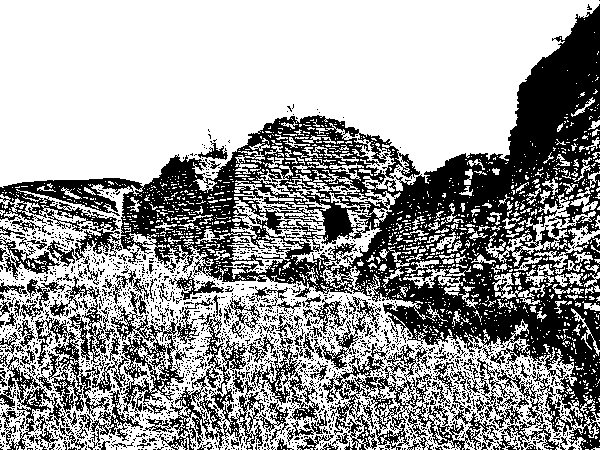
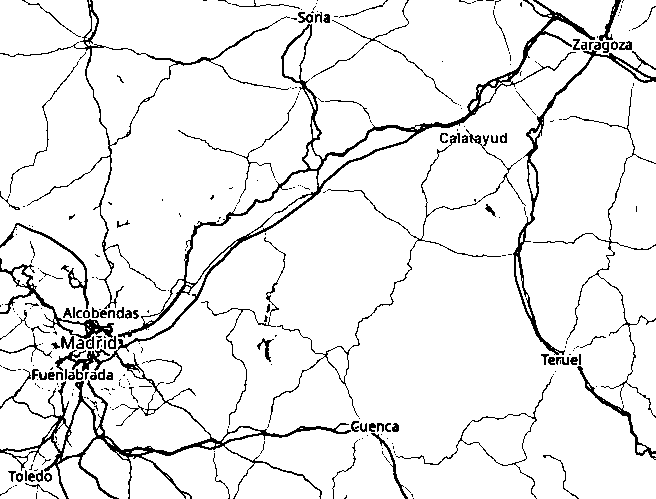
Abb. / Fig. "La torre del homenaje del Castillo de Boltaña, de característica planta hexagonal, construido entre los siglos VIII y XII", by Juan R. Lascorz under Creative Commons Licence CC BY-SA 3.0 (modified); Map of Spain between Madrid and Zaragoza, openstreetmap.org, Open Data Commons Open Database-Lizenz.

"Old Spanish translations of the Bible" in Bibliamedieval.es: 1250 Biblia prealfonsí (E8/E6), 1270 General Estoria (=GE), 1425-50 La Biblia E3 abarca, 1420-1445 Biblia Escorial I.i.7 e I.i.5 (E7/E5), 1400-1430 Escorial I.i.4 (E4), 15. Jh. Biblioteca Nacional de Madrid (BNM) manuscrito 10.288, 1450-1475 Real Academia de la Historia (RAH) ms. 87, 1422-1430 Biblia de Arragel.
Register der Überlieferung der Übersetzungen bis 1950
Personenregister (Übersetzungen etc.)
Adressregister
Zurück zum Inhaltsverzeichnis
E-Mail: kriswagenseil [at] gmx [point] de