
Caparo Forest ReserveThe Caparo Forestry Reserve is in the state of Barinas, on the south bank of the Caparo River, in the far west of Venezela. This is what scientists give the unwieldy name of "the Interior Plain of Western Venezuela and Eastern Colombia," a flat lowland at the foot of the Andes. The Caparo is tributary to the Apure, and hence, part of the Orinoco Flow, like most Venezuelan Rivers. The nearest town of any size is a desolate place, with the singularly unimaginative name of El Cantón (the canton). The poverty of El Cantón can be imagined only by those who have traveled off the beaten track in the Third World, but may be suggested by a mural I saw there shortly after Christmas: it depicted thin, ragged people peering in the window of a house where an obese family feasted, and to one side, a sarcastic "Merry Christmas" message. Nevertheless, one can obtain basic supplies here before striking out into the Reserve.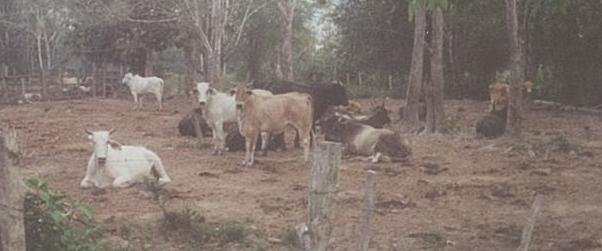 I went to Caparo as part of a group of students and faculty from Cleveland State University and University of the Andes, as well as Cleveland Metroparks Zoo officials. You will have to take my word for it; when I tried to order my course transcript from CSU, they claimed to have no record of me. From El Cantón, we drove down a dusty road through cattle range, to the field station Campamento Cachicamo (Armadillo Camp). There are numerous cattle lands inside the Reserve, most of them illegal. Campamento Cachicamo is very basic, but adequate to our purposes, with bunkhouse-style bedrooms (each bed requiring its own mosquito net), communal dining room, small library, and laundry room. The resident cats and dogs roamed about, mooching bits of food from us, and at night, the giant marine toads joined them but did not mooch. As in any tropical field station, we always took care to knock and shake out our boots each morning before putting them on -- never know what kinds of nasties may have crawled in during the night. But that precaution did not save me from an entirely different sort of hazard -- somehow, I got chiggers. Must have accidentally leaned or sat on something in the forest without realizing it. The itch had a daily cycle -- it would start at bedtime, I would spend the night frantically scratching, then it would fade in the morning and was not noticeable at all during the day. Then bedtime would come and it would all start again. The itch cycle stayed with me for two whole weeks after I returned home to the Temperate Zone!
On the other hand, I am one of those people blessed with a resistance to mosquitoes. Somehow, I only get bitten when I am alone; if anyone else is around, the mosquitoes bite them instead of me. I suppose that was why I was the only member of the group who opted not to take Laruim; I had read bad things about the side effects, and preferred to take my chances with the bugs.
|
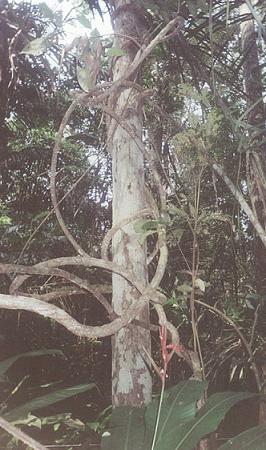 One of the most abundant trees in the area was the Palo de Maria, which we all had reason to learn to recognize quickly. Look closely at a palo de Maria, and you will see a tiny hole in the smooth bark. Bang on the trunk with the flat side of your machete, and you soon see what the hole is for, as a swarm of tiny black ants pours forth to defend their tree. They are Pseudomyrmex, and have a bite out of all proportion to their tiny size -- it feels like the sting of a wasp!
The brilliance of the tropical sun and the depth of the forest shade created strange tricks of the light which made photography within the forest very difficult: most subjects were in light too dim for a good picture, whilst others were in shafts of such bright light they appeared washed out. This picture of a clavito liana climbing a sarare palm is typical of the difficulty, and actually came out better than most attempted pictures. Other wildlife was much more pleasant from the human point of view, although one would be well advised to stay alert when capuchin monkeys show up, as they have a habit of throwing things at humans in their territory. Being high in the trees, they strike from above. Spider monkeys, too, are none too happy to see us, but they mostly just scream their protests. Along the roads, one may catch glimpses of tegu lizards, and such large birds as Spix's guans, parrots, and occasionally toucans 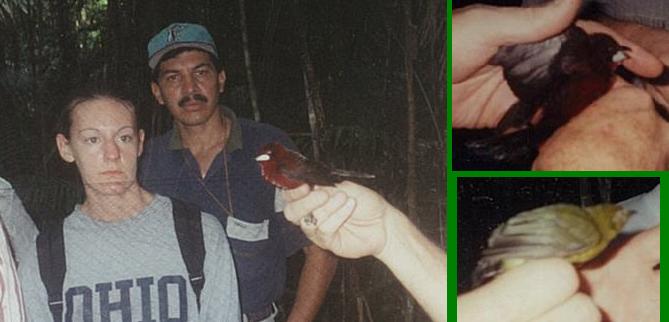
To see smaller birds, we had to set up mist nets. The bird in the picture is a silver-beaked tanager (Rhamphocelus carbo). The hand holding it is that of Miguel Ilija, a professor at University of the Andes. This tanager is one of the more common birds, often seen in suburban gardens as well as in the forest; it is dark blackish-red, with a bright silvery-white bill. In the top inset, the same silver-beaked tanager shows the underside of the wings. An experienced mist-netter can tell the approximate age and molt condition of a bird by its feathers. Other birds in the mist nets were deep forest species never seen in the towns: In the lower inset is a wire-tailed manakin (Teleonema filicauda), and other birds we got included olivaceous flatbill, cinnamon attila, and plain-brown woodcreeper, to name a few. |
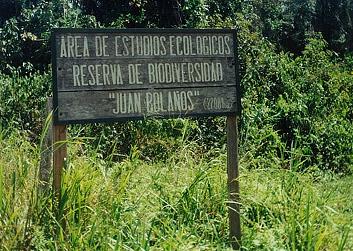 Within the Caparo Reserve was a subsection called the Juan Bolaños Biodiversity Reserve. The sad irony is that, other than this sign indicating it, there was nothing distinctive to set it apart from the rest of the Reserve. The same roads and deforested areas were within the "biodiversity" section as elsewhere.
We set up a camera-trap each day when we left the study area, hoping to capture images of nocturnal wildlife. Everybody hoped for pictures of the rare giant armadillo, or the "danta" (tapir); but at the same time, we more realistically joked that we were liable to come back and find the whole roll of film full of pictures of peccaries. As it turned out, we got no pictures at all from the camera-trap. Professor Ilija said that, with poaching such a big problem, there was no point in managing wildlife in the Reseve. The people of this region were so poor, they could scarcely be expected to buy meat; most of the protien in their diets came from wildlife illegally killed. Ilija felt that the only solution to poaching -- at least here in Caparo -- was somehow to enable people to afford meat. Then and only then could they consider giving up hunting, illegal or not. |
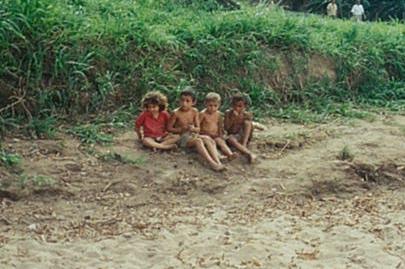
Although our mornings were busy with collecting tree data, we had time for fun on some afternoons. One day, we took a trip on the Caparo River with a local Venezuelan boatman. We rode in a dugout canoe formed from a single saquisaqui tree -- no doubt identical to the type of canoe used on this river down through the centuries, even from pre-Columbian times, but with the modern innovation of an outboard motor, and plastic milk crates serving as seats. We launced from a flat place at the river's edge, not far from a little hut whose owners sold colas and beer, and where a small child sat naked in the dust. Although we scanned the water carefully for signs of the river dolphins, we could not see any. We did, however, see hoatzins, those strange birds that look like cartoon chickens, which would rather clamber through shrubs than fly or run.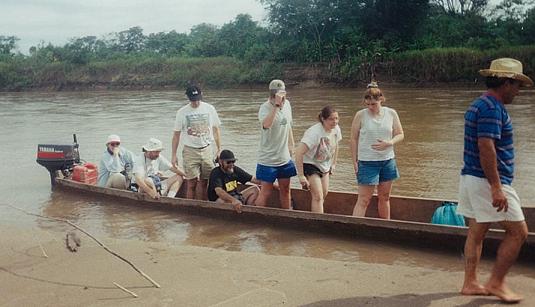 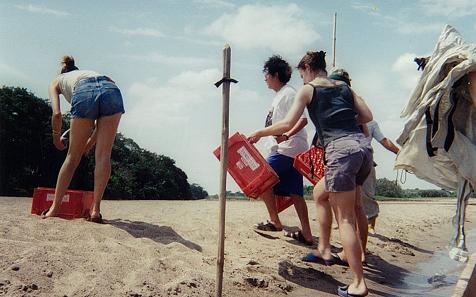
All along the river banks were clearings, with thatch-roofed huts perched above the river, and dugout canoes at the water's edge. Occasional groups of men or children could be seen, greeting us as we passed by. The river, like the roads, ran through patchy rangeland, where herds of Brahmin cattle and flocks of goats and tropical hair sheep roamed amid dust and coarse growth. Outside the Reserve, there was little if any forest left. In Caparo, I learned a lot about what the socio-ecological situation is really like in South America -- not at all like the pretty pictures of tropical rain forests seen in magazines and books, in which the threat of deforestation is often discussed in many words but seldom shown in many pictures; nor like the crisp scientific articles and illustrations which are my usual fare; nor again like the Disney-fied scenery of First World national parks, where people go to soak in the beauty of nature. Caparo was messy. For every beautiful sight, there was a corresponding ugly one. Ever since colonization, the forests and the people have remained separate; people from the villages might enter the forest in search of this or that resource, but the forest is not where they live their lives. This is the difference between the modern South American and the indiginous, for whom the forest was not a specific place, but the world.
|

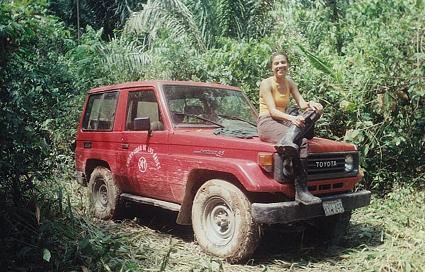 We spent our days in the forest. This is loosely called a "tropical dry forest," because it experiences a distinct dry season, but it is not a dry forest in the strict sense of a forest that drops its leaves in the dry season; rather, it is technically classified as subevergreen forest -- wetter than a true dry forest, but not wet enough to be a rain forest. Tropical ecology has a bewildering array of terms for forest types, based on the amount and source of water, degree of deciduousness, elevation, and temperature. We were here in the dry season, but even so, the roads were little more than muddy trails, and the trucks got stuck once or twice. The footpaths, called "picas," were mere traces in the jungly growth, so that our machete men (students at University of the Andes) had to walk ahead and re-open them. They were highly skilled -- far from chopping at random, they surgically cut away exactly what was needed to open the path, and no more. Once we got out to the experimental plots, they knew the common Spanish names of every tree, shrub, and liana. That was our primary project: the mapping and measuring of trees in the measured plots, to compare biodiversity in undistubed forest, to that in an illegally harvested area. The illegal cut had been high-graded: the poachers took only the best trees, leaving the inferior ones standing.
 We came at last to the most special place along the river: a sandbar where black skimmers had their rookery. They seemed little perturbed by our presence, although they would leave their nests if approached, and so we took care not to disturb them unduly. The nests were simple scrapes in the sand, the eggs so well camouflaged, they could be easily missed even at close range. These birds seemed especially vulnerable, nesting on an open sand bar so near to desperately-poor human settlements. When I asked Professor Ilija about this, he said that the people in this area were not interested in black skimmers or their eggs, and therefore had no reason to come to the sand bar; he added furthermore that this total lack of interest was the only hope for wildlife in Caparo. I was educated in the environmental-studies tradition that wildlife was best protected by educating local people about it, and giving them an interest in its preservation. Now, here was a man who knew the area and its social situation intimately, telling me precisely the opposite. I was forced to question how applicable our academic theories really are.