
 In 1981 -- before the DVD player was invented -- seeing a movie was actually a memorable event involving going to a theater, purchasing tickets, and getting to see a screen bigger than even today's flat-screen TVs. One such movie I remember was "Clash of the Titans" -- and I DON'T mean the 2010 remake.
Whether or not the movie's portrayal of ancient Greek life was accurate is almost beside the point. Those scenes speak to the unfulfilled longings in all of us -- longings few of us ever satisfy.
In my part of the world, that most natural of nurturing acts, breastfeeding, is controversial. We don't see scenes like Perseus' babyhood. Nursing mothers are expected to be "discreet," that is, to hide the act from view, as if there was something shameful about it. Likewise, the innocence of Perseus' childhood is banished from view -- we might see it on a nude beach, but most everywhere, mother and child alike are expected to "put something on." As a result of all this shame, few teens would be as unabashed as the teenage Perseus, completely at ease with his own body. And so we live alienated, from our bodies, from our selves, and therefore from others.
One of the emptiest statements I ever heard from the mouths of Christians is a quote from the Bible: "If the Son shall make you free, you shall be free indeed" (John 8:36). It is empty, because I have seldom if ever met a Christian who was truly free; in general, the Christian life is one of patrolling one's own thoughts and actions, making them conform to what they think is God's will. Is this a case of cognitive dissonance, of trying to convince oneself of the belief one is "supposed" to have, because the Book says so, even though reason belies it? If they are so "free," why do we see so many of them afraid to step outside those self-imposed boundaries of the Book?
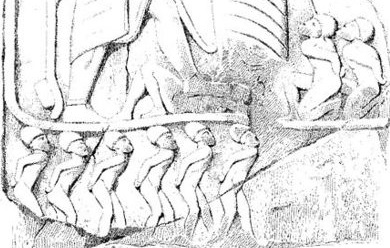 Why is the human body such an object of shock? There have been many civilizations through the ages in which clothing was worn most of the time, but where it was not felt necessary to have laws regarding nudity. Even the Old Testament: the only specific clothing laws pertained to the temple priests, whose vestments were prescribed in detail, and who were required to wear undergarments to avoid accidental exposure while ascending to the altar. In the King James Version, there appear to be prohibitions against "uncovering your nakedness," but this is euphemistic usage; in context, it is clear that what is actually being forbidden is a list of specific incestuous acts. In that part of the world, depictions of battles and victories often show prisoners of war naked; as this was intended to humiliate them in their defeat, it is problably unlikely that many Israelites would have habitually appeared naked in public, but we see no evidence that simply being undressed was punishable in ancient Israel. Isaiah the prophet even walked about nude for three years (Isaiah 20:2-4), and Micah seems, figuratively at least, to have done so also (Micah 1:8). Most humans, in most ancient civilizations, would have thought us strange to bother with laws against nudity, which in itself does not harm anyone.
How is it, then, that all three of the Abrahamic religions evolved strict head-to-toe covering, only relaxed in the West in the mid-20th century? It is too simplistic simply to attribute it to the influence of Augustine in the Fourth Century, and his hostility to bodily pleasures. It is true his copious writings shaped all Christian theology since, but Judaism and Islam have had their own streams of theology.
Nor is it simply a byproduct of the patriarchal Sky God worshipped by the Abrahamic religions, since patriarchal Sky God religions have produced many civilizations throughout Eurasia, including that of ancient Greece, where public nudity was accepted in various contexts, such as the Olympic games, or the gymnasia where athletes trained (gymno- we might point out, is a Greek prefix meaning "naked," so the very words gymnastics and gymnasium inherently signify nudity).
Nor, even, is it necessarily our need to regulate sex. Every human culture regulates sex, as does every animal species. There is no human culture which allows unbridled sexuality; all have some set of mores and standards circumscribing it. But this does not inevitably lead to legal sanctions against nakedness in and of itself. And in any case, Christianity did not cut its sexual ethics from whole cloth: Christianity was born in a very Hellenized world, where the cultural legacy of ancient Greece was strong; Christianity borrowed the basic outline of sexual ethics from that already developed by Greek philosophers. The difference was, Christianity made it ever more rigid, and ever more under the control of the authorities.
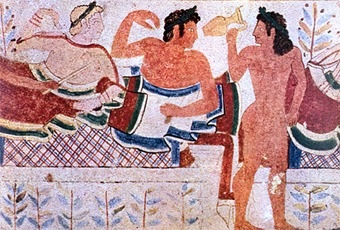 Now, life in ancient Greece was not all idyllic. There was stratification much like what would later exist in Mediaeval times: a few aristocrats, a great mass of helots (i.e. peasants), and also slaves. Several of the city-states conducted early experiments in democracy, but only native-born free males could participate, and other city-states, like Sparta, were ruled by tyrants. The pagan religion emphasized a belief in Fate (although we might point out that some Christians' ideas of God's will are essentially the same as Fate). Nevertheless, in one way -- the way so beautifully portrayed by the childhood of Perseus in "Clash of the Titans" -- the pagans (Greek, Etruscan, Iberian, and many others) were freer than their Christian successors, despite platitudes about "the Son shall make you free."
Whatever the origins of this body-denial, it does seem to have been but a stage in human history. We can look at the clothing of Europe during the Elizabethan age, with its sumptious ruffs, hoops, and other assorted frippery hiding even the very shape of the body inside; and compare that with Europe today, where nude beaches are more accepted than here in the States, and laws about public nudity more relaxed. We can look at America, where it took less than a century to evolve from the skirts-and-bloomers style of women's swimsuit to the bikini. We can look at San Francisco, where until a few years ago, public nudity per se was not a crime, and even today, certain events, such as the Bay to Breakers Run, still allow it. We can hope that the human body will soon be decriminalized, and that some generation of children, not so very far in the future, can grow up like Perseus. When our bodies and our minds are both free, then truly we shall be free indeed.

I am accepting emails again, unless the spam gets too bad
