|
a little can am history
| |
Let’s paint the picture for high performance in 1977. Decals and tape stripes had replaced the raw, visceral power of the 1960's musclecars. For example, there was the Mustang Cobra II, but its 302 could only manage 127 horsepower. Dodge had the hot black and gold Warlock truck, but this was before most people thought of a truck as a performance vehicle. Chevy reintroduced the Z/28 after a two-year absence, but its 350 was a paper tiger. The Corvette was still around, but it was never really considered a musclecar. Overall, when you consider the choices that existed for an affordable, American performance car in 1977, Pontiac was a big player. Its Trans Am was a huge sales success that year, spurred on by the popular movie, “Smokey and the Bandit”. But the Trans Am wasn’t the only performance car they offered that year.
The 1977 Can Am was designed from the beginning to be a limited-production performance car, with an anticipated production run of 5000 units. The name for the car came from the Can Am (Canadian-American) racing series.
For years, it was rumored that seven production Can Ams were painted "Mandarin Orange". Jim Wangers, who was a primary player in getting Pontiac to go ahead with the Can Am project, recently debunked this myth. In a February 2001 email to fellow Can Am owner Mark Fearer, Jim stated that, "To my knowledge there were never any 'orange' Can-Ams officially built by Motortown for Pontiac in 1977...when the car was first presented to Pontiac in 1976 by myself and Motortown, it was painted in Carousel Red and was proposed to be called 'The Judge'." This was rejected, and a white paint scheme with similar graphics was proposed instead. Pontiac was still open to a comparison with the GTO in its advertising, though. Magazines featured Can Am ads which used the phrase, "Remember the Goat".
For the total sum of $1214.43, the Can Am Option Package could be added to a LeMans Sport Coupe with the louvered quarter windows. The package consisted of the following:
Standard Equipment - Can Am package
T/A 6.6 400-cid 4-barrel Pontiac V8 (or Olds 403 if sold in California) Power front disc brakes TH400 heavy-duty automatic transmission Power variable-ratio steering Rally RTS handling package GR70x15 radial tires Body-color Rally II wheels Twin sport mirrors Cameo White paint with special tri-color striping Blacked-out moldings, and black lower body-side accent stripe Grand Prix instrument panel Rally gauge cluster with in-dash clock
Pontiac built each car slated for conversion with all of the mechanical bits that made the Can Am unique. Due to the limited planned production run of 5000 units, they outsourced the remainder of the work. Jim Wanger's Motortown Corp. was contracted to fit the cars with the striping and rear spoiler, and modify the hood to make room for the shaker hood assembly. For some reason, every Can Am came with a 1976-style shaker, which had a different shape than the shaker offered on the 1977 Trans Am.
A partial listing of options available on the Can Am included:
Optional Equipment Available on the Can Am
Air conditioning Front seat console with buckets 15x7 Cast aluminum wheels "Saf-T-Track" rear axle GR70x15 White letter tires Custom Sport steering wheel Soft Ray glass Color-keyed seat belts Dual horns Interior decklid release Interior hood release Am/FM/8-track radio Dual horns Decklid release AM/FM/CB radio Instrument panel tachometer (replaces clock) Power door locks and windows Glass or steel power sunroof
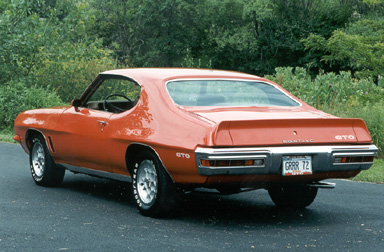
Unfortunately, Can Am production ended prematurely, when the mold used in manufacturing the unique “duck tail” spoiler was accidentally damaged. It's interesting to note that the exact same circumstances surrounded the discontinuation of the duck tail spoiler that was produced (in very limited numbers) for the 1972 GTO. There is some controversy over exactly how many Can Ams were produced; depending on the source, the final tally stood at either 1100 or 1377.
Pontiac probably could have sold the entire 5000 and more if management had approved fixing the mold. But the Can Am used the same dash as the Grand Prix, which was a highly profitable sales leader in 1977; every Can Am sold pirated sales of the GP! The broken spoiler mold was the last straw, and the project was axed. In theory, Pontiac could've had even more demand for the Can Am, had they authorized the sale of the car in another key market – Canada. For some reason, the Can Am was sold only in the United States; perhaps it was because every Canadian-market LeMans was powered by a Chevrolet engine.