WRECKING THE REEFS
CORAL ECOSYSTEMS ARE IN DESPERATE TROUBLE ALL AROUND THE WORLD--AND GUESS WHO'S TO BLAME
Once the coral reefs of the Caribbean all shimmered with life. Herds of iridescent parrotfish darted through forests of branching corals. Spiny lobsters lurked in crevices, while squid, spooked by shadows, dissolved into clouds of ink. But now many of these bustling underwater habitats are taking a beating--and the tropical storms that tore through the region in recent weeks are the least of their problems. "Reefs are tough," observes Clive Wilkinson, a biologist at the Australian Institute of Marine Science. "You can hammer them with cyclones, and they'll bounce right back. What they can't bounce back from is chronic, constant stress." The kind of stress, in other words, that is being applied by humans.
Across the globe, from the Gulf of Mexico to the South China Sea, people are killing coral reefs. Cyanide fishing, harbor dredging, coral mining, deforestation, coastal development, agricultural runoff, shipwrecks and careless divers are putting so much pressure on these extraordinary ecosystems that they may not survive beyond the next century. "You can never point to one thing and say it's this that's killing the reefs," Wilkinson observes, "because in reality it's almost everything."
[ Complete Story About the Coral Reef Damage ]
CORAL REEF
 PAGE
PAGE
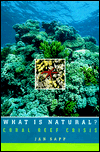

$30.00 ** $20.00 at Barnes and Noble**SAVE $10.00
[ What Is Natural? Coral Reef Crisis ]

Did you know...
Coral reefs are considered the "rainforests of the ocean"?
Corals are animals, not plants, made up of thousands of living organisms called polyps?
Corals produce a natural sunscreen which chemists are developing to market in Australia?
Corals' porous limestone skeletons have been used for bone grafts in humans?
 Imagine a desert deep underwater.
But then rising like an oasis is a retired oil platform.
Carefully prepared, it provides food and shelter
in the Gulf of Mexico, attracting all kinds of fish and those who enjoy them.



 [NOAA Report: Jump-starting a Reef's Restoration: See September 1999 Issue]
 [NOAA Report: Coral Reef Task Force Meets: See October 1998 Issue]
 ['Spectacular' Reef Explored In Flordia Keys Sanctuary: See October 1997 Issue]
 [Major Public Outreach for Year of the Reef: See March 1997 Issue]