

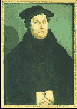

Martin Luther was born in Eisleben, Germany, the son of Hans Luther, who worked in the copper mines, and his wife Margarethe. He went to school at Magdeburg and Eisenach, and entered the University of Erfurt in 1501, graduating with a BA in 1502 and an MA in 1505. His father wished him to be a lawyer, but Luther was drawn to the study of the Scriptures, and spent three years in the Augustinian monastery at Erfurt. In 1507 he was ordained a priest, and went to the University of Wittenberg, where he lectured on philosophy and the Scriptures, becoming a powerful and influential preacher.
Albert of Brandenburg, archbishop of Mainz, sponsors a sale of indulgences to pay for, among other things, construction of Saint Peter's in Rome. Papal emissaries sought everywhere to raise funds by the sale of indulgences. The system was grossly abused, and on a mission to Rome in 1510-11, Luther was appalled by the corruption he found there. Luther's indignation at the shameless traffic, carried on in particular by the Dominican Johann Tetzel, became irrepressible.
As professor of biblical exegesis at Wittenberg, Germany (1512-1546), he began to preach the doctrine of salvation by Faith rather than "good works"; and on October 31, 1517, drew up a list of 95 Theses on indulgences, denying the Pope any right to forgive sins, and nailed them on the church (castle chapel) door in Wittenberg.
The theses invite debate over the legitimacy of the sale of indulgences. Copies of the theses spread rapidly over Europe.

Pope Leo X at first took little notice of this disturbance, but in 1518 summoned Luther to Rome to answer for his theses. His university and the elector interfered, and ineffective negotiations were undertaken by Cardinal Cajetan and by Miltitz, envoy of the pope to the Saxon court. The scholar Johann Eck and Luther held a memorable disputation at Leipzig (1519); and Luther began to attack the papal system more boldly.
In 1520, he publishes his three famous treatises: An den christlichen Adel deutscher Nation "Address to the Christian Nobility of the German National Concerning the Reform of the Christian Estate," followed by a treatise: De captivitate Babylonica ecclesiae praeludium "A Prelude concerning the Babylonian Captivity of the Church", which also attacked the doctrinal system of the Church of Rome. And finally, "On the Freedom of a Christian", with which he wins powerful support. In 1518 Luther was joined in his views by Melanchthon.
The papacy takes steps against Luther as a heretic. Tetzel retreated from Saxony to Frankfurt-an-der-Oder, where he published a papal bull containing 41 counter-theses, and burnt Luther's. Luther and the Wittenberg students retaliated by burning Tetzel's, before a multitude of doctors, students, and citizens in Wittenberg. The Wittenburg faculty supports Luther.
In 1521, Luther published his acrimonious reply to Henry VIII's attack on him in "Assertio septem sacramentorum adversus Martinum Lutherum" (About the nature of the seven sacraments) Later that same year, Charles V, Holy Roman Emperor, convened the first "Diet at Worms", before which Luther was called to retract his teachings. He refuses to recant unless proven wrong by the Bible or by "clear reason." An order was issued for the destruction of his books, and he was put under the ban of the Empire. Luther is excommunicated from the church.
On his return from Worms he was seized, at the instigation of the elector of Saxony, and lodged (for his own protection) in the Wartburg, the elector's fortress. During the year he spent there, he translated the Scriptures and composed his cogent controversial treatise, "Refutation of the Argument of Latomus'. Civil unrest called Luther back to Wittenberg in 1522. He rebuked the unruly elements, and made a stand against lawlessness on the one hand, and tyranny on the other.
A divergence had gradually taken place also between the views of the Humanist scholar Erasmus and Luther. There was an open breach in 1525, when Erasmus published De libero arbitrio (1524, Discourse on Free Will), and Luther followed with De Servo arbitrio (Concerning the Bondage of Will). In the same year he married Katherine von Bora, a nun who had withdrawn from convent life.
In 1529, he engaged with the controversial question of transubstantiation in the famous conference at Marburg with Zwingli and other Swiss theologians; he obstinately maintained his view that Christ is present in the bread and wine of the Eucharist. The drawing up of his theological views in the Augsburg Confession (1530) by Melanchthon, ably representing Luther at the "Diet of Augsburg", marks the culmination of the German Reformation.
Many German princes and cities sign the "Augsburg Confession" as an expression of the Evangelical Faith.
Luther died in Eisleben in 1546, and was buried at Wittenberg. Endowed with broad human sympathies, massive energy, manly and affectionate simplicity, and a rich, if sometimes coarse, humour, he was undoubtedly a spiritual genius. His intuitions of divine truth were bold, vivid, and penetrating, if not necessarily philosophical and comprehensive; and he possessed the power of kindling other souls with the fire of his own convictions. His voluminous works include "Von den guten Wercken" (1520, Of Good Works), and "Widder die hymelischen Propheten von den Bildern und Sacrament".
In 1555, "The Peace of Augsburg" provides that each German prince can determine the religious affiliation of the territory he rules. The Reformation sweeps Northern and Eastern Europe.
United Methodism is not a direct descendant of the Protestant Reformation but -- as an offshoot of the Church of England -- is a descendant of the English Reformation (beginning 1533-34) which led to the establishment of the Church of England by Henry VIII. Henry split from Rome for a number of reasons. One contributing reason was that the pope delayed and ultimately refused to annul Henry's illegal marriage to Catherine of Aragon, the aunt of Charles the V, who was putting considerable pressure on the pope to delay the annulment. Another contributing reason was the influence of Lutheranism in influential circles of Anglican theology.
Henry VIII was highly critical of Martin Luther and never adopted Protestant doctrines. However, some of his Anglican arch bishops and clergy were highly influenced by the Reformation on the continent.
 Vom Himmel hoch, da komm ich her. (1539)


(Back)