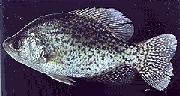
Crappie FishingCrappie are, in my opinion, one of the most fun fish to catch and certainly one of the best tasting fish. They swim in large schools and are found throughout most of the U.S. and into Canada. Crappie prefer fairly warm water and are normally found in nearly all types of cover. They average 7-12" fully grown, however with enough food and cover they can reach lengths up to 18". A large crappie is referred to as a "Slab". In most waters, crappie with a weight of 1/2 to 1 pound are considered good fish. In other waters, crappie are not considered large until they hit the 1 1/2 or 2 pound mark. They can, under ideal circumstances, reach weights of up to 6 pounds.
|
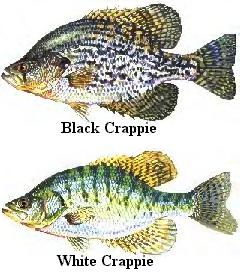 Black Crappie vs. White Crappie
There are two sub-species to the common crappie. The black crappie, which gets its name from its slightly darker appearance, and the white crappie. The black crappie is usually white or gray with dark gray or black spots covering most of its sides. It has 7-8 dorsal spines on the top of its back. The white crappie tends to be lighter in color and often has distinct vertical bars of gray extending down its sides. It has 5-6 dorsal spines. Both of the sub-species have nearly the same feeding patterns and spawning time. I have heard the black crappie prefers clearer water, where the white crappie tolerates muddier water better. They are both terrific in the pan, I might add.
|
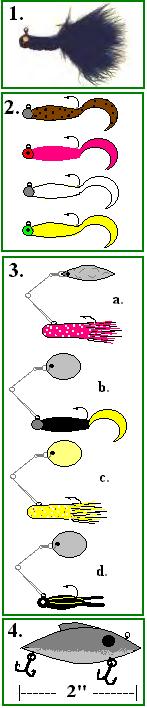 Crappie Baits
Crappie are versatile feeders, eating most types of insects, worms, and small crayfish and minnows. This variety of forage makes choosing baits for crappie fairly simple. Just about every angler has one bait that he or she swears will outfish any other. This is because that person probably uses that particular bait much more than any other. This is not necessarily a bad thing, however, because having confidence in your bait is almost as important as having a bait at all. As a rule of thumb, if the fish are eating it, keep using it. When the fish seem to stop eating it, don't keep using it. If the fish aren't biting, you can try three things: 1. Maribou Jigs- These are the small jigs that have little furry bodies and puffy, feathery tails. They come in many sizes and tons of colors,are very durable, and are fairly cheap to buy (I catch them on sale at Wal-Mart for $.25 for a four-pack). They can also be easily made at home with some yarn and pipe cleaners. These jigs are perfect for finesse fishing picky crappie, vertical jigging over structure, or suspending under a bobber. I prefer a 1/16 or 1/32 oz. jig. When choosing a color, I follow the guidelines below. 2. Curly-tail Grubs- These are the soft plastic baits that have curly tails on the back that produce lots of action when jigged or retrieved steadily. They come in many sizes, but I like a 1 1/2"- 2 1/2" grub for crappie. Rig them with a 1/8- 1/64 oz. jig head, depending on conditions and preference. Follow guidelines below to choose a color. 3. Small Spinners- These are my personal favorite lures to use when crappie fishing. This is because they are very versatile, effective, and fairly weedless. When I say versatile, I mean you never know just what you are going to catch on them. I have caught 16" bass, 9" bluegill, 21" catfish, and 13" pike while crappie fishing with a spinner. The spinners I use and have the best results with are the smallest sized ones I can find. The 1/16 oz. Beetle Spin is the perfect size. Wal-Mart caries several sizes of the individual spinners, but the absolute smallest ones are the best. I have also found that gold blades seem to produce slightly more strikes than the normal silver. I strongly recommend trying the tiny gold blades the next time you are on the water. Here is a breakdown of the types of spinners I use: a. Small Willow Leaf Blade- This is a very effective type of blade and seems to work well on most species. Try rigging it with a 2" tube bait or curly tail. b. Small Silver Colorado (circular) Blade- This blade type produces a lot of vibrations and can be fished very slowly. Rig with 2" tube bait or, for even more action, add a curly tail to it. This combo is great for very stained, dark water. c. Small Gold Blade- My Favorite! A tiny, gold, Colorado (or willow leaf) blade with a 1/32 oz. jig head and a hot-colored, 2" tube bait is a dynamite lure for nearly any freshwater species. I suggest going to Wal-Mart and picking up a 2-pack of these tiny gold spinners. You will be glad you did! d. Beetle Spin- These come in tons of colors, sizes, and brands, but they have never let me down. The 1/8 and 1/16 oz. sizes are perfect for crappie as well as other fish. They are also a good choice. 4. Small Crankbaits- If you can find a small, minnow-shaped crankbait (a 1/8 or 1/16 oz. Rat-L-Trap is excellent), you may be able to catch a few bigger, more active crappie. I also have to recommend Yo Zuri Snap Beans. They are very tiny crankbaits that come in a pack with a 1/16 and 1/32 oz. size. They are expensive, but are the best micro-cranks I have ever used. These baits can be effectively fished by trolling or casting and retrieving. They are great for locating the depth at which larger crappie are feeding or suspending. Try one the next time you are faced with one of these situations.
Choosing Colors Now that you know which type of lure to choose, what color should you use? Well the answer to this is simple, yet difficult. Often you must try many different colors before you find the one that will catch the most fish. However, here is something to go by:
Try following these basic guidelines the next time you are choosing a lure and color and I think you will be pleased. However, remember this is just a guideline. If these techniques do not produce fish, try something totally different. |
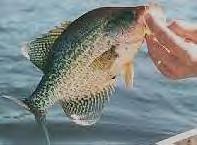 Crappie Tactics
Crappie are fairly active year round, but fall and spring offer the hottest fishing. The warming spring water temperatures triggers a feed-a-thon amongst fish. Crappie spawn when the water temperature reaches about 52-60 degrees. Just before spawning (when the water hits about 48-51 degrees), they move into shallower water and feed aggressively. This is known as the pre-spawn period. Most crappie move into shoreline cover such as fallen trees and shallow coves during this time. The females will then lay their eggs and move to slightly deeper water while the males stay in the shallows and guard the nest. If you catch several smaller fish in shallow water, try moving to the nearest dropoff and you may find the larger females feeding. These pre-spawn and spawn periods of spring often offer the best fishing of the year. The cooling water of the fall also offers good crappie fishing. When the warm summer waters begin to cool down, the fish begin feeding aggressively in order to fatten up for the winter. Schools of big slabs can be caught easily during this "fall feed-up". Crappie are fish that love structure, so key in on ares with prominent cover. Rock piles, shallow coves, stumps, points, fallen trees, and submerged brush are all favorites. Many anglers sink Christmas trees, old bushes, tires, and even wooden pallettes to create homes for big fish. Vertical jigging is a good method to fish submerged cover. A 1/32 or 1/16 oz. jig dropped into brush and twitched will produce many fish if the conditions are right. Try swimming a small spinner through stump fields or along fallen trees to locate the slabs. When you identify the depth at which most of the fish are holding, try suspending a jig or minnow at that depth under a small bobber. This is an effective way to keep your bait in the desired depth for a much longer period of time. |