Explanation of Coordinate Geometry
Two Dimensional Coordinate Geometry
A Cartesian plane is made up of a two dimensional (flat) surface that is divided into four quadrants. These quadrant are the result of the plane being divided by two straight lines intersecting at right angles and metting at a point called the origin, O. The horizontal axis is labelled as the x-axis and the vertical axis as the y-axis (although other labels can be used.)
distance between two points
The distance between two points on a plane is given by:

midpoint between two points
The mid-point between two points has coordinates that are mid-way between the coordinates of the two points. That is, the coordinates of the mid-point, (x,y) of the line segment, AB, joining the two points A (x1,y1) and B (x2,y2) are given by 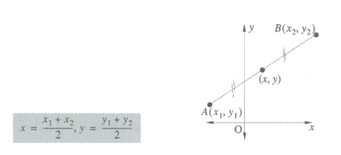
Standard Forms of Linear Equations:
1. y=mx+b
There are several forms that linear relations can take. Probably the most useful is known as the gradient intercept form: y=mx+b
In this case, the gradient of the line is equal to m and the y-intercept is equal to c. This means that if the relation is in the form, it is quite easy to say what the graph looks like without constructing tables of values and plotting points.
2. ax+by+c=0
Another common form for a linear equation is: ax+by+c=0
This form of the linear equation does not give the gradient and y-intercept of the line. When sketching or plotting linear equations in this form it is probably best to calculate the intercepts on both axes. This is done as follows:

Properties of Straight Lines:
1. Gradient of a line

From this we can obtain the point-gradient form of a line. That is, if (x,y) is any point on a straight line having a gradient, m, and (x1,y1) is another fixed point on that line then the equation of that line is given by: y-y1=m(x-x1).
2. Parallel lines

3. Perpendicular lines
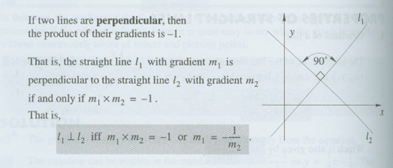
Return to main page