|
All Things Alfa!
|
|
|
Here are my experiences, evaluations and comments on the Italian cars I have owned. They are posted and commented on in roughly the order I owned them.
My introduction to Italian cars came by way of a 1983 Bertone (Fiat) X 1/9. Mine was a nice two tone colour with off white on top and dark steel grey below. A red racing stripe horizontally bisected the car. I knew very little about Italian cars, other than I wanted to experience the passion. Mine was fuel injected and as such very reliable. It was, however a total rust bucket. Late model Fiats were better protected but once the rust got hold it advanced rapidly. The little Fiat handled magnificently but was short on power. I didn't own it long enough to make improvements on the engine, but it was long enough to get completely enamoured by All Things Italian.
Ahhh..the stuff dreams are made of. Pictured above is a 1992 Alfa Spyder Veloce (Italian for quick, or fast.) Mine was identical expect it was Forest Green (slightly darker than the famous BRG, or British Racing Green.) I found the car sitting in the back of a Honda dealership of all things. They didn't quite know what to do with it, but were more than happy to take my car (a 1993 Nissan 300zx) in on trade. I don't regret it at all. Where do I begin on such a beauty? Do I talk of the 30 year lineage, dating back to the Duetto? Do I attempt to verbalize the sounds the engine made? Do I talk of the sunny days where the top was down and nothing was wrong with the world? Do I delight you with the leather interior and the perfect seats? I know not where to start. With Bosche fuel injection my Spyder never let me down, never failed to delight and never failed to attract looks. I once got a hat tip from a gentleman in an MG. If that's not praise, I don't know what is. Sure there were difficulties, no Italian car is without them. Being largely hand-built the quality cannot match a Japanese car. But if exactness is what you crave, you are in the wrong place. Italian cars do what no others can, they communicate with you on a cellular level. When you drive an Italian car you know it was built by people that have such a flair and passion for what they make. Every ounce of the car tells you, in no uncertain terms, that you are driving the finest cars ever made. My lovely and cherished Alfa came to an ignoble end when a woman in an old Dodge America ran a red light and nailed me at 55 miles per hour. The Spyder's frame was bent in four places, the wheels each pointed in different directions and yet I walked away with a broken fingernail. How's that for safety?
During my love affair with my Spyder, I picked up a forlorn 1976 Lancia Beta, pictured above. The image is file stock, but my car was pretty close to this. At one point in time Lancia was it's own company, but by the time this car was built, Lancia was wholly owned by the Fiat conglomerate and as such shared many parts with other Fiats. The engine was transverse (FWD) something that did not occur for me to examine until the car was mine. I dislike FWD because of the way power is transferred to the driving wheels but this one drove fine. In fact, it had sat unused for 3 years. Of all the bad things you can do to an Italian car, not driving them is the Number One bad thing. Italian cars, unlike many others, need to be driven daily, and hard. They thrive on it. All of my Italian cars (with the Beta being the sole exception, as explained below) have been daily drivers and only once have I ever been left stranded (the fuel pump relay blew on my X 1/9. Cost me $1.35 for a new one.) The Beta was going to be a winter car, as it had no A/C, but a fine heater and a hard top, and I was going to store the Spyder during the, admittedly mild, Virginia winters. Before I could get too deep into restoration a neighbor made me an offer that I couldn't refuse, so off it went. The engine was a 1.6 Litre DOHC dual Weber fed and was very willing to rev to 8000 rpms. Power was modest, about 120 hp but the Webers made a delightfully throaty roar. Good Betas are hard to find, rust being the prime enemy so it pays for a careful inspection before purchase.
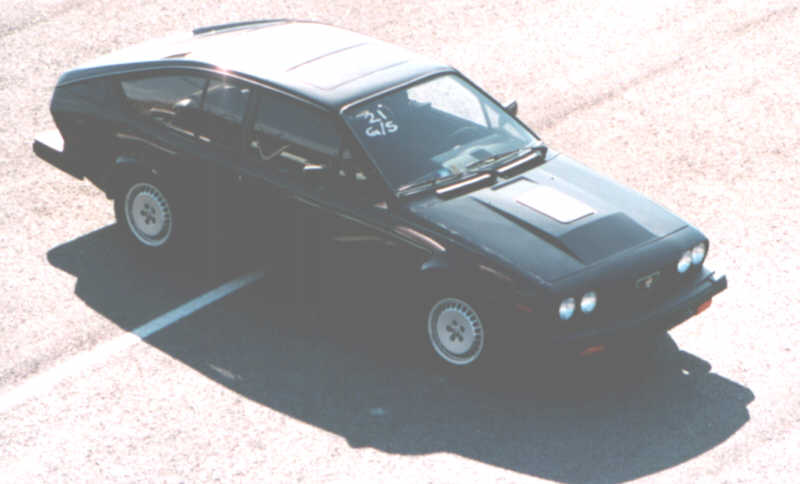
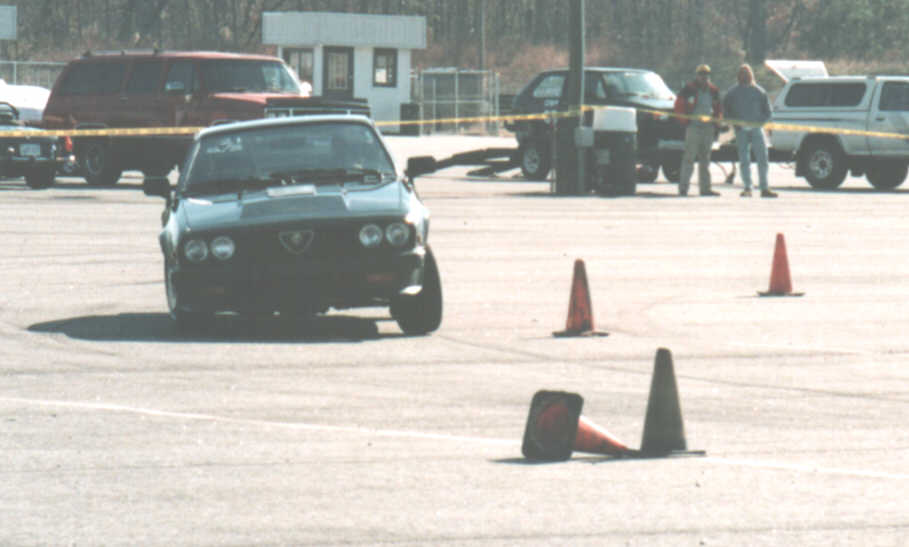
After the Spyder, I discovered a 1985 Alfa GTV-6 for sale (pictured above.) One twist of the key and the 2.5 Litre SOHC V-6 growled to life and I was sold! What a wonderful engine. Alfa really put some fine engineering into the engine and transaxle, achieving 50/50 weight balance. As you will see below, I autocrossed the GTV-6 with success (two First in Class wins.) If the Spyder was quick, the GTV-6 was downright fast. The engine, again Bosche injected, never ran out of power. This car had sat for sometime and was the first Alfa that really needed a good mechanic to sort it out. The fine folks at E.G. Bradley, here in Richmond Virginia, were instrumental in keeping it in tip top shape, and providing performance parts. This was also the first of several Italian cars I would own that I had much in the way of improvements made to it. The designers at Alfa incorporated a front torsion bar that was adjustable so lowering the car as a mere matter of twisting to desired height and getting lower springs in the back. Fifteen inch wheels, complete with Pirelli's best rubber helped keep the power of the V-6 firmly in control. The trunk was also useable, unlike the Spyder's (which has a full size spare taking up most of the space) and in a pinch could seat four adults. A sold the car to pay for my next car, a dream and a disaster.
This is a 1977 Lancia Scorpion. The American version had round headlights, but was otherwise near identical. At the time it was also my dream car. One showed up at the mechanic's place one day and I was sold without a second thought. This proved to be my undoing as the Scorpion was in terrible condition. The prior owner had restored the interior to a decent standard, and then given up. It had terminal rust and the engine was stock. Here in America the 1.8 Litre mid-mounted engine was detuned to meet emissions and was so strangled that it barely put out 80 hp. The first step, of course, was to remedy this. With a huge Weber, racing cams, ANSA exhaust and header, and a host of other refinements the engine was soon breathing like it should. Next, the body was stripped bare and all the rust was corrected. The car was sprayed with multiple layers of PPG's finest black lacquer and then polished to a high shine. At 10 feet away I could comb my hair in the reflection. Absolutely no orange peel anywhere. The car handled like it was on rails and I could take corners at speeds undreamed of in any of my other cars. I autocrossed it only once before I found out there was no competition in my class. No competition equals no fun so I stuck to the streets. The downfall of this magnificent car was the scarcity of parts. Some things that failed
on the car were simply not available, anywhere or at any price. This is the drawback to
owning a car of which probably less than 500 still exist in America. When the heater core
died during the middle of a harsh winter, I'd had enough and sold the car. I miss the
engine's siren song and the stunning looks, but I do not miss the headaches or the prices
of parts. A friend of mine said it best, "Very emotional, big egos, nothin' but
trouble.
I have a new car now, a 1977 Alfa GT, also known as an Alfetta. Similar in body style to the GTV-6, this car was the precursor. Lurking under the hood is a 2.0 Litre Straight Four. SPICA mechanical fuel injection allowed the car to pass emissions with only an air pump as pollution control. This in an era where domestic manufacturers were struggling with EPA regulations and power, driveability and reliability suffered as a result. Not so with the Alfetta. All original, with all mechanical receipts (the original owner was somewhat fanatic about oil and plug changes) and a near perfect interior, engine and exterior. I will be taking pictures soon and posting them here.Along with detailed information on the car. Watch for it soon. |