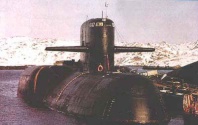
How Andromeda Scared Greenpeace
|
Soviet submarine used "mysterious weapons" and terribly
scared Greenpeace
The solution of the naval scandal that nearly spread all over the
world is rather funny; PRAVDA.Ru is the first among Russian mass media to
report about it. The story was told by captain of the second rank of the
Andromeda submarine, Vladimir Chernolikhov. This happened over ten years ago, it's high time now to unveil
all naval secrets of Yeltsin's epoch. It was in summer of 1990 when
glasnost and perestroika were very popular words in this country; the USSR
made its desperate attempts to remain united. At that very period we heard
about guys from the Greenpeace ecological movement. A Greenpeace ship was
heading to Novaya Zemlya to the Soviet nuclear test ground. Soviet
television reported it was a provocation of the CIA. It is quite a problem for the nuclear submarine to keep pace with
Greenpeace as the submarine's gyration radius is enormous. But the Soviet
command ordered to keep an eye on Greenpeace and inform about any activity
on board the ship. On one day chief officer Boris Durtsev went on watch,
the man was awfully angry on that day. Captain Nikolay Guzanov trusted the experienced chief officer and
left the post for his cabin. Boris Durtsev remained alone to stand
sentinel. He suddenly asked the crew if someone had an electric shaver.
When the chief officer got the shaver he decided to imitate a torpedo
attack with the sound of the electric shaver. As Greenpeace crew had all
necessary devices to listen to what was going on on the submarine, they
heard the familiar noise of a torpedo attack. The crew was rather
experienced and recognized the scary maneuver by its sound. Greenpeace got
alarmed when the Andromeda chief officer entered the submarine's
hydroacoustics compartment. Greenpeace devices heard the sound of an
approaching torpedo. The vessel got really very scared, as soon as
Greenpeace changed its course and made full speed ahead. Probably the
foreign ship decided that Russians were not to be trifled with. Seven years ago a delegation from Portsmouth, US, came to the
Russian northern city of Severodvinsk. Joshua Handler, a well-known
Greenpeace man was a member of the delegation. During the meeting it
turned out that the man was on board of Greenpeace when the Soviet
submarine imitated a torpedo attack. According to Joshua, the crew of
Greenpeace got really scared with the sound imitating a torpedo attack.
Records of the "torpedo" sounds were even given to the US Navy.
The authority probably hasn't yet solved the riddle of the
"mysterious Russian weapon". To tell the truth, not only "weapons" used by the
Soviet submarine, but also Andromeda itself was an absolute mystery for
the USA. The matter of the fact is that the submarine was docked at the
Severodvinsk shipyard for about ten years. Indeed, as compared with other
Soviet submarines made in Severodvinsk, construction of Andromeda was the
longest one. In 1972, the USA started creation of Tomahawk cruise missiles
meant for attacks from surface ships and submarines against targets on
ground and at sea. Tomahawk tests finished in 1976. That was a new kind of
weapons of strategic and tactical purpose that seriously unbalanced the
arms systems of the USSR and the USA, the two confronting countries. At
the end of 1976 the Soviet Ministry of Defense ordered to start
development of analogous Soviet missile complexes. Meteorit-M complex with
a cruise super sonic strategic purpose missile ZM-25 launched from a
surfaced or submerged submarine was one of the complexes. Unfortunately,
it took quite a long period to get the missile complex into the shape. The
first official test of the Meteorit-M complex started only in 1988: it was
launched from the surface (4 times) and from a submarine (3 times). At
that, there were many bad launching as well. Andromeda was chosen a
submarine base for launching of the complex. Further works on the missile complex required construction of
special carriers; the Navy and the shipbuilding industry faced several
problems in that sector. That is why the works were stopped in 1989. Now
Andromeda moored at a remote navy base in Murmansk-130, it is to be soon
utilized. |