
Scorpene class submarine under construction for Chilean Navy
The
foreign media recently released two despatches dated 21 and 24 Jan and
they are revealing. We post both of them below, to indicate that
the $2 billion Scorpene submarine deal, to build six boats at Mazagon
Dock, Mumbai, is now close to finalisation. It seems likely that Mr L K
Advani Dy PM discussed this in Paris along with the other isues like
terrorism and signing of the Extradition Treaty. He must be aware
of all the specifics, now that he has a full-fledged Dy PMO and all
Cabinet Papers of defence acquisitions are routed through him. Mr
Ajay Prasad, former Addl Secretary Defence is the head of Dy PMO. 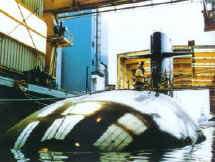
The
French Prime Minister Raffarin is coming to Aero India 2003 at
Bangalore on 06 Feb and IDC will cover the show, which is being
separately previewed. The show cannot be missed by any supplier or
potential supplier of defence goods. The who’s who of defence
purchasers in India will be at the show including the Defence Minister
and senior to mid level bureaucrats. DCN
which is building the Pakistani Agosta Bs is the same company for the
Indian Scorpenes.
We
are in a position to send exclusive daily reports of the happenings at
Bangalore from 05–09
Feb, so please contact us at idc@ispone.net
or marcodel@vsnl.com
by
E-mail.
1.
BBC, 24 Jan 2003
“India
and France are expected to sign a bilateral extradition treaty during a
visit by India's Deputy Prime Minister, LK Advani. India believes that
such treaties will help with intelligence sharing and lead to
coordinated action against terrorism. It already has similar treaties
with Britain, Germany, Italy and the US. Mr. Advani will also finalise a
defence deal worth more than two billion dollars involving the building
of six French-designed Scorpene submarines in Mumbai.”
2.
News International, 21 Jan 2003
“Indian
and French sources have announced an agreement worth USD 2 billion to
build six Scorpene submarines in India. Under the agreement, India, will
also receive 36 missiles from a European consortium. Sources said that
the deal is complete and is now awaiting approval by the Cabinet
Committee on Security.”
The
Scorpene Story
So
here is the SCORPENE story, just as the media reported that the CBI was
withdrawing the investigation into the so called HDW scandal ––
acquisition of HDW submarines from erstwhile West Germany. A number of
naval personnel who were unnecessarily dragged into the case now
stand vindicated, but those who got the gravy will now rest easy. It was
the Navy, which lost out as for several years no submarine was built at
MDL. On the other hand Pakistan just announced its home built Agosta B
class submarines, the second of which after Khalid is undergoing sea
trials. The same company DCN, which will supply India the Scorpenes is
building the Agostas.
In the late 70s India signed an agreement with Howaldstswerke (HDW) of Germany to build four plus two 1500 ton submarines based on the Gabler IKL design. INS Shishumar (S 44) and Shankush (S 45) were commissioned in 1986 at Kiel. Two more were successfully built at Mazagon Docks when INS Shalki (S 46) and Shankul (S 47) costing some $100 million each were commissioned at the Mumbai yard in 1986 and 1989 respectively .The negotiations for the last two submarine kits were in progress in 1986, when an innocuous telegram from the Indian Ambassador in Germany to the Government of India in New Delhi, inquired if the same commission terms paid for the first four kits were applicable to the fifth and sixth kits also –– the cat was out of the bag!.
The
furor led to a CBI inquiry and a court case followed which put paid to
HDW submarine building in India. The hunt for the names of the
recipients of the commission is still being pursued and the Indian Navy
went on to acquire 10 Kilo class boats from Russia. Though Mazagon Dock
had been refitting the four HDW Shishumar class boats for the Indian
Navy, the core submarine building team especially the welders and
assemblers have since been disbanded, due to lack of orders which is a
big loss to the nation. The US stopped supplies for the Submarines and
now Indian Navy is upgrading two with German Periscopes and Fire
Control. The CBI case is being closed.
Hence
it is heartening that after a lull of 12 years the Indian Navy has
finally got the green signal for construction of six
Franco–Spanish Scorpene Submarines under Project 75 at Mazagon Dock.
Each of the submarines is expected to cost around 15 billion rupees
($300 million). The technology will be transferred by DCN and Thales of
France and this will give Indian ship building another boost in welding
expertise, modular ship building and electronics as also shore up
Mazdocks' order book.
The
submarines are similar but more advanced than the earlier and proven HDW
boats as they will have options on the Module Energie Sous–Marin
Auotonome (MESMA) Air Independent steam Propulsion AIP, to enable
operation under water for days without surfacing. Only three countries
Sweden, Germany and France have this ability and it will be a new high
for the Indian Navy, which has always led the other services in
absorbing latest technology and transferring its benefits to industry.
In fact in all seminars the Navy model of building ships with
collaboration of DRDO and its own WEESE research set up is being quoted
for the Army and IAF to follow.
The
Scorpene design is capable of taking a small nuclear reactor in the hull
in the future, and is therefore an ideal choice for Indian Navy’s long
term nuclear ambitions as it is building its own larger nuclear
submarine the ATV, now that the Nuclear Command and Triad has been
announced. DCN audited the HDW boat and Mazagon Dock capabilities and
offered the Scorpene in which IZAR of Spain is indirectly involved. The
four lead Chilean Navy Scorpenes are being jointly built by DCN of
France and Izar of Spain. India and the French-led consortium began
negotiations for the Scorpene package some two years ago with NHQ
rightly insisting on technology transfers.
It
was on the basis of its accumulated experience, that in 1991 the Spanish
shipbuilder IZAR which now owns Bazan, decided to pursue its own third
generation conventional submarine design that would be appropriate for
the growing international market, sharing 50% of the risk with a foreign
partner. Izar teamed up with the French company DCN and in 1992 based on
their long experience of working together, commenced the definition
phase of a medium-sized conventional attack boat of 1,500 tons. The
unique aspect of the design concept was that it can integrate any
equipment or technology solution or weapon system the customer nominates
and the Indian Navy is in the process of finalizing its own selections
under Project 75.
The
Chilean Navy ordered four Scorpenes in 1998 and two boats are currently
under construction in Spain and France. The “O Higgins” is due to
commission in 2004 and the “Carrera” in 2006 and Indian constructors
will gain from the live on job training and the building philosophy in
modules, which is similar to what India’s ATV project is following.
The Chilean Scorpene submarines are built in four blocks, two of them by
Izar at Cartagena Spain and the other two by DCN in Cherbourg France.
The two built in France incorporate the bow section which includes the
torpedo tubes, bow chamber, control room and accommodation . The
Spaniards are building the stern section which includes the tail cone
with propulsion, engine room and battery chamber. Unlike the double deck
10 Russian Kilo class submarines that the Indian Navy has been
operating, the Scorpenes are single decked.
In
the first Chilean boat the Spanish blocks will be taken to Cherbourg
where they will be welded and assembled. The weapon system will be
integrated and tested for sea trials off Chebourg. In the case of the
second it will be the reverse. The DCN blocks will be taken to Cartagena
where the rest of the operation will be carried out. The Scorpene can be
described as a submarine of new design philosophy that incorporates the
latest advances and trends in conceptualisation and technology, but
based on the principle of low cost in both the project execution and
construction phases via the modular system. It further incorporates
operation by fewer crew and a maintenance cycle of 50 mission capability
days 2000 miles away .The Scorpene’s length is 61.7 metres and is
propelled by the CM-2000 version of the Jeumont Schneider 2,900 kW
electronic engine, with a fixed pitch seven bladed propeller. The
compressed air and water cooling and power supply is provided by four
Izar/MTU 396 12V SE 84, de 632 kW, diesel-generators at 1,700rpm, or 360
high capacity lead battery elements with tubular boards, electrolyte
agitation and water-circuit junction cooling.
All
the propulsion elements of the Scorpene and auxiliary equipment are
situated in two independent chambers and mounted on elastically
suspended structures for silent operation to avoid sonar detection and
provided with a dry snorkel system for air intakes for the diesels when
snorting just below the surface. The “Scorpene” is manoeuvred by two
prolonged rudders, in the upper and lower part of the hull, and four
hydroplanes, two aft in the bow keel cross and two in the topsail. The
weapon fit is what the Indian Navy has specified and has not been
disclosed and the distributed architecture design can be integrated by
redundant and re-configurable local area networks to incorporate the
Navy’s Staff requirements .The use of high elasticity steels such as
H80 and HY80 that require pre-heating to 120o prior to
welding is indicative of the complexity of manufacturing these modules
and the handsome spin offs the Indian industry will gain.
The
operation is carried out using ceramic resistor stacks controlled by
special computer equipment, which at the same time regulates the quality
of the welding. The welding work will need to be carried out by highly
qualified professionals with special physical aptitudes given the
extreme difficulty of the operation and the critical need for perfection
for the hull to withstand depths of over 300 meters. Mazagon Docks
already has experience of this as it acquitted itself well in the
earlier HDW programme .
The
Indian Navy, Mazdocks and DCN are celebrating and in time this project
could change the whole philosophy of modern defence ship building in
India just like the Leander project signed with Yarrows did in the 70s
.The Indian Navy now has over a dozen variants of the original Leanders
and another 6 on order and the project gave birth to some 216 sub
assembly suppliers. The Scorpene project is likely to do the same if
steered well.
