Cold war demolition machines — five
Typhoon class submarines — will be scrapped. New generation subs
are entering the scene.
Igor
Kudrik, 2002-06-12 19:03
Severodvinsk shipyard Sevmash has started defueling a Typhoon
class submarine. The submarine will be scrapped shortly after
that. The whole process is funded by the US Cooperative Threat
Reduction program, or Nunn-Lugar program.
The Soviet Union has built six Typhoons — world's biggest
submarines included into the Guinness Book of World Records and
promoted in Hollywood's Hunt for the Red October. This 172 meters
long submarine is capable of carrying 20 ballistic missiles each
armed with 10 nuclear warheads.
The design work of Typhoons started in 1973 and was an answer
to American Trident submarines which could carry 24 new solid fuel
intercontinental missiles. The USSR engineered solid fuel
missiles, but they grew in size what influenced the design of
Typhoon class. The submarine was to integrate two independent
hulls — a kind of catamaran. The oblate form of the submarine
was prompted by the shallow waters in the area of Severodvinsk
shipyards. Such solution led to increased displacement of the
submarine — Typhoon class has 49,800 tonnes displacement
submerged and was nicknamed a "water-carrier" — but it
also led to increased safety and better possibilities to perform
repairs and upgrade due to a high degree of modulation of various
parts of machinery. Typhoons were also designed to launch missiles
from the Arctic being capable of surfacing from underneath 2 to
2.5 meters thick ice to shoot out its arsenal.
Each Typhoon had two PWR reactors with 100,000 h.p., located in
the starboard and portside hulls. The nuclear installation was
equipped with the system of battery-free cooling, and the reactor
control rods would go down automatically in case of emergency even
if the submarine flips.
The first submarine entered service in 1981. The last Typhoon was
commissioned in 1989. All of them were stationed in Nerpichya
base, Zapadnaya Litsa fjord at the Kola Peninsula. The Soviet
Union had ambitious plans of building Typhoons in great numbers
and assign them both to the Northern Fleet and the Pacific Fleet.
But by the end of 1980s a decision was made to halt the program
due to the cost of the endeavour and political considerations —
the cold war was nearing its end. The seventh Typhoon was
dismantled in the building berth in Severodvinsk in 1990.
Another reason to quit Typhoons was the complicated
infrastructure they required to operate properly. Redesigning of
Nerpichya base which earlier hosted first generation submarines of
Echo-II and Hotel classes started in 1977. Most of the other
existing bases could not accept Typhoons due to their football
field size. The reconstruction of Nerpichya was completed in 1981.
New pier plants were designed and built to supply Typhoons with
electricity and heat when in base. Typhoon's missiles were also
difficult to handle due to their size. They could be transported
only by railway and lifted by a 125-tonne crane. Neither the
railway nor the quay crane were commissioned. No initial design
features were functioning in the pier plants either. They were
used just like any other quay facilities except for being larger
in size. The loading of missiles was carried out by a transport
ship Aleksandr Brykin which was built specifically for
Typhoons and had 125-tonne crane onboard.
The Pacific Fleet was also to build base facilities for
Typhoons but had failed to do anything in that direction until
1990s when the Typhoon program was finally wrapped up.
In 1996, TK-12 and TK-202 and in 1997 TK-13 were taken out of
regular service and placed on reserve.
Two last built submarines — TK-17 and TK-20 — allegedly
remain in service but de facto they have not been fulfilling any
missions the past two or three years.
The first submarine within Typhoon class — TK-208 —
commissioned in 1981 has been under repairs in Severodvinsk since
1990. In 2000, Severodvinsk received additional funding for
repairs and said that the submarine might join the Northern Fleet
in 2001. The submarine is, however, still in Severodvinsk.
 |
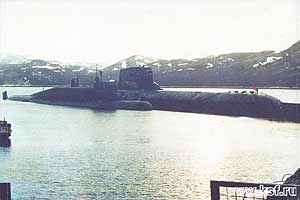
| One of the
Typhoons was spotted in Gadzhievo
base. |
| photo:
www.ksf.ru |
|
|
|
Demolition machine under
decommissioning
TK-202 arrived to Severodvinsk first week of July 1999 for
decommissioning. The work on this submarine and four others — in
total five except for TK-208 — is to be funded by the US
Cooperative Threat Reduction program. Although being in
Severodvinsk since 1999, no major work has started on TK-202 —
except for cut out missile tubes — until June this year. The
question to decommission the first Typhoon was a complicated
political decision. These giant submarines are still one of the
prides inherited from the Soviet Union and scrapping the pride was
hard to accept for many politicians. From the practical point of
view Typhoons have become useless after the end of the cold war
and too expensive for the scarce budget of the Russian navy.
The first week of June, Sevmash shipyard started to defuel two
reactors of TK-202. CTR is paying for all the jobs necessary to
do. This includes funding of infrastructure, such as a storage pad
for TK-18 containers which will hold spent fuel from this Typhoon
and other strategic submarines decommissioned at Zvezdochka
shipyard, located at the opposite side of Sevmash on Yagry island.
Four Typhoons to go, fifth
generation subs to enter
The remaining four Typhoons — TK-12, TK-13, TK-17 and TK-20 —
which are not currently in Severodvinsk are still at Nerpichya
base. One of the Typhoons was observed, however, at Gadzhievo.
Should TK-208, which has been under repairs in Severodvinsk,
ever enter service again, it is unlikely the submarine will go
back to Nerpichya. Unofficial sources suggest that all the base
points located in Zapadnaya Litsa fjord — Malaya Lopatka,
Bolshaya Lopatka and Nerpichya — are in the process of closing
down. The submarines, which remain there — Oscar and Victor
classes — will be transferred to other bases such as Gadzhievo
and Vidyaevo. The base point Andreeva Guba used as a dumping
ground for spent nuclear fuel and radioactive waste will be
cleaned up, given funding, including international, is in place.
The only operational strategic submarines left in the Russian
Navy are Delta-III and Delta-IV classes. Sevmash which is along
with decommissioning also still builds new submarines has
reportedly four boats in its construction docks, including one
Borey class strategic submarine and one Severodvinsk class, likely
multipurpose, submarine. Borey class has been recently
reclassified by the Russian navy to be the fifth generation,
whereas Severodvinsk class is referred to the forth generation.
The two other submarines under construction are unknown. The
newest Russian submarines — Akula class attack submarines —
belong to the third generation.

