OSLO-SEVERODVINSK - Russian navy may face nuclear-free
seas by 2010; repairs Typhoon class submarines to use them as test platforms for
weapons, which are still in design.
Igor Kudrik, Andrey Mikhailov, 2002-11-13 15:26
A Typhoon class submarine — Arkhangelsk (TK-17) — left the docks
of Sevmash shipyard (Severodvinsk, Arkhangelsk county) and headed to its home
base in Zapadnaya Litsa at the Kola Peninsula on November 9th 2002. The
submarine has been under repairs and upgrade for one year.
The first submarine within Typhoon class — TK-208 — commissioned in 1981
has been under repairs in Severodvinsk since 1990. Its repairs and upgrade seem
to near the end as the submarine was taken out of the dry dock and is undergoing
pre-sea trial testing. During this long 12-year resting period submarine's
ID-number TK-208 was replaced with name Dmitry Donskoy. The sea trials of
the submarine are scheduled for spring 2003.
The longish repairs of Dmitry Donskoy were apparently not caused only
by the lack of funding. As recently as this year Russian admirals started to
refer to Dmitry Donskoy as to the submarine of the forth generation. This
submarine built in early 1980 belonged at that time to the third generation. No
submarines of the forth generation have been constructed in Russia so far.
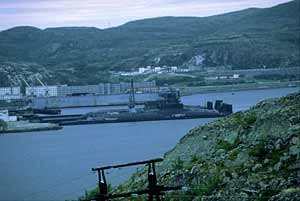
| A Typhoon class submarine
— Arkhangelsk (TK-17) — left the docks of
Sevmash shipyard (Severodvinsk, Arkhangelsk
county) and headed to its home base in Zapadnaya
Litsa at the Kola Peninsula on November 9th
2002. |
| Severodvinsk |
|
|
|
 |
There were also reports that Typhoons, or at least upgraded Dmitry Donskoy,
will be used as testing platforms for new weaponry.
The type of weaponry is a big dilemma for the Russian navy, however.
It all started, when the first forth generation submarine — starting from
this year it is referred to as the fifth generation submarine — Yury
Dolgoruky, Borey class armed with ballistic missiles, was laid down at
Sevmash in 1996.
The initial plans suggested that Yury Dolgoruky would be carrying Bark
missiles. The maker of Bark class missiles was the Makeev Design Bureau, which
designed almost all Soviet/Russian sea-based ballistic missiles. The Bureau had
been working on this missile since 1982. The Bark-class missiles were a
dramatically modified version of the SS-N-20 currently installed on Typhoon
class submarines. But after a number of unsuccessful tests, Bark missiles were
discarded in 1998. The design of a new ballistic missile system was given Moscow
Institute of Thermo-equipment (MIT), which designed land based solid fuel
ballistic missiles of Pioneer, Topol and Topol-M classes. The new missile system
was nicknamed Bulava-30.
Back in 1996, it was said that Yury Dolgoruky would completed in 2002.
Today a new date — 2007 — is set, given Bulava-30 is ready by that time.
And here enter Typhoons. Out of six originally built Typhoons, three, as
Russia's Navy officials maintain, are slashed for decommissioning. In 1996,
TK-12 and TK-202 and in 1997 TK-13 were taken out of regular service and placed
on reserve.
TK-202 arrived to Severodvinsk first week of July 1999 for decommissioning.
The work on this submarine is being funded by the US Cooperative Threat
Reduction program, or CTR. This autumn spent nuclear fuel was to be unloaded
from TK-202 reactors at the Zvezdochka shipyard (Severodvinsk) defuelling site.
The construction of the defuelling site was also financed through CTR. TK-12 and
TK-13 are lining up for their turn to be scrapped.
The remaining three Typhoons, TK-208, TK-17 and TK-20 may be used to ensure
that by 2007 Russian navy is not having nuclear-free-seas situation and finally
commissions the fifth generation submarine.
Programme until 2010
According to Russian daily Vremya MN, the funding of the Russian navy until 2005
will focus on keeping in operation the existing submarines, including SSBNs of
Delta-III class in the Pacific and Delta-IV class in the Northern Fleet. Along
with that the funding to complete Yury Dolgoruky should be provided in
full. But 2010, a serial production of Borey class submarines should start, as
suggested by the current programmes.
The share of the navy in the defence budget, however, has not exceeded 11 to
12% during the past years. The naval lobby has been trying hard to raise navy's
budget allocations up to 25%, but so far those attempts have not been
successful. Given the current state of affairs, the strategic forces of the
Russian Federation are slowly migrating towards the shore. At least the
land-based strategic forces have a modern missile system — Topol-M — which
the navy lacks so far for the reasons mentioned above.
Putin's favouritism of the naval forces has proven during the years of his
presidency to be more of PR-related, rather than having any practical
application. The bulk of the funds earmarked for the navy go to ensure the
timely payments of allowances, whereas only a small fraction is spent on
development.
Typhoon class submarines — overview
K-no.
(fabric no.) |
Ship yard
-Laid down
-Launched |
Active service
-Start date
-End date |
Accidents/Incidents
|
Present condition |
| TK-208 (Dmitry Donskoy) |
Sevmash
30/06 1976
23/09 1979 |
12/12 1981
|
1986: Reactor cleaning unit leakage
1987: Reactor cleaning unit leakage
|
The submarine has been under upgrade and repairs at
Sevmash shipyard since 1990. Repairs intensified in 2000, but the
submarine is still at the shipyard. Scheduled to enter service in spring
2003 |
| TK-202 |
Sevmash
01/10 1980
26/04 1982 |
28/12 1983
1996 |
No data |
Under decommissioning with CTR funds at Sevmash
shipyard in Severodvinsk since 1999. Defueling started in June 2002. |
| TK-12 |
Sevmash
27/04 1982
17/12 1983 |
27/12 1984
1996 |
No data |
Laid-up in Nerpichya Bay, Zapadnaya Litsa. |
| TK-13 |
Sevmash
05/01 1984
30/04 1985 |
30/12 1985
1997 |
No data |
Laid-up in Nerpichya Bay, Zapadnaya
Litsa. |
| TK-17 (Arkhangelsk) |
Sevmash
24/02 1985
Aug 1986 |
06/11 1987
in service |
No data
|
Repaired at Sevmash 2001-2002. Based in Nerpichya
Bay, Zapadnaya Litsa.
|
| TK-20 |
Sevmash
06/01 1986
Jul 1988 |
Sep 1989
In service |
No data |
Based in Nerpichya Bay, Zapadnaya Litsa.
|

