Secret nuclear plant detected in North Korea
Signs point to second plutonium processor
Jonathan Watts in Tokyo and Julian Borger in
Washington
Monday July 21, 2003
The Guardian
North Korea may have secretly built a second nuclear reprocessing plant to
produce weapons-grade plutonium, according to evidence found by US intelligence
agencies.
The installation may be hidden inside a mountain.
The news, reported in yesterday's New York Times, complicates the diplomatic
attempts to resolve the nine-month nuclear stand-off and raises fresh questions
about the information gathering abilities of the CIA.
Earlier this month North Korea said it had completed reprocessing 8,000 nuclear
fuel rods, enough to make six to eight bombs.
|
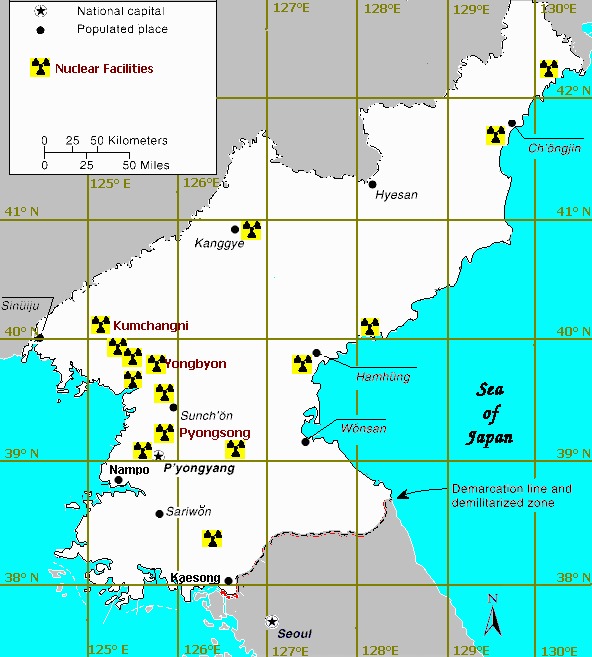
Known Nuclear Facilities |
But US officials played down the claim as a
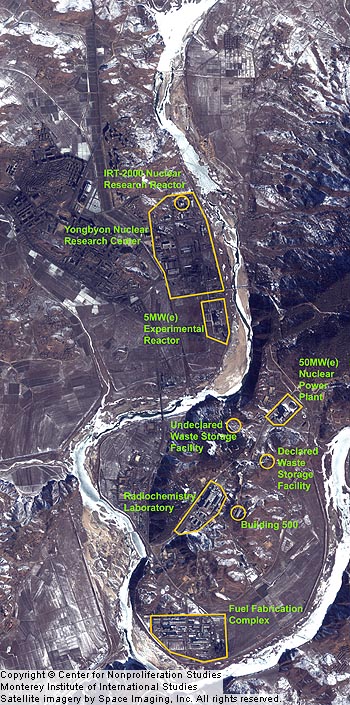
possible bluff, because satellites had detected no signs of activity at Yongbyon,
the only confirmed nuclear plant in North Korea.
Furthermore, the monitoring equipment along the border did not immediately pick
up heightened emissions of krypton 85, a gas given off during reprocessing.
White House officials confirmed yesterday that high emissions of krypton 85 had
now been observed.
But press reports citing American and Asian officials say that computer analyses
of the wind direction suggest that the gas was coming not from Yongbyon but from
another source, possibly hidden inside a mountain.
The information, which has been shared with Tokyo and Seoul, seems to back up
reports from a South Korean agent that the North has a second plant north-east
of Yongbyon.
But after the debacle of the Iraq dossiers and previously misleading satellite
intelligence on North Korea, the White House has responded cautiously.
|
The New York Times quotes an unnamed senior official as saying that the evidence
was "very worrisome, but still not conclusive." Tony Blair, who was in South Korea yesterday on the second leg of an Asian tour, said North Korea was a "real threat and danger." He ruled out military action, but said an "awful lot of pressure" should be put on Pyongyang to comply with its international obligations. Last week Mohamed El Baradei, head of the International Atomic Energy Agency, described North Korea as the "most immediate and serious threat to the nuclear non-proliferation regime". The former US defence secretary William Perry said that the situation was drifting towards war, possibly before the end of the year.
But in a way exactly opposite to its approach to Iraq, Washington has gone out
of its way to avoid recognising North Korea's claims to possess a powerful
deterrent. he previous crisis was averted when North Korea allowed the IAEA to keep watch
over Yongbyon. |
 |
|
Satellite Photos of Yongbyon Nuclear Complex |
South Korea is already beginning to accept a nuclear fait accompli by its
neighbours.
Senior officials in Seoul say privately that they have little choice but to live
with North Korea's atomic bombs, and the US will probably be willing to do the
same as long as the weapons are not exported.
North Korea, one of the world's most impoverished and militarised states, has
consistently managed to outwit its more powerful enemies, although at the
expense of its starving and isolated population.
But with no independent confirmation of the reports, Pyongyang's reprocessing
claims and Washington's reports of a second nuclear plant could be a game of
bluff and double-bluff as China tries to bring the two sides back together for
negotiations.