
U.S.
Submarine Force Looking
to ‘Cross-Pollinate' with Allies
Sharing
underwater techniques and tactics is the main objective
By Robert A. Hamilton
Groton
— As the first U.S. Navy officer to pass through the vaunted British
“Perisher” course for submariners, Lt. Cmdr. Stephen Mack had to make quite
a few adjustments.
First,
there was the lexicon difference — “port rudder” instead of “left
rudder,” for instance. Then there were different methods of measurement —
meters rather than feet.
And, perhaps more importantly, there were different ways of doing business;
officers handle navigation on British submarines, while in the U.S. fleet
enlisted quartermasters handle the task.
In
the undersea community there was considerable trepidation about Mack's departure
for England early this year. About 50 percent of those who get to Perisher are
drummed out before graduation. The Royal Navy made it clear that standards would
not be relaxed for “the colonial.”
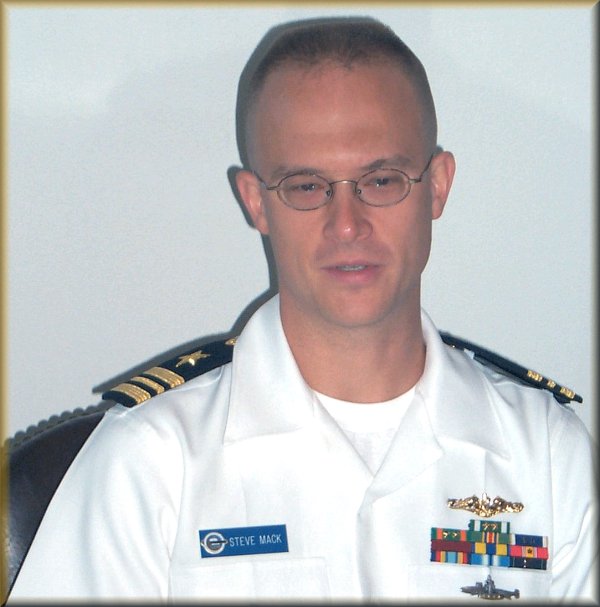 “I
was a little nervous,” Mack said. “I don't think anyone wouldn't be. But I
looked at it as just too big an opportunity to pass up.”
“I
was a little nervous,” Mack said. “I don't think anyone wouldn't be. But I
looked at it as just too big an opportunity to pass up.”
Mack did well enough that, when he completed the course, “Teacher” — Royal
Navy Cmdr. Paul Avraham, head of the Perisher course — pinned on the American
his own set of British dolphins that he had earned 20 years earlier.
“That's
not something we share lightly, even within the profession,” said Capt. Mark
Breor, director of officer training at the Naval Submarine School in Groton,
where Mack reported after returning home. “That was a very significant
gesture.
In
the meantime, the British are preparing to send some of their submarine officers
to the United States for the Prospective Commanding Officer (PCO) course offered
in Groton. The exchange is one of several under way or in the planning stages to
“cross-pollinate” and share tactics and techniques with allied forces.
In
the Pacific, U.S. submariners trained with their Australian counterparts this
summer, and Vice Adm. John J. Grossenbacher, the Navy's Commander of Submarine
Forces, has proposed similar exchanges with the Dutch and the Canadians.
“As a force, we're going to learn a lot about how other people operate,”
Grossenbacher said.
Cmdr.
Barry Bruner, who directs the PCO course for the Pacific submarine force, said
the exchanges bring a couple of benefits. First, they provide a better
understanding of the capabilities of allied navies. The Australians, for
instance, operate the diesel-electric Collins class of boat; the U.S. Navy
operates only nuclear submarines.
“The PCOs come out of this course with a much better understanding of diesel
submarines than anyone else in the Navy,” which is important, Bruner said.
“There's a good chance, if we do go to war, it will be against a country that
operates diesel submarines.”
Given
the participation of Australian forces in Operation Enduring Freedom and other
recent multination coalition actions, it is likely that the Australian navy's
submarine force would participate in any naval action involving the United
States in the Pacific.
“If that happens, we've already had the experience of doing in-depth, detailed
operations with our allies,” Bruner said.
•Mack
was navigator on the USS Memphis when Breor was captain, and the second officer
chosen to enroll in the Perisher course, Lt. Cmdr. Edward Pittman, worked for
Breor at the Atlantic Fleet Nuclear Propulsion Examining Board.
Mack
said he had just returned from a six-month deployment when he was approached
about taking the assignment to the Perisher course, which meant another extended
absence from his family. Because the program is so intense — courses start at
dawn and discussions often go past midnight — it made no sense to move his
family to England.
 Mack
was given an eight-week introductory course when he arrived in England last
January, then enrolled in the 16-week Perisher. He said the two forces do many
things differently, particularly when it comes to navigation. In the U.S. Navy,
enlisted quartermasters do most of the charting; in the Royal Navy, the officers
handle the task. In addition, their charting techniques are different.
Mack
was given an eight-week introductory course when he arrived in England last
January, then enrolled in the 16-week Perisher. He said the two forces do many
things differently, particularly when it comes to navigation. In the U.S. Navy,
enlisted quartermasters do most of the charting; in the Royal Navy, the officers
handle the task. In addition, their charting techniques are different.
Some of the equipment on board the British submarines was different as well,
though, in the tradition of the Silent Service around the world, Mack would not
elaborate.
Every
Perisher graduate from 1917 until today has had his name carved into large
wooden panels in the hallways of the school, and Mack's classmates have promised
to send him a picture of his own name when the latest class is added.
Graduates of the Perisher course go directly into an executive officer's spot on
a British submarine, and depending on how they do there, some will be chosen to
move up to command. Mack's classmates were surprised to learn he would spend the
next 18 months at sub school, teaching tactics in a simulated attack center
instead of going to sea.
Mack
gave his first briefing on the British program to Submarine Group Two staff last
week, and he will soon deliver a presentation to the Navy's top submarine and
fleet officers.
“There is a pretty significant amount of interest in how it worked,” he
said.
“And I think it's only healthy for us to look at how everyone else operates,
and say, ‘Maybe there are better ways we can do things.' They were always
asking me the same thing over there — ‘What can we do better?' ”
•
The exchange course in the Pacific fleet goes back to August 2000, when the HMAS
Waller visited Pearl Harbor, Hawaii, and participated in PCO operations there,
Bruner said.
Last year, 11 PCO students and two instructors from Pearl Harbor flew to Perth,
where they took part in an exercise that pitted the USS Asheville against the
HMAS Sheehan.
The two navies have decided to formalize the relationship, alternating every
other summer at Pearl Harbor and Stirling Submarine Base in Australia.
Each class typically spends a little less than three weeks underwater, taking part in the submarine-on-submarine operations. The officers who finish the course are much better equipped to deal with the diesel submarine threat, Bruner said. "The knowledge level on both sides goes up quite a bit every time we do this," he said. "There's no question in my mind that this is the key to increasing the experience level of submarine commanding officers."
