
Jaredite Barge
This story is the result of premature excitement and a lack of logical thinking. It seems that a vessel of some kind was found in Lake Michigan in January of 1999. Many members of the church, upon reading the story, immediately recognized its description as being similar to the description of the barges used by the Jaredites in the Book of Mormon. From there you can imagine what happened. Here is the original story from CNN:
'Monster' in Lake
Michigan is manmade,
but just as mysterious
January 26, 1999
Web posted at: 2:48 p.m. EST (1948 GMT)
CHICAGO (CNN) -- OK, so it's definitely not the Loch Ness Monster. It's not even alive.
But Lake Michigan is indeed harboring a
mysterious object.
Right where the Chicago River enters the Great Lake sits an oak construction the size of a
bus and shaped like a zeppelin.
Nobody can say what exactly it is, and it's in the way -- slated to be demolished by the
Illinois Department of Natural Resources when it revamps the basin that is currently the
object's home.
But not if Sam Frank of the Underwater Archaeological Society of Chicago has anything to
say about it. Frank is trying to organize a moving party to get
the big wooden thing out of the way, and hopefully leave it available to divers in a safer
location.
And Frank would be delighted if someone could step forward and explain just what the
object is and how it came to rest at the bottom of Lake Michigan.
Here is the picture placed with the story:
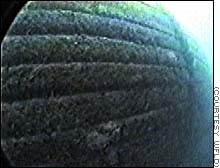
Now, there were other stories with more detailed descriptions including the hatch on top and the metal bands used to hold it together. It is easy to see how so many got so excited. However, think about this for a second. The Jaredites lived over 2,00 years ago. This barge is made of wood. How could it possibly survive intact like this for 2,000 years?! Well, the truth is, it didn't. here is the follow-up story from the Chicago tribune telling us exactly what this thing is.
ANSWERS SURFACE FOR LAKE ENIGMA
By Peter Kendall
Chicago Tribune, 2/8/99
Archeological divers hoping to identify a mysterious, bus-size
wooden object submerged near the Chicago River locks now know what it
is: a sunken dream.
When he built it secretly in a shop on Belmont Avenue in 1942, Mike
Tym, a Ukrainian immigrant, called it an "amphibious semi-submersible
type of sea-going tow barge."
The name alone could sink the thing.
A floating fuel tank, it was designed "to reduce losses of shipping
from torpedoing, bombing and shelling," the inventor said in a letter
to the U.S. government. The tank was to be towed by boats.
"When loaded, it is almost submerged, what makes its detection and
destruction difficult," his letter said in sometimes strained
English.
Tym wanted to build a fleet of the behemoth, blimp-like barges to
ferry gasoline and oil, and a Navy contractor paid him $2,500 to build
a prototype. Despite a successful government test of a 34-foot-long
prototype in Lake Michigan on a choppy November day, no orders came.
Why the prototype came to lie at the bottom of the turning basin
remains a mystery.
In May, a volunteer fleet of boats and dozens of divers plan to move
the object, without ever letting it reach the surface, to a protected
site in Lake Michigan. There, divers can swim around it.
If the object is not moved, it would be destroyed by a state project
to convert the old ship turning basin into a marina.
The divers began making their elaborate moving plans before knowing
what it was they would be moving. The unidentified sunken object was
intriguing in its mammoth size and its fine craftsmanship, and there
was hope it might be some important 19th Century relic.
Other theories included the possibility it was a buoy to hold
anti-submarine netting or a device in which to navigate the city's
century-old water tunnels.
Divers still plan to go ahead with the move in May.
"It's no Spanish galleon, but we aren't disappointed," said Sam Frank
of the Chicago Underwater Archaeological Society. "Our focus is
preserving the history of Lake Michigan, and this is Lake Michigan
history."
It is also family history.
The official Navy photos of the barge, taken on the day it was tested,
were stored away in a yellowed file folder in a box in the basement of
Michael Tym VII, the 64-year-old son of the inventor.
He went to look for them after reading a Tribune article about the
unidentified object and believed it looked remarkably like the strange
barge his dad had built during the war.
The elder Tym died in 1981, almost two decades after he had retired to
a little house on a beach in Mexico.
"If he were in this room, he would charm the pants off you," said his
son. "He was very European; he clicked his heels when he was
introduced to a woman."
A onetime philosophy student in Kiev, the senior Tym fled his homeland
after the Bolsheviks took over.
"He was one of the czar's guys," his son said.
The father's folders, entombed in a cellar, bear doodles and plans of
a creative mind.
"A field grain silo or water tank, 1941," says one plan.
"Aeroplane runway," says another.
He also had a design for barracks that could be erected in a hurry.
Other ideas were more eccentric. An old newspaper clipping shows him
in an "unsinkable boat," a rocket-like monstrosity he fashioned from
aluminum, bobbing in Lake Michigan.
"None of these really made money," said his son. "He was not
materialistic; that wasn't his motivation."
The unifying element of his work is a synthetic cast stone he
trademarked as Tymstone.
Family lore has it that Tymstone was used to create the rock-like
walls in the coal mine exhibit at the Museum of Science and Industry,
although the museum could not confirm that last week.
Papers in the family's files show that Tymstone was used on the
trademark Perisphere and Trylon, a 200-foot globe and a 700-foot
needle at the New York World's Fair of 1939.
"To me, it's an inspiration," said his son. "He came to Ellis Island
in 1925 without a penny in his pockets and 12, 13 years later his
Tymstone is being used at the World's Fair."
Tymstone was incorporated into the barge design, giving the wooden
structure a stone-like lining.
"We saw this stuff and didn't know what it was," said Frank, the
diver, who has peered inside the sunken barge.
Michael Tym vaguely remembers his father's barge project.
"There was a little cloud of secrecy over it," he said. "It wasn't top
secret, but it was confidential Navy stuff."
The family files contain three pages of notes taken by a Navy official
about the test on Nov. 20, 1942.
After the barge was trucked from a shop at 1215 Belmont Ave., it was
lowered into the water and immediately appeared slightly unstable. "It
rode like an eggshell," the notes said.
The barge was then filled with water, and a tug towed it into the
harbor to see how it handled when loaded.
"The harbor had quite a chop on by then, and the barge occasionally
buried herself out of sight for a few seconds," the notes said.
"However, it showed no tendency to dive and appeared to handle
easily."
Just as the inventor had predicted, the loaded barge was hard to
detect in the water.
"Although the sky was leaden during the tests, it was evident that the
nearly submerged craft would offer little visibility even on a bright
day," the report said. "If camouflaged, it would hardly be seen a
short distance away."
The conclusion: "There is no question but the test was a success, so
far as it went. The barge is rigidly designed and strongly
fabricated."
Tym's plan was to build much bigger versions. Unlike the
60-ton-capacity prototype, he wanted to construct 70-foot-long
behemoths that would carry 420 tons of fuel.
Exactly why the government did not buy the idea is unclear. The family
files contain almost no subsequent correspondence, save a request that
the government reconsider building the barges.
There is also no mention of what happened to the vessel after the
test, and certainly no indication that it sank.
"Why it is lying on the bottom," said the inventor's son, "is a
mystery to me."
Now you know the TRUTH about the Jaredite barge. None of this however, destroys the authenticity of the Book of Mormon. I testify it is the word of God. I know this through a witness from the Holy Ghost, independent of anything or anyone else.
