Breeding Fennec Foxes
This page has information about breeding Fennec Foxes. The information is all based on their wild habits and the experiences of different breeders who have worked with them.
Hand raised Fennecs are very docile and lovable. A hand-raised Fennec is one that is taken from its parents and bottle-fed.
Fennecs that have been raised by their parents are not tame.
Mating: The Fennec breeding season is January through March.
Gestation Period: 50-52 Days
Number of kits per litter: 2-5
Litters per year: 1 (in the wild)
Lactation: 9-10 weeks
Note: Fennecs that breed in captivity have been known to have up to
three litters per year. This may be due to the fact that the kits are
removed from their parents so early. In the wild, if all the kits in a litter
die, the parents may have another litter that year.
The Breeding Pen:
If possible, the breeding pens should be very large, with enough places to hide their kits should they feel disturbed.
If outside, things like dirt tunnels, rock hiding places, etc. should be available for them to use. There are also the
regular boxes and such. One breeder I know has a whole room in her house used solely as a place for her Fennec pair to live.
How many Kits do I have?
A very important thing to know when raising Fennecs is to leave them alone when whelping (giving birth). They do not like
any disturbance. When disturbed they move the kits. If they have no place to move them to, they may even eat the kits.
You will know how many kits you have when you remove them for hand-rearing. A male will probably be very protective of
his offspring, so be careful if you don't want to be bitten.
When to Remove the Kits:
Some breeders recommend taking kits from their parents at 12 to 24 hours old, and some don't move them until ten days of age.
Taking them from their parents can seem harsh, but since they are going to live in captivity they will be much happier if
they have been acclimated to humans.
Appearance:
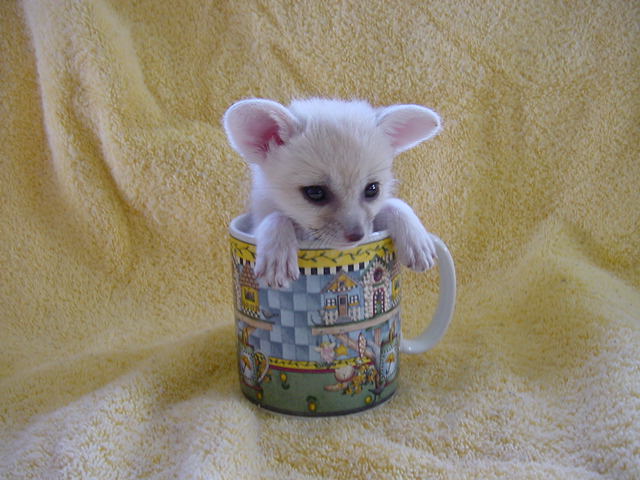
At birth, these little foxes are barely an ounce in weight and are covered with a light peach fuzz. Their skin is charcoal
grey where the dark markings will be in their hair when they are adults. At birth, their ears are folded over just like
domestic dog puppies and are sealed shut just like their eyes. At about 12-14 days their eyes open for the first time
They have bright, jet black shiny eyes that look straight into yours. The tiny ears stand up at about 2 weeks. But that
is the only time that they will be tiny. From that time on, it seems that the ears are the fastest growing part of their body.
Within a short time they have full-sized ears though the rest of their body is still
small.
Feeding:
Now that you've pulled the kits, what do you feed them?
Many breeders use Esbilac milk replacer formula. The main problem with this formula (this is only in the powdered kind) is that
the mixture tends to get lumps and clog the nipple. The formula has a protien component, casein, which causes it to have small
particles even when fully dissolved. This seems to be a problem only with the powdered formula. With fennecs, the fear is always
that they will inhale their formula and die. This usually happens because the kits are sucking so vigorously, and a lumpy formula
only makes it more likely that the kits will inhale and choke to death. There is also the possibility of drinking too much too fast
and then bloating and dying.
Several breeders have found solutions to this problem:
Some of them only use the canned formula, which doesn't have any lumps, and some mix up as much formula as they think they will
need for the day and refrigerate it, as it seems to help the lumping. But this only helps the lumping problem. There is still the
possibility of the kits inhaling their formulas. Some breeders have found that syringes work much better than bottles, because
they can control the flow much better, making sure that their kits don't inhale. They recommend the 3cc size. Some say that they
start on a syringe and then move to a marsupial nipple, which seems to work quite well for foxes. Another method is to use the
baby nurser by Four Paws (more of a cone shape). It seems to help with the size of the hole so that there isn't too much formula
coming out. A hot needle can be used to burn the hole. If the hole turns out too big, you should get rid of it immediately.
In the instance that your kit does start to choke, you sould immediately turn them upside down, holding their legs with one hand
and their belly with the other, gently swaying them back and forth until the formula comes back out. One breeder, who has never
lost a kit, hangs them upside-down and pats the back forcefully. The decision is left to the breeder to decide on which
method they will use.
Kitten milk replacer is said by some to be better and healthier than the Esbilac formulas. Also, if you want to make your own
formula, here is a mixture of formula that some rehabbers use for orphaned or abandoned baby animals:
1 can evaporated milk
1 can water
1 tsp. Karo syrup
1 egg
Fennecs can begin to eat solid food at about 15 days, and they love mixed vegetables (except for lima beans). They also love
insects like mealworms. Fruit and eggs are good for them too. Raw meat can be fed, but it can cause their urine to have an
unpleasant smell. Rodents and lizards can be fed, though this might cause them to behave more aggresively. Dog and cat food, or
Mazuri's wild canid food can also be given, as long as this isn't the only thing they're getting to eat.
Vaccinations:
Vaccinations for Parvo and Distemper are necessary for your kits, as they may die from either of these diseases. Breeders have
discovered that only a "killed" or "modified-live" vaccine should be used. The recommended dosage is .5cc for each vaccine. If they
receive a live vaccine, they may contract the disease and die. It is also recommended that you de-worm your kits, and it won't harm them.
Every breeder or pet owner should find out about any problems that they may have in their area and consult their veterinarian.
Training:
Fennecs are easily trainable and keep their bodies very clean. They can be trained to a litter box, like a cat.
You should use a litter box that has a protective shield, as they can scatter the litter all around. Clumping litter may not be
a good choice as it sometimes adheres to the fur on their foot pads, forming hard pieces that will need to be removed. Fennecs
also have a habit of dragging their food from a dish to their favorite spot in their enclosure. That could be the litter pan,
and if so, they will ingest some of the litter with their food. So if you do litter train, use a non-toxic litter that will not
harm them if they eat it.
Fennecs are diggers. If they are not going to be outdoors, you might want to consider daily exercise such as chasing and retrieving
toys. Fennec kits love water too, so you might want to get a kiddie pool for them to play in. Also, if they are kept outside, make
sure that their enclosure is escape-proof. They can dig 20 ft. in one night. If you use a wire mesh fencing be sure that the holes
aren't big enough for them to get through.
Fennecs can be trained to a leash as well. They can be taken on walks, but remember to never take them out without a leash or
carrying cage, as they will run off without any warning. Remember that these are wild animals, and should be treated as such. Wild
instincts are possible to modify but the instinct to search and hunt will over-ride their training and
attachment for you and they will scamper off in pursuit of a grasshopper or other fast moving creature without giving you a second
thought at the time. They could easily be lost in a flash.