
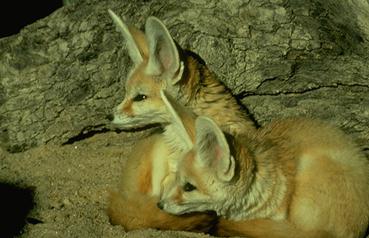
A fennec is a canine, but their need to protein is as great or greater than a cat's. If you feed a fennec an omnivore diet you will have all manner of health problems. Their bodies are not geared for so much fiber. They cannot utilize it. Fennecs also have very unusual teeth. They are the only ones known to be like this. Wildlife biologists study these anomolies and state that the teeth are like they are because of the large amount of insects and small boned animals they have in their wild diets. The closer we stay to the diet in the wild, whether it's a fennec or another exotic animal, the better off the animal is going to be from a health standpoint.
If your fennec never gets a fruit or veggie, it would not kill them. Take away their meat/insects, and they will die, probably from cardiomyopathy or liver disease.
Your Fennec should also receive a couple heaping teaspoonfools of veggies (frozen mixed veggies, fresh broccoli, tiny tomatoes, and whatever veggie he will eat) per day, as well as a very few fruits as treats. Cherries are a big favorite. But their major diet should be the meat. They need a diet high in protein.
Watch the feces of your animal. It is filled with the vegetables that we feed. Corn is not well digested and neither are carrots. All manner of green stuff is passed. Grains are not used well by Fennecs!
Care must be given when feeding a raw diet to ensure it is 100% complete in nutritional value. Feeding only parts of an animal (legs, wings, thighs) can actually cause more harm then good. When this is done it can lead to lack of calcium, or calcium absorption problems. This leads to brittle bones and other diseases. Even a raw diet must be monitored!
If you are worried about your fennec's diet, please give him extra taurine. You can simply empty a 500 mg capsule on top of the mealworms and veggies. You can also give Vionate (a vitamin recommended for foxes) a couple of times a week.
These little devils have a sweet tooth. They also are willing to eat almost any human food that you offer them, but this is NOT good for them.
To help neutralize urine odors, you can use cranberries. Buy them frozen and just thaw them.
Regarding grapes: Several animals have succumbed to grape overdose. Vets have been warned to alert canine owners that they should proceed cautiously as it is not yet known why dogs are dying from the ingestion of grapes. It affects the kidneys. There have been about 50 reported cases of dogs dying from them. If you do choose to feed them, do so sparingly.Higher quality protein stengthens the immune system. Also, diets higher in protein actually enhance kiddney function.
Rotating meat-based diets with various alternative meats, both raw, canned and dryfood is one of the best things we can do for our pets. Health improves and allergies disappear.
When fed taurine, the symptoms, if caught in time, are reversed. Some newer research is showing that we have a number of breeds of domestic dogs that need it...each time cardiomyopathy has occurred, there has been a reversal in the symptoms when this has been fed. Some of the dog food companies have begun adding taurine to the dog foods, simply because of the breeds that need it.
A cat diet is the best for the fennec. Because of this, adequate taurine should be added to the diet. Cooking destroys a lot of taurine, so raw meat is the best source.
Cats needs large amounts of taurine in their diets. In many ways, fennecs are like cats when it comes to taurine...they need it, as do wolves. A fennec's eyes are like the eyes of a cat. Even their body structure is much like that of a cat...and as such, much protein is needed. Cats have reproductive problems, cardiomyopathy, juvenile cataracts, etc., due to low amounts of taurine being fed. Some of these same things have occurred in our fennecs.
In studies by Dr. Francis Pottinger it shows that over several generations, cats on a raw diet were normally healthy while those on a cooked diet demonstrated allergies, heart problems, arthritis, various infections, neurological diseases and shortened life span.
One paper cited a case where a theraputic dose of taurine was given and the heart returned to normal after that. The study seems to suggest the recamended daily taurine be about 250-500mg/kg which I beleive is the same as parts per million when reading lables on food. 1000mg/kg would a a theraputic dose. This was fur farm foxes though. The california natural cat food has 2933ppm of taurine and tha mazuri feline small has 2600ppm but you need to have more if your feenec gets things like veggies or fruit on the side since the 250-500mg/kg is amount needed in the total daily diet.
Mice, which are usually plentiful, supply this needed amino acid (and it is only found in animal protein, not in vegetation). It is believed the average mouse has about 2000 to 2400 mgs of Taurine in it.
Another nice benefit of Taurine: It can can protect animals from endotoxins. This also means that your Fennec Urine will be less odiferous, because toxins produce odor.
The only problem with tuna is that it has enough mercury in it to threaten humans, let alone something as small as a fox. You can never tell how much is in any given can either. One can can be a lot and the next a lot less.
Your fennecs can also eat the adult black bugs, but make sure they get a change to lay their eggs first!
Silkworms can also be fed to your fennec. They are excellent in nutritional value-especially the protein!
Crude Protein 63.8%
Fat 10.6%
Ash 7.4%
Carbohydrate 18.2%
Calcium 0.34%
Phosphorus 0.8%
Ca:P ratio 1 : 2.35
And there are many places on the net where you can buy them or you can
raise them yourself.
Water
A fennec fox drinks water if available, but it can also survive for long periods of time with only the water content from its food. It is smart to keep water available for them at all times, though.
Weight
Male Fennecs rarely weigh more than 3 1/2lbs., or 1.75 Kilograms
Females weigh less than the males, usually 2-2.5 lbs, or 1-1.25 Kilograms
Longevity
If Fennecs are kept healthy, they can live 11-14 years in captivity.
