
|
|
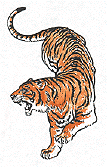
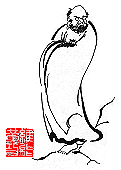
In China, however, crude methods of self existence gradually developed into highly refined methods of combat. Methods which reflected not only fighting tactics, but also the principles of psychology, physiology, medicine, physical therapy, and meditation. Many styles of Kung Fu revolve around the ideas of metaphysics and nature. Ancient boxing masters often developed their fighting techniques by observing the world around them. Animals, birds, and insects provided the basis for many systems of Kung Fu developed in the past. Other influential factors were the beliefs of Chinese philosophy an religion. The soft style of Tai Chi Chuan, for instance, is rooted to the teaching of Taoism. In addition to its value as a means of self defense, Tai Chi is highly beneficial for the promotion of good health. Through its training, one can attain inner peace and a sense of physical and emotional well being. For this reason, Tai Chi is often called Chinese Yoga: the art and science of meditation through movement. While the soft styles of Kung Fu derive their philosophy from Taoism, many of the hard styles trace their origin to the Buddhist monastery called Shaolin (Siu Lum in Cantonese). It was there that a mysterious Indian priest named Tamo established residence nearly 1500 years ago. According to legend, Tamo arrived at the Shaolin monastery where he found the monks in poor physical condition. Because of their inability to stay awake during meditation, Tamo introduced a series of 18 exercises designed to nourish both body and mind. These therapeutic movements are said to have merged with self-defense tactics studied in the Shaolin Temple. During his stay there, Tamo is also credited with introducing the Buddhist philosophy of Chan (Zen in Japanese) into China. The next major development supposedly occurred in the 16th century, when a wealthy young man named Kwok Yuen entered the monastery to study their methods of boxing. A skilled swordsman, Kwok Yuen not only mastered the Shaolin art, but expanded its fighting patterns into 72 exercises. Still yearning for greater knowledge, he left the Temple and traveled throughout China in search of other boxing masters. Eventually, he met two other experts: Pak Yook Fong and an old man named Li. The three retired to a monastery, where the 72 movements of Kwok Yuen were increased to 170. These techniques were then classified into five different animal forms: the dragon, tiger, leopard, crane, and snake. Thus was born Shaolin Kung Fu's "Five Form Fist." Although many details of the Shaolin art are not clear, records indicate that priests from the Temple proved themselves formidable fighters in many historical battles. Down through the centuries, therefore, the name Shaolin became renowned for the skill of its boxing monks. Behind the Temple walls, self discipline augmented technical skill. A rigid code of ethics was established to improve the caliber of Shaolin boxers. In addition to the development of fighting skill, therefore, humility, prudence, patience, and dedication became equally important in the Shaolin way of life.
For century after century, the secrets of Shaolin Kung Fu remained hidden within the Temple. When China was conquered by the Manchus in the 17th century, officials and supporters of the defeated Ming dynasty sought refuge at the monastery. Fearful of a possible uprising, the Manchu government launched several attacks on the Temple. During the final attack, legend says that the monastery was burned to the ground. Boxers who survived this raid, however, established new lives in the outside world, and in so doing, propagated the Shaolin art throughout the four corners of China.
|


 The origin of Kung Fu is lost in the pages of time. During prehistoric ages, the art of self defense was pretty much confined to man's own ingenuity. Throwing of rocks and wielding crude weapons such as clubs and stone axes were no doubt the earliest means of warding off primitive man's many enemies.
 Unfortunately, a great deal of Kung Fu's history is obscure. Because dates and details are often contradictory, much of what we hear today must be considered legendary.
 According to popular belief, boxers could only graduate by passing a harrowing life-or-death examination. The candidate was sealed in a specially designed labyrinth, which had only one exit—the front gate of the Shaolin Temple. As he worked his way through this maze, the boxer encountered deadly traps, armed dummies, and other lethal devices, all triggered mechanically. If he succeeded in reaching the exit, the potential graduate came face to face with one final obstacle—a huge red-hot urn. To gain his freedom, the Shaolin disciple would need to wrap his forearms around the smoldering object and move it aside. In so doing, he received on his forearms the formidable seal of two dragons—the sign of a Shaolin graduate.