



Fox to create series for wireless phones
“The Twentieth Century Fox studio” veut s’aventurer dans un nouveau domaine : la diffusion d’une de ses séries les plus populaires « 24 » sur les écrans des téléphones cellulaires.
D’après la compagnie « Twentieth Century Fox », ce concept sera diffusé sur le nouveau « high-speed wireless service » offert par Vodafone PLC, l’une des plus grandes compagnies de téléphones cellulaires sur le marché.
Teri Everett, représentant de « Fox Entertainment Group » a reconnu que c’est la première fois dans l’histoire que « Hollywood studio » accepte la diffusion d’une série télévisée via des téléphones cellulaires.
Appelées les « mobisodes », la compagnie Vodafone commencera à diffuser des épisodes de la série « 24 » à partir de janvier 2005 en Angleterre. Ils seront ensuite introduits en Europe et aux Etats-Unis un peu plutard.
De plus, «The deal is part of a broader agreement between Fox Entertainment Group and London-based Vodafone under which Fox, the entertainment unit of Rupert Murdoch's News Corp., will develop other programming to be viewed on the phones », affirme l’auteur de l’article.
En mars, Vodafone prévoit de lancer le « Vodafone live, with 3G » qui diffusera des bandes-annonces et des extraits de films par un service appelé « Movie of the month », mais également l’actualité, des informations sur le sport, la musique et les jeux.
On devrait absolument reconnaître le génie de cette invention. En effet, si une personne n’a pas la chance de suivre son émission préférée ou les informations à la télévision à une certaine heure, grâce à son téléphone cellulaire, elle pourra visionner son programme indépendamment de l’endroit où elle se trouve. Cependant, on se demande si dans quelques années ce genre d’invention représentera un danger particulier pour les taux d’audiences de la télévision ?
Pour plus d’informations, visitez l’adresse suivante: http://story.news.yahoo.com/news?tmpl=story&ncid=1293&e=10&u=/ap/20041111/ap_en_tv/fox_cellular_tv_series&sid=95573418
Nokia integrates handwriting technology into new product line
Nokia announced today that it has emerged as a competitor for current smart-phones, with the unveiling of its 7710 model. This phone, whose design is in widescreen format, will allow users to not only place cellula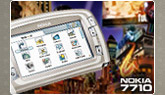 r calls, but also write on the phone with the help of a pen input, which will identify their handwriting and convert it into text messages.
The 7710 phone also includes email functions, VPN (virtual private network) software, 128 MB of memory, a digital camera with video playback, streaming and recording capabilities, a visual radio function that allows users to view information on the artist they are listening to, and eBook software that allows users to read and download eBooks via the Internet.
“Smart phones are now at the heart of the industry,” said Anssi Vanjoki, Nokia’s general manager of multimedia. “Mobility is a powerful force. Not only are smart phones reaching the mainstream, they are drawing on cross-industry technologies to spur further innovation.” Nokia has over the last several years been losing market share, and hopes this new line of multimedia products will help them establish themselves as the leader in the cellular marketplace once again.
The phone was among several others in the unveiling of its new product line at a news conference in Bangkok, Thailand. While pricing for the product was not announced, Nokia expects to begin distribution of the 7710 in Europe and Africa in the first quarter of 2005.
For more information, please visit: http://news.com.com/Nokia+phone+adopts+handwriting+recognition/2100-1039_3-5435327.html
Intel investit dans un nouveau projet de réseau sans-fil
Intel tente de développer un nouveau réseau sans-fil basé sur la technologie WiMax, qui fera compétition aux services haute-vitesse, câble et sans-fil. C’est dans  le but d’offrir un service plus rapide et plus puissant que Intel développe cette nouvelle technologie. Cette dernière utilisera la technologie WiMax déjà disponible, et les puces électronique fabriquées par Intel.
La technologie WiMax est une version plus puissante de la technologie Wi-Fi plus répandue. WiMax, comme Wi-Fi, permet de se connecter à Internet à distance, mais contrairement à Wi-Fi qui permet la connexion à l’intérieur de quelques centaines de mètres, WiMax possède un rayon de quelques kilomètres.
Les utilisateurs de la nouvelle technologie pourront ainsi se déplacer sur de plus grandes distances sans être déconnectés. Intel prévoit rendre son service disponible en 2006. Le nouveau réseau ne sera pas réservé exclusivement aux États-Unis, mais aussi à des régions plus souvent oubliées, comme le Mexique et l’Alaska.
Cette nouvelle technologie est une bonne nouvelle pour les consommateurs qui désirent avoir une connexion haute-vitesse sans-fil de qualité. Grâce au rayon définitivement plus large, elle améliorera la mobilité des utilisateurs. De plus, comme il est mentionné dans l’article, les technologies sans-fil possèdent cet avantage qu’ils ne nécessitent aucune construction pour l’installation de câbles.
Pour plus d’informations, visitez le lien suivant : http://www2.canoe.com/techno/nouvelles/archives/2004/10/20041026-143636.html
Keeping Electronic Pens Alive
When portable computers using electronic pens (like Microsoft Tablet PC) came onto the market, people were curious as to what they had to offer. The el ectronic pen replaced the mouse, and made it much easier to use the computers. However, they didn’t have much to offer besides the electronic pen, and even the pen could sometimes be a burden. To keep the electronic pen alive, researchers have created new software to improve this technology.
Dr Zhai from IBM has created a program named SHARK, or Shorthand-Aided Rapid Keyboarding. SHARK displays an on-screen keyboard which “places common letter combinations near one another in a hexagon grid”. The user writes words by tracing the pen on the on-screen keyboard and making shapes. Dr Zhai refers to these shapes as “sokgraphs”. Everytime the user traces a word, the shape will appear on screen. After a while, “you learn so much of the shape that it comes to mind and you can gesture it based on memory”. A scientist at Microsoft named Ken Hinckley has created Stitching, which allows people to exchange files easily with the stylus. In a meeting, if A wants to send a file to B without interrupting, A points flicks his stylus towards B and the file has been sent.
These tablet computers are good for those who dislike typing, and those who aren’t technologically savvy. It is difficult for a new user to type on a keyboard with ease, therefore the electronic pen makes it easier for them. Also, the portability aspect makes it more appealing to more people.
The article does not give us many details about the software, and makes SHARK sound quite complicated. Also, it is not mentioned how close you have to be for the Stitching software to work. Neither products have a price tag on them yet. I believe that in the future, no one will be writing anymore and everything will be typed. These Tablet PCs and electronic pens are great for now, but don’t offer anything new or exciting.
For more information, please visit: http://www.nytimes.com/2004/11/11/technology/circuits/11next.html?oref=regi
