



Qualcomm plans network to bring TV to cell phones
La compagnie Qualcomm, fabricante de puces électroniques, veut développer un réseau haute-vitesse pour pouvoir visionner des vidéos via le téléphone cellulaire. Le service pourrait, par exemple, envoyer des nouvelles en direct ou envoyer de l’information à propos des actions à la bourse aux clients qui en manifestent le désir.
Ceci se ferait avec l’intermédiaire des fournisseurs comme Sprint ou Verizon. L’espace disponible sur le réseau serait limité, mais la compagnie prévoit réserver certains espaces aux fournisseurs. L’avantage de ce service est que, contrairement aux services de visionnement déjà existants, le visionnement n’empêchera pas de recevoir des appels. Un prix abordable est prévu pour avoir accès au réseau. Le service sera disponible aux États-Unis et prévoit démarrer en 2006.
Ce service est une autre innovation qui permettra d’améliorer la mobilité des consommateurs. L’information convoitée pourra être livrée au client par le biais de son téléphone cellulaire et ce, en tout temps. Le service attirera sans doute plusieurs consommateurs grâce à son aspect pratique et à son prix abordable.
http://news.com.com/Qualcomm+plans+network+to+bring+TV+to+cell+phones/2100-1037_3-5435206.html?tag=cd
Microsoft teaming with Swatch to offer new wireless technology
Microsoft and Swiss watch-maker Swatch have combined forces to produce a wireless data service, through the form of a watch. Announced in late October 2004, the watches w ill offer news, sports, weather updates and stock quotes via Microsoft’s MSN Direct wireless data service. The new watches will also offer twice as many information channels as did previous Microsoft models.
Introduced as the “Paparazzi” line, the watches will also offer local entertainment updates through a partnership with publisher Time Out, as well as various The companies have announced that the watches will come with three levels of service. All watches will receive free local weather reports, news headlines and stock quotes. The second level of service requires a $40 annual commitment, which will provide users with more weather data, personalized news and sports scores, stock quotes and horoscopes. The third level of service requires a $60 annual commitment, and will provide users with all of the above, including the capacity to receive instant messages and calendar reminders from their PC, if they use Microsoft Outlook (much like a Blackberry).
“This is a new way of getting information,” Bill Gates, Microsoft's chairman and chief software architect, told a news conference. “It's glanceable information and it's a combination of the two things that I think people really care about--fashion, something that's fun and exiting, and technology that brings them personal information,” he said.
The Paparazzi line will be available for $150 US., and should be ready for distribution for the holiday season.
For more information, please visit:
http://wireless.newsfactor.com/perl/story/27825.html?count=18
Push-to talk : Bouygues Telecom choisit le reseau GPRS
L’opérateur mobile du groupe de BTP met en place un sy  stème de type talkie-walkie. Afin d’éviter les problèmes de saturation, il a préféré l’utilisation du GPRS, via la voix sur IP, au lieu du GSM « bas débit ».
Bouygues Télécom commence à vendre son service de « push-to-talk » appelé aussi « Instant Call », sur son réseau GPRS. Un porte-parole de l'opérateur explique : «Il n'y a pas de risque de saturation, car le service Instant Call ne perturbe pas le canal voix (GSM)». De même, l'utilisation du GPRS permettrait le développement de services de «push-to-vidéo».
Auparavant, cette technologie basée sur le principe du talkie-walkie était très utilisée dans des entreprises. L’auteur de l’article affirme : « Grâce à un combiné spécial, des employés peuvent facilement converser entre eux, en duo ou en conférence, en appuyant chacun leur tour sur le bouton de leur téléphone pour parler ». De plus, ce système permet de créer une liste de correspondants avec une connexion au réseau en temps réel.
L'opérateur mobile a pris comme exemple celui de l'américain Nextel aux Etats-Unis, qui a connu un grand succès avec son service de PTT utilisant le GPRS. La technologie du GPRS utilise le procédé de voix sur IP (VoIP) pour transmettre la voix. En revanche, c’est un procédé qui pose quelques problèmes à Nextel, car il ne permet pas aux utilisateurs d'écouter des conversations.
La police fédérale américaine a de ce fait réclamée aux fournisseurs de ce type de services des solutions pour élargir les interlocuteurs. Cependant en France, la question ne s’est pas encore posée.
L’ « Instant Call » est en collaboration avec Motorola, fournisseur de l'infrastructure et des combinés (le V400p). Son coût est de 25 ou 44 euros HT par mois selon le forfait proposé. Les communications sont illimitées en individuel et en groupe. Cette offre ne sera pas disponible au grand public avant 2005.
On peut facilement reconnaître les avantages du système « push-to-talk » par rapport aux fonctions d’un simple téléphone cellulaire. Cependant, il faudrait que les compagnies distribuant ce produit règlent les problèmes posés par l’impossibilité d’avoir des conversations avec plusieurs personnes en même temps et qui se trouvent à de longues distances.
Pour plus d’informations, visitez le lien suivant : http://www.zdnet.fr/actualites/business/0,39020715,39181954,00.htm
Monkey Business: Advancements in Prosthetic Limb Improvement
Scientist Andrew Schwartz from the University of Pittsburgh has been teaching monkeys to move a robotic arm with 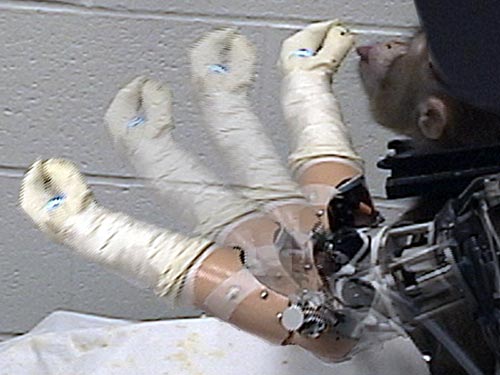 only their thoughts. The monkey’s arms are tied to his side, with a robotic arm attached to its shoulder. The monkey will think of a movement, and the robotic arm will complete the motion. For example, if food is placed in front of the monkey and it wishes to eat, the robotic arm will grab the food and bring it to him.
The movement of the robotic arm is the result of the monkey’s thoughts being interpreted through a computer. The computer reads the information passing through the motor cortex, the part of the brain that actualizes movement. The brain activity is “fed to a computer where an algorithm developed by the University of Pittsburgh interprets the neuronal messages and sends them to the robotic arm”.
Researches of the sort have been tried before, however Schwartz’ research is unique because of the “closed loop” aspect of the brain experiment. Schwartz had to teach the monkeys to identify the arm, and be able to control it voluntarily. Contrary to an “open looped” experiment, the monkey is completely conscious of the arm and its activity. Schwartz’ research demonstrates a real step ahead for amputees. If the research is a success, amputees will be able to use a robotic arm to function like a real limb. The robotic arm would need to be transformed into a more realistic limb, and it would be as though the amputee was never without an arm or leg.
If this is possible, then there may come a day where amputees will be able to feel and sense with their prosthetic limbs. John Donoghue of Cyberkinetics has taken his research to a different level. Instead of monkey’s, Donoghue uses quadriplegics and implants electrodes into their motor cortex. These researches help us understand the brain, and the great things it is capable of when partnered with technology.
For more information, please visit: www.wired.com/news/technology/0,1282,65468,00.html
