
 |
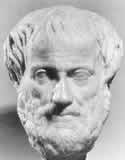
Aristotle |
|

1. Introduction
 In
contrast to Plato's stress on the intelligible world, the realm of the Forms
or Ideas, Aristotle turns back to the realm of the objects of sense perception,
and is conscious of doing so in reaction to the Plato's depreciation of the
same. Nevertheless, his years of association with Plato left Aristotle still
very much Platonic in his orientation and conclusions. Aristotle lived before
the age of specialization, so that he studied and lectured on every conceivable
topic: physics logic, biology, literary criticism, psychology, astronomy,
ethics, aesthetics, and metaphysics. What is now usually defined as philosophy,
a knowledge of reality in its basic structure, a study of being as being, Aristotle
sometimes terms first philosophy (a.k.a. metaphysics), although he uses the
term "philosophy" also for the study of first causes and principles. Moreover,
his Physics, to a large extent overlaps with what he defines as first
philosophy. Now, of course, little of what Aristotle wrote on the natural and
the life sciences is correct; in fact, the high esteem that Aristotle's works
had in the middle ages was blamed for delaying the development of modern science. Whether
what he says on first philosophy is correct is another question. Although one
can ignore his more specific and empirical works as irrelevant to his philosophical
views, there is no obvious starting point in expounding Aristotle's philosophy,
since it all hangs together as an organic unity. A key to understanding Aristotelian
philosophy is its central assumption that language reflects reality, in his
case Greek; an analysis of linguistic categories gives access to ontology, the
way things really are.
In
contrast to Plato's stress on the intelligible world, the realm of the Forms
or Ideas, Aristotle turns back to the realm of the objects of sense perception,
and is conscious of doing so in reaction to the Plato's depreciation of the
same. Nevertheless, his years of association with Plato left Aristotle still
very much Platonic in his orientation and conclusions. Aristotle lived before
the age of specialization, so that he studied and lectured on every conceivable
topic: physics logic, biology, literary criticism, psychology, astronomy,
ethics, aesthetics, and metaphysics. What is now usually defined as philosophy,
a knowledge of reality in its basic structure, a study of being as being, Aristotle
sometimes terms first philosophy (a.k.a. metaphysics), although he uses the
term "philosophy" also for the study of first causes and principles. Moreover,
his Physics, to a large extent overlaps with what he defines as first
philosophy. Now, of course, little of what Aristotle wrote on the natural and
the life sciences is correct; in fact, the high esteem that Aristotle's works
had in the middle ages was blamed for delaying the development of modern science. Whether
what he says on first philosophy is correct is another question. Although one
can ignore his more specific and empirical works as irrelevant to his philosophical
views, there is no obvious starting point in expounding Aristotle's philosophy,
since it all hangs together as an organic unity. A key to understanding Aristotelian
philosophy is its central assumption that language reflects reality, in his
case Greek; an analysis of linguistic categories gives access to ontology, the
way things really are.
2. Biographical Information
Aristotle was born in Stagira, a Greek colony
in Macedonia in 384 BCE and died in 322 BCE. At Stagira, Aristotle's father
was the personal physician to the King of Macedonia, Amyntas. In 367 BCE, Aristotle
became a pupil of Plato at the Academy in Athens, where he remained for over
20 years. Upon the death of Plato in 347, Aristotle had hopes of being
named as Plato's replacement as the director of the Academy, but was disappointed
in this. From 347 to 343 BCE, Aristotle traveled among the Greek islands and
Asia Minor. In 343 BCE, he accepted the invitation of Philip, King of Macedonia,
to become the personal tutor to his son, Alexander, who would later become known
as Alexander the Great. In 336 BCE, Philip was assassinated, and Alexander
succeeded his father as king. His tutoring days now at an end, Aristotle
left for Athens, where he founded his own school in the gymnasion called the
Lyceum; Aristotle's followers were sometimes called the peripatetics, probably
because Aristotle used to lecture peripatôs (walking) in covered
walkways or stoa. Upon Alexander's death in 323 BCE, Athens revolted against
Macedonian rule; Aristotle, being considered pro-Macedonian, fled to the city
of Chalcis, where he died the next year. What remains of Aristotle's writings
are his lecture notes, which are extensive; he wrote dialogues, as did Plato,
but these have been lost.
3. Philosophical Views
3.1. Epistemological Issues
3.1.1. The Categories
Aristotle recognizes that words are often used in different senses; this is particularly true of the verb "to be." Since the philosopher studies Being, it is essential to determine in which senses things can be said to be. Aristotle analyses ordinary language and categorizes ten ways in which something can be said to be, ten types of predicates (i.e., categories) that can be joined to a subject. In adopting this methodology, he assumes that language is isomorphic with reality: that the way we categorize our experience is a reflection of the things really are; many ancient philosophers, such as Parmenides or the Sophists, would not have granted this premise. The following is a list of the categories. (Categories 4; 1b 25 - 2a 8; Topics 1.9; 103b 20 - 104a 2)
1. Substance (ousia or ti estin): what x is in its essential nature, its definition. Aristotle differentiates two types of substances: primary substances, which are individual things, corresponding to proper nouns, and secondary substances, types of things, which correspond to nouns in general.
2. Quality (poion): x has the qualitative attribute of y, but y is not part of x's essence or definition.
3. Quantity (poson): x has the quantitative attribute of y, so that x is so large, so long etc.
4. Relation (pros ti): what x is in relation to y: x can be behind or beside y; x can also be compared y with respect to its attributes, being colder, redder, etc.
5. Place (pou): where x is located absolutely is y, but not relative to something else.
6. Time (pote): when x is y.
7, 8. Condition or state (kesthai): y is what x is doing, but not acting on another thing (a direct object); x is sitting, standing, etc. Condition and state differ in the permanence of x's acting, the former being less permanent.
9. Action (echein): what x is doing to y (direct object); x is cutting, running, etc.
10. Passivity (paschein): y is how x is being acted upon by another thing (passive voice); x is being cut, being read, etc.
The relationship between Categories 1 and 2-10 is one of subject (hupokeimenon) to predicate (katêgoroumenon); this is a basic grammatical distinction in language, reflecting the fact that this is how people think. Subjects are entities that can be defined; they have certain attributes and perform certain actions or are acted upon "accidentally," i.e., not as a function of their definition.
In Categories 5, Aristotle discusses the category of substance in more detail. He says, "Substance, in the truest and primary and most definite sense of the word, is that which is neither predicable of a subject nor present in a subject; for instance, the individual man or horse" (Categ. 5 2a11-13). That which is predicable of a substance (subject) is its higher or more universal classifications, the species and genera of a substance; these Aristotle calls secondary substances, whereas the individual thing is a primary substance. One could call this predication within a category. For this reason, one could call this a transitive relation, for these predicates exist in a hierarchy of the less to the more universal, so that, if B is predicated of A and C is predicated of B, it follows that C is predicated of A. For example, if Socrates (A) is a man (B) and a man (B) is an animal (C), then Socrates is an animal. What is predicable of a subject (or substance) is essential to that subject. That which is in a subject is an predicate of the substance, but such predicates are not part of the definition or essence of the subject, i.e., not predicable of the subject, and do not exist without the subject. Thus, a predicate that is in a substance does not belong to the category to which the substance belongs, so that one could call this cross-categorical predication. Aristotle says that this type of predicate belongs to the substance refers to this type of predicate as "not as a part, and cannot exist separately from what it is in" (Categ. 1 1a24). Aristotle gives the example of the predicable "white": "For instance, 'white' being present in a body is predicated of that in which it is present, for a body is called white: the definition, however, of the color 'white' is never predicable of the body" (Categ. 2a 31 - 34). Nevertheless, color is of white, because white belongs to the genus of color. Aristotle remarks about primary substances, the individual things to which other things are predicated: "Primary substances (prôtai ousiai) are most properly called substances in virtue of the fact that they are the entities which underlie everything else, and that everything else is either predicated of them or present in them" (Categ. 2b 15 - 18). What is predicated of a primary substance is a universal or secondary substance and what is said to be in a substance is an accident (sumbebêkos), a non-essential predicate. Another feature of a primary substance is the fact that each is numerically one and capable of admitting contrary qualities at different times (see Categ. 3b 24 - 26; 4a 10 - 12). An individual man can be hot one day and cold the next; contrary qualities can be predicated of him, the individual, which underlies its predicables. (Categories 5; 2a 11 - 4b 20)
In Categ. 2, Aristotle makes a four distinction ontological distinction that is, of course, reflected in language.
What is predicable of is a universal, a secondary substance, whereas what is not predicable of is a particular, a primary substance. On the other hand, what is said to be in a thing is a non-substance, whereas what is not said to be in a thing is a substance. The third classification is probably the most difficult to understand, because Aristotle differentiates between a universal non-substance and a particular non-substance. The former can be predicated of the latter, but the latter can only be in a substance. In other words, the former is a more general genus to which the latter belongs, as grammar belongs to the genus knowledge.
It
should be noted again that Aristotle assumes that language is isomorphic with
reality. Grammatically, the subject has logical priority over the predicates,
since the latter cannot exist without the former. From grammatical or logical
priority, Aristotle moves to ontological priority; he can do this because he
assumes that language is isomorphic with (corresponds to) reality. Thus
an individual thing, what Aristotle calls a primary substance, has ontological
priority over what can be attributed to it.
| Do you agree with Aristotle
that the structure of language reflects the structure of Being?
If not what is the relationship between grammatical categories and the
way things really are? |
3.1.2. Posterior Analytics
In his Posterior Analytics, Aristotle expounds on the nature of knowledge (epistemê). (Often epistemê is translated as "scientific knowledge.") He holds that reality exhibits an hierarchically-ordered structure, so that a thing (defined by its essential nature) is classifiable according to a multi-leveled system of classification, moving from lower to higher degrees of abstraction. For example, let's say a particular thing is identified as a tree, which means that it is defined as a tree, as belonging to the species or classification of tree; but, because a tree belongs to the genus of plant, which belongs to the even higher genus of living thing, then that particular tree or any tree must be both plant and living thing. Thus to know that a particular thing is a tree is know that it is a plant and that it is a living thing. Whatever is true of the genera to which a particular thing or a lower genus or species belongs is true of that particular thing or lower genus or species. It follows that, according Aristotelian epistemology, whatever is known is known necessarily and universally, since to know is to know how a thing is to be classified, which classification is universal and necessary. Likewise, it follows that there can be no knowledge of a thing understood according to its accidental qualities, since these do not express the essence of a thing, according to which it is situated in the generic hierarchy of being. The fact that a particular tree, for instance, happens to have a clothes line attached to it is accidental or merely coincidental of that particular tree and any other tree with clothes lines attached to them; to have a clothes line attached to it is not part of the definition of tree, which explains why having a clothes line attached to it is not necessarily and universally predicable of the species tree.
For Aristotle, knowledge is deduction ultimately from non-demonstrated premises. He defines knowledge (epistemê) as follows, "We suppose ourselves to possess unqualified knowledge of a thing, as opposed to knowing it in the accidental way in which the sophist knows, when we think that we know the cause on which the fact depends, as the cause of that fact and of no other, and, further, that the fact could not be other than it is (1.2. 71b). To know a fact is to know the explanation or cause (aition) of the fact, what makes the fact necessarily what it is. The explanation or cause of a fact, expressed propositionally, turns out to be some type of necessary and universal connection between the subject and predicate of a proposition. According to Aristotle, no knowledge would be possible without non-demonstrated premises because these are ultimately the source of knowledge. These non-demonstrated premises seem to be axioms, or necessary truths. He sometimes calls these non-demonstrated premises archai, and in one passage say this about them, "Assuming then that my thesis as to the nature of scientific knowing is correct, the premises (archai) of demonstrated knowledge must be true, primary, immediate, better known than and prior to the conclusion, which is further related to them as effect to cause" (Anal. Post. 1.2. 71b). The premises obviously must be true to be the cause of knowledge. In addition, they must be function as the starting part of all knowing, which is meant by primary (prôton) and immediate (amesos). A premise is primary if there is no prior premise from which it derives; it is immediate if there is no middle term between the subject and predicate of the premise that explains and justifies the connection between them. For an archê to be prior to the conclusion means that the conclusion depends upon it. He also says that these archai are "better known than...the conclusion," by which he means that they are more universal, for the universal is better known than conclusions. If there were no non-demonstrated premises there would be an infinite regress of syllogisms, never terminating in a premise that itself needs no demonstration or one would be involved in circular reasoning, in which one deduces a premise from one of its consequences. For this reason, Aristotle affirms, "Not all knowledge is demonstrative: on the contrary, knowledge of the immediate premises is independent of demonstration" (Anal. Post. 1.3 72b). Some of these non-demonstrated premises will be shared by all sciences, while others will be particular to the science concerned. Each academic discipline (or science) begins with non-demonstrated premises, from which it proves syllogistically the many assertions of truth particular to it.
Beginning ultimately from the non-demonstrated premises or axioms, one deduces other true propositions by means of syllogism, and this is what Aristotle calls demonstration (apodeixis). For him, to know something is to demonstrate it, which means to deduce it from true premises. In other words, demonstration is the capacity to situate a thing in the generic hierarchy to which it belongs; it is to justify the connecting of a predicate to a subject by showing that a subject necessarily belongs to a genus which has the predicate being attributed to it. According to Aristotle, demonstration is a process that reveals the cause or explanation (aition) of something, why the predicate belongs necessarily to the subject. Determining the the cause or explanation begins with the fact that a predicate belongs to a subject (C is predicated of A); this is simply empirical observation and the connection between the two is not yet known to be necessary. But merely to note that a predicate belongs to a subject is not to know the the cause or explanation of this fact. Rather, to determine the the cause or explanation of the fact that C is predicated of A is to find a middle term that connects to both A and C: since B is predicated of A and C is predicated of B, it follows that C is predicated of A. The middle term, B, is the the cause or explanation of the necessary and universal pairing of subject A with predicate C. In other words, one explains why every A is C by finding a middle term, B, such that necessarily, CaB and necessarily, BaA. Aristotle writes, "Demonstrative knowledge must be knowledge of a necessary nexus, and therefore must clearly be obtained through a necessary middle term; otherwise its possessor will know neither the cause nor the fact that his conclusion is a necessary connection" (Anal. Post. 1.6). For example, let says that one has noted through repeated observation that cows nurse their young. One then seeks to explain why it is the case that cows nurse their young. That is, why does A belong to C? The explanation of why cows nurse their young is that they are mammals and mammals are defined, in part, as animals that nurse their young. Thus, C (nurses their young) is predicated of A (cows) because B (being a mammal) is predicated of A (cows) and C (nurses their young) is predicated of B (being a mammal). In other words, cows nurse their young because they are mammals; that is, mammals, by definition, and therefore necessarily, nurse their young. In this case, explanation consists in finding a genus—mammal—to which a species—cow—belongs; the genus mammal is defined in part by the predicate "nurse their young," which is exactly what one has observed cows doing. It must be emphasized that, as mammals, cows necessarily and universally nurse their young; this type of predicate is what Aristotle calls a commensurately universal attribute. He explains, "I term 'commensurately universal' an attribute which belongs to every instance of its subject, and to every instance essentially and as such; from which it clearly follows that all commensurate universals inhere necessarily in their subjects" (Anal. Post. 1.4. 73b). Thus if B is the explanatory middle term between A and C, then the proposition "Necessarily, Abc" is convertible, which is to say, the proposition "Necessarily, Acb" will also be true. In the example given, if a mammal nurses its offspring (Abc), then necessarily what nurses its offspring is a mammal (Acb).
In Anal. Post. 1.13, Aristotle explores in more detail concerning the difference between what he calls a fact and a reasoned fact or knowing that (hoti) something is the case and knowing why (dioti) it is the case. The middle term of a syllogism must provide an explanation or cause of the fact that the predicate belongs necessarily and universally to the subject, not simply to prove that it that it does. He gives two examples of sylllogisms, one whose middle term does provide the explanation or cause and one that does not. It is an observed fact that the planets (A) do not twinkle (C). Why the planets do not twinkle is provided by the middle term: because they are near (B). This can be expressed as a syllogism:
Every planet is near (Aab).
Everything near is a non-twinkler (Abc).
Therefore, every planet is a non-twinkler (Aac).
The middle term, "near," provides the explanation or cause for why the planets do not twinkle. (As such Abc is convertible with Acb: everything near is a non-twinkler and every non-twinkler is near.) Aristotle formulates another syllogism from the same elements, however, that does not provide the reason why but merely deduces that something is the case.
Every planet is a non-twinkler (Aab).
Every non-twinkler is near (Abc).
Therefore, every planet is near (Aac).
In this syllogism the middle term is "non-twinkler." What is deduced is the fact that every planet is near, based on the known facts that every planet is a non-twinkler and that every non-twinkler is near. What the syllogism does not do is provide the explanation or the cause of the fact that every planet is near. It is not the fact that every planet is a non-twinkler that is the explanation or cause of the fact that every planet is near. The characteristic of being non-twinkling is a correlate of being near but is not the explanation or cause of it. In other words, whereas being near is a cause of non-twinkling, non-twinkling is not a cause of being near.
Aristotle stresses that induction (epagogê) is the origin of the first non-demonstrated premises themselves, not known through deduction; on the basis of experience, which consists of remembered perceptions, one comes to ascertain universals. Such universals are not known intuitively or innately. He writes, "Thus it is clear that we must get to know the primary premises by induction; for the method by which even sense perception implants the universal is induction" (Anal. Post. 2.19). For example, the repeated perception of eating sugar would lead to the universal assertion that sugar is sweet: sweetness thus forms part of the definition of sugar. This is not demonstrative knowledge, however, because these universal assertions are non-demonstrable, since they are ascertained inductively rather than deductively. They are perceived by mind (nous) operating on remembered perceptions. To have knowledge (epistemê) is to understand how all empirical facts fit into the unified system of the generic classification of reality. For example, the proposition "Sugar is sweet" requires an explanation or cause (aition), which consists of discovering a middle term which is a genus to which sugar belongs so that it has necessarily and universally the property of sweetness.
3.2. Physics
3.2.1. Introduction
As a background to Aristotle's view of motion, hearken back to Parmenides who claims that motion is illusory. He argues that for there to be becoming something must either come to be what it is from something or from nothing. The latter is not possible because only nothing comes from nothing, not something; the former is not possible because if something comes from something it must already be. Thus, Parmenides concludes that the senses deceive a person into believing that change occurs. Aristotle is not, however, convinced by Parmenides's arguments, because he rejects the latter's epistemological point of departure. Aristotle has greater confidence in the senses as a means by which reality might be known; in other words, he has an empiricist orientation. He writes, "We physicists, on the other hand, must take for granted that the things that exist by nature are, either all or some of them, in motion which is indeed made plain by induction" (see Physics 1.2; 185a; 2.1 193a; 8.3 253a-b). In Physics, he sets out to demonstrate the possibility and nature of motion change is possible; one could say that he aims to give credibility to the common sense belief that motion is real.
| |
Aristotle's Physics is a study of "nature" (phusis). His understanding of nature, however, is a little difficult to grasp. Aristotle defines nature as "a principle (archê) source or cause (aitia) of being moved and of being at rest in that to which it belongs primarily, in virtue of itself and not in virtue of a concomitant attribute" (Physics 2.1; 192b). In other words, "nature" is that whereby something either moves or comes to rest having been in motion according to its essential nature, rather than accidentally. A thing may move accidentally if that motion is not the result of its essence, whch means that it was not "natural" for the thing to be moved in that way. The difference in meaning between "principle" (archê) and "cause" (aitia) is unclear, and, in fact, they seem to be synonyms, in which case "nature" is a designation for that which causes things to be changed. (Motion means change, not simply locomotion). Nature as a principle or cause is said to be within things, serving as the principle or cause of its motion and coming to rest. Later in Physics, Aristotle affirms that "Nature is everywhere the cause of order" (Physics 8.1; 252a). From such a statement, one can infer that the motion of which nature is the principle and the cause produces change regularly and predicably. His understanding of nature precludes randomness; rather, nature as a principle of motion is different in each thing and aims to arrive at a particular completed state. As Aristotle puts it, "It is plain then that nature is a cause, a cause that operates for a purpose" (Physics 2.8. 199b). Things that have "a nature" have such a principle or cause of motion; these include animals and their parts, plants and simple bodies (earth, fire, air and water). Excluded are manufactured objects as manufactured; as composed of something that has a nature, however, a manufactured object can be studied by the physicist (e.g. a bed as made of wood but not as a bed). In summary, the study of "nature" is the study of the totality of objects that have magnitude (megethos) and have a principle of motion or rest within themselves. (As Aristotle uses the term, to have "magnitude" is to be a physical body.)
Aristotle considers "nature" (phusis) both with respect to a thing's first matter (prôtê hulê) and its form (morphê). He says that nature is "the first material substratum (hê prôtê hekastô hupokeimenê hulê) of things which have in themselves a principle of motion or change" (Physics 1.2; 193a). He means by this statement that the matter of which a thing is composed, or its first matter, in the sense of its most immediate, determines in which ways and under which conditions it can be changed. For example, if a wooden bed sprouted when put into the ground it is the nature of the bed as wood, or the matter of the bed, that is the principle of the change undergone by the bed. It is the nature of wood to grow under certain conditions. That the wood has the form of a bed is accidental or incidental with respect to its nature. Aristotle points out, however, that another way of understanding "nature" is to identify it with the "form" (morphê) of a thing. He writes, "The form indeed is 'nature' rather than the matter; for a thing is more properly said to be what it is when it has attained to fulfilment than when it exists potentially" (Physics 2.1; 193a). A thing is said to be what it is on account of its form and not its matter, and as such it has a nature. For example, what is only potentially flesh or bone, that is, that of which flesh and bone are composed, is not flesh or bone, since the form is lacking. It seems that Aristotle believes that one can view the "nature" or principle and cause of change of a thing as both its matter and its form. The physicist knows the nature of a thing in both senses, matter and form, since that thing is "neither independent of matter nor can be defined in terms of matter only" (Physics 2.2; 194a). How a thing can and will change will be determined by both its matter and forms. The inclusion of both a thing's matter and form with respect to a consideration of its nature will have implications for Aristotle's theory of causation.
3.2.2. Motion as Consisting of Three Principles
In Book One of Physics, Aristotle explores the principles of motion. By principles, he means that which ultimately is the causes of motion. He acknowledges that he cannot enter into conversation with the likes of Parmenides and Melissos, since they deny that there are any principles of motion, insofar as they deny that motion exists; rather he begins from the assumption that some things are in motion (Physics 1.1; 184b-185a). Among those of his predecessors whom he calls the "physicists," Aristotle identifies two views: either that the underlying body or first material principle is one, from which multiplicity results through rarefaction and condensation, or that the contraries are already contained in the one and emerge from it by separation. He rejects the former view in favor of the latter. Aristotle commits himself to the position that the the principles of motion are contraries. That is to say, motion occurs when one contrary (or its intermediate) changes into another contrary (or its intermediate), as white comes from the non-white or black; the contraries, as principles, are not produced from one another nor from something else, which is what makes them principles (Physics 1.4-5). In addition to the two contraries, there must exist a third thing, a substratum in which the contraries inhere; contraries cannot act upon each other to produce motion, since each contrary cannot become its opposite or an intermediate; a third principle is required: a substratum that, while sustaining motion, remains the same thing before, during and after the motion. (Physics 1.6; 189a - 189b) The principles of any motion, therefore, are three: a substratum and two contraries, each the privation of the other. As will become evident, what Aristotle describes is motion in a narrower sense, or what he calls kinêsis.
Later in Physics 1, Aristotle explains that a substratum itself can also come into being. He argued previously that any change presupposes a substratum of change, that which persists through the change; this type of change is the "coming to be so and so," or accidental change. There is, however, a second type of change: "coming to be in an unqualified sense," or substantial change (Physics 1.7; 190a 34 - 190b 4). In this kind of change, an individual thing comes into being, not from nothing, but from some substratum or "matter." Aristotle draws an analogy: "The underlying nature is an object of scientific knowledge, by an analogy. For as the bronze is to the statue, the wood to the bed, or the matter and the formless before receiving form to any thing which has form, so is the underlying nature to substance, i.e. the 'this' or existent" (Physics 1.7; 191a 8-12). For example, a carpenter may make a bed, a substratum or individual thing that has not existed before; but it did not come into existence from nothing, but from a another substratum (matter or substance), i.e., a piece wood.
Aristotle then identifies five types of changes: Generally things which come to be, come to be in different ways: (1) by change of shape, as a statue; (2) by addition, as things which grow; (3) by taking away, as the Hermes from the stone; (4) by putting together, as a house; (5) by alteration, as things which 'turn' in respect of their material substance. (Physics 1.7 190b) (How these five types of change relate to the three type of change--qualitative, quantitative and locomotion--discussed later in Physics 3.1; 201a is not explained.) What each of these five types of change have in common is that "these are all cases of coming to be from a substratum." He means that in each case, change is the result of a substratum or subject undergoing change. From this he concludes that all whatever comes to be in a change is a complex. He writes,
Thus, clearly, from what has been said, whatever comes to be is always complex. There is, on the one hand, (a) something which comes into existence, and again (b) something which becomes that-the latter (b) in two senses, either the subject or the opposite. By the 'opposite' I mean the 'unmusical', by the 'subject' 'man', and similarly I call the absence of shape or form or order the 'opposite', and the bronze or stone or gold the 'subject'.
The product or result of any change is a complex or compound consisting of something that changes but remains the same and that new thing that comes into existence as a result of the change. In other words, all change presupposes a substratum, for without this, there would be no change, because changes requires that something remain self-identical through the process of change. But there are two types of substratums, corresponding to the two types of change: accidental and substantial. Aristotle provides two examples of what he means; for both examples, he identifies what he calls the subject and the opposite in the change. The man who, formerly unmusical, becomes musical is an example of change in which the subject, the man, assumes the opposite attribute, musicality. In another example, the subject is identified as bronze, stone or gold and the opposite is the absence of shape or form of the statue that is about to come into existence. In this example, the subject of the change consists of that which the statue is made (what elsewhere in Physics Aristotle calls the material cause) and the opposite is the shape or form that the shapeless or formless bronze or stone or gold receives in the process of becoming a statue. The first example of a man becoming musical is an example of what he called "coming to be so and so," or accidental change, whereas the second example is "coming to be in an unqualified sense" (generation), or substantial change. That is to say, in the first example, the substratum is the substance man, whereas in the second example the subject is the matter that receives a shape or form.
It should be pointed out that "coming to be in an unqualified sense," or substantial change, does not cohere well with Aristotle's discussion of substance in the Categories, where substance is defined as "that which is neither predicable of a subject nor present in a subject" (Categ. 5 2a11-13). Accidental change or "coming to be so and so" is consistent with the analysis of substance in Categories, because substances are ontologically primary, persisting through the process of change. But the generation of a substance from a substratum, or material cause, implies that substance is not ontologically primary, but derivative of the "subject" and the "opposite," the two components of any product of change, in this case the matter and the form. (Indeed, the fact that Aristotle says that "whatever comes to be is always complex" implies that substance, that which comes to be, is ontologically secondary.) It seems that, to be fully consistent, Aristotle should say that substances should never come into being or perish; for only on this condition can they be ontologically primary. But such a position would contradict empirical observation, the foundation of Aristotle's views on motion.
3.2.3. The Four-fold Nature of Causation
As Aristotle explains in Anal. Post. (71b 9-12; 94a 20), to know a thing is to know its causes. (Causes seems to be used synonymously with principles.) In Physics 2.3, he delineates four such causes (aitiai), what have come to be known as the material, formal, efficient and final causes (see Physics 2.7 198a). This four-fold causation theory was tremendously influential in mediaeval philosophy and theology and even after the mediaeval period Aristotle's influence was still felt. A thing is what it is by virtue of four causes; to know a thing is to know these four causes. These four causes explain all things that have a nature, or all things that have within themselves a principle of motion and rest. In Physics 1.4-5, Aristotle uncovered three principles of motion, the substratum and the two contraries (a quality or form and its privation). Leaving out of consideration the privation of the contrary, he joins to these two internal constitutive causes two other external causes. The substratum is the material cause, whereas the positive contrary is the formal cause. (Even earlier, in Physics 1.2, Aristotle affirmed the necessity of considering a thing's matter and form when identifying its nature.) To these are added two external causes, the efficient cause and the final cause. (Physics 2.3; 194b 16 - 195a 25). He points out, however, that often the formal, efficient and final causes are identical: "The last three often coincide; for the 'what' and 'that for the sake of which' are one, while the primary source of motion is the same in species as these (for man generates man)" (Physics 2.7 198a). In other words, in the case of a "natural" thing, its formal and final causes are the same insofar as the final cause is simply for the thing to be what it is formally. Likewise, its efficient cause is the same because it originates from another of the same species (Physics 2.7; 198a).
The material cause of something is "that out of which a thing comes to be and which persists." In other words, it is that of which the thing is composed. Aristotle gives the example of bronze as the material cause of a statue. It is important to note that Aristotle intends matter or material cause in a relative sense: matter is relative to form, since it is that in which a form inheres, the substratum of a form. For example, the material cause of a table is wood, but the material cause of wood is cellulose, which, no doubt, has its own material cause. "Prime matter" or matter without form is only a theoretical construct, since matter does not exist apart from form. Included in the material cause is the genera in which the material is included; these genera are predicable of the bronze. The genus of bronze is metal, so that metal can be said to be the material cause of a statue. But the material cause does not have to be something corporeal; the material cause of a song, for example, is sounds.
Something is what it is because it has a certain form (eidos) or structure; in other words, it has a formal cause. Aristotle says, "In another sense the form or the archetype, i.e. the statement of the essence, and its genera, are called 'causes'...and the parts in the definition." That which makes something what it is in terms of its definition or classification is the formal cause. (Plato, similarly, refers to the participation of individual things in the forms.) A table is not simply the wood out of which it is made; it is a table insofar as it has the form or essence of tableness, i.e., that the wood is organized in such a way as to become a table; likewise a song is not simply sounds but the organization of the sounds in a certain sequence. The genera to which the formal cause belongs is also part of the formal cause. For instance, the formal cause of a table is not simply the form of table, but the higher genus of furniture and all other higher genera.
The third cause is the efficient cause. It is through the agency of something that another thing becomes what it is. Aristotle calls this cause, "the primary source of the change or coming to rest...what makes of what is made and what causes change of what is changed." The agent or instrument that causes something else to be what it is, is the efficient cause. Aristotle gives the example of the man who gives advice to another and the father who begets a son: in both cases an external cause is responsible for the becoming of something else. To use a simpler example, the efficient cause of a table is a carpenter, and the efficient cause of a song is the song writer.
The final cause is the end or goal towards which something moves. Aristotle says, "Again in the sense of end or 'that for the sake of which' a thing is done, e.g. health is the cause of walking about. ('Why is he walking about?' we say. 'To be healthy', and, having said that, we think we have assigned the cause.)" Now the assignment of final causes is readily applicable to human activity or production, since, in such cases, the final cause is defined by the intention or the "for the sake of which" something is done or produced. But, as applied to things that have "a nature," as defined above, it is not so obvious how there can be final causes. For Aristotle, with respect to the objects studied by the physicist, the final cause is coincidental with the formal, so that the end or goal towards which something tends is to become what it is formally, to actualize its formal potentiality. Thus the final goal of a tree is be fully a tree. Moreover, Aristotle believes that the four elements have a natural place in the cosmos, so that it is their final cause to be in that place.
3.2.4. Teleology in "Nature"
Aristotle affirms that the regularity and mutual adaption in nature (or things that have a nature) is an indication of teleology. He understands "nature" on analogy with the world of human production, where things are designed and created to serve purposes. In other words, things happen (motion) for the sake of something else. The form of some "natural" object defines its end or its "for the sake of which." Aristotle explains, "And since 'nature' means two things, the matter and the form, of which the latter is the end, and since all the rest is for the sake of the end, the form must be the cause in the sense of 'that for the sake of which'" (Physics 2.8; 199a 30-34). What he means is that every thing defined according to its form or essence exists for the sake of something, i.e., has a "natural" end or purpose: function follows form. For example, the leaves of a plant defined according to their form or essence (as opposed to it matter or of what it is made) exist for the sake of providing shade for the fruit of the plant (or some other purpose consistent with their distinction form). Aristotle conceives "nature" as having order and intelligence, an integrated system, as if it were designed: "Now surely as in intelligent action, so in nature; and as in nature, so it is in each action, if nothing interferes. Now intelligent action is for the sake of an end; therefore the nature of things also is so....If, therefore, artificial products are for the sake of an end, so clearly also are natural products" (Physics 2.8; 198b 12-19). He rejects what could be called an ancient version of the theory of evolution (associated with Empedocles), in which some random changes were coincidentally adaptive to a beneficial end. He concludes, "It is plain then that nature is a cause, a cause that operates for a purpose" (Physics 2.8; 199b). Nature is the cause of motion, but that motion is always purposeful, which is to say intelligent, for "Intelligent action is for the sake of an end" (2.8; 199a). (Physics 2.8; 198b 10 - 199b 33)
| How does Aristotle's
view of natural teleology compare with the theory of evolution?
Does Aristotle's position lead inevitably to the argument for the existence
of God from design, the teleological argument? |
3.2.5. Motion
Aristotle insists that "There is no such thing as motion over and above the things. It is always with respect to substance or to quantity or to quality or to place that what changes changes" (3.1. 200b33). He seems to be taking aim at Plato's theory of Ideas in this statement, insofar as he is denying the existence of the Idea of motion existing apart from things that are in motion. He resolves the problem of how something can become something else inherited from his predecessors by differentiating between the potentiality (dunamis) and actuality (entelecheia) inhering in a substratum or matter. He defines motion (kinêsis) as "the fulfillment of what exists potentially, insofar as it exists potentially" (Physics 3.1; 201a 10-12). A thing is in a state of actuality, meaning that it is what it is, but it also is potentially something else. Its potentiality is, as it were, an attribute of thing as actual. Aristotle explains further, "It is the fulfilment of what is potential when it is already fully real and operates not as itself but as movable, that is motion. What I mean by 'as' is this: Bronze is potentially a statue. But it is not the fulfilment of bronze as bronze which is motion. For 'to be bronze' and 'to be a certain potentiality' are not the same" (Physics 3.1; 201a). The actuality of a thing as movable, that is to say, its potentiality as moved, is motion. Potentiality inheres in a thing and it is the thing as this potentiality in the process of being actualized that can be said to be in motion. For example, a green tomato has the potentiality to be a red tomato. The actualization of its potentiality to be red is motion, in particular, alteration from being green to being red. Aristotle explains further, "We can define motion as the fulfilment of the movable as movable, the cause of the attribute being contact with what can move so that the mover is also acted on. The mover or agent will always be the vehicle of a form, either a 'this' or 'such', which, when it acts, will be the source and cause of the change, e.g. the full-formed man begets man from what is potentially man" (Physics 3.2; 202a). A thing as movable is moved by contact with an efficient cause, or a mover. The mover becomes the means by which a form comes to inhere in the moving and then moved thing. It is the actualization of the thing as movable through its contact with an efficient cause that is motion. Aristotle would agree with Parmenides and Melissos that being does not come from non-being in an unqualified sense. But he asserts that being comes from non-being in a qualified sense as the actualization of a potentiality; potentiality is qualified non-being. In this way one can say that something both comes and does not come from something else: it comes from the potentiality inherent in something but does not come from what is actually existing.
In Physics
3.3, Aristotle considers the case of motion that is a single actuality consisting
of the realization of two distinct potentialities, those of a thing capable
of causing motion and a thing capable of being moved. He writes, "A thing
is capable of causing motion because it can do this, it is a mover because it
actually does it. But it is on the movable that it is capable of acting. Hence
there is a single actuality of both alike" (Physics
3.3; 202a). According to Aristotle, the actualities of the agent and the patient
are the same actuality, insofar as they are co-dependent and interactive; thus
the same actuality is in both mover and moved. Aristotle gives the example of
teaching and learning: the teacher actualized in teaching acts upon the learner
actualized in learning in a single actualization of teaching/learning. The two
actualizations are not, however, the same in definition (logos), that
is, they are not the same thing. The agent's acting upon the patient is different
in definition from the patient's being acted upon by the agent. So a learner
learning is not the same as a teacher teaching. He writes "To generalize,
teaching is not the same as learning, or agency as patiency, in the full sense,
though they belong to the same subject, the motion; for the 'actualization of
X in Y' and the 'actualization of Y through the action of X' differ in definition
(logos)" (3.3. 202b). While it is true that to one motion belongs
two actualizations, these actulizations are not the same thing.
| Does Aristotle's introduction
of the categories of "potentiality" and "actuality" really solve the
problem of how something can come to be? Or is he merely systematizing
the common sense viewpoint? |
Later, in Physics Aristotle narrows his definition of motion (Physics 5.1. 224a-225b). He differentiates three types of motion: accidental, partial and essential. (The same is true of movers: some cause motion accidentally, some partially and some essentially [Physics 5.1. 224a].) In accidental motion, something changes but the motion is merely accidental or incidental. In other words, accidental motion is motion that is not included within the potentiality for motion according to the essence of the moved. He gives the example of saying that something musical walks. Since it is not essential to the definition of "musical" that those who possess this attribute are able to walk, to say that a musician walks is to attribute an accidental or incidental attribute to a man as musical; a musician needs neither to be able to walk or not to walk to be a musician. (On the other hand, if one said that a biped walks, such motion would be essential, since it is of the essence of being a biped to walk, which is defined as locomotion using two legs.) Partial motion is of the type in which one can say that something changes when one part of it does so. Aristotle gives the example of saying that the whole body is restored to health when really only one part of it—such as the eye or the chest—is restored to health. Essential motion results when something as what it is changes. The essence of a thing includes a range of potentialities; the realization of one or more of these potentialites is essential motion. In such cases, change is always between contraries, between a contrary and an intermediate or between two intermediates. He also calls this a change from subject (hupokeimenon) to subject, by which he means that a subject or substratum changes in some respect but remains the same subject: the subject or substatratum is present before, during and after the change. This Aristotle defines as motion proper or kinêsis, as opposed to change or metabolê, defined as generation (genesis) and destruction (phthora) (Physics 225a-b; 229b30-230b-20). He excludes not only accidental and partial motion as true motion, but also the movement from non-subject to subject and subject to non-subject, what one may call substantial change. Substantial change is not from contrary to contrary in the same substance.
With respect to motion proper there are three types of motion. Reflecting on his ten categories, Aristotle determines that motion proper is solely with respect to quality (kinêsis kata to poion or kata pathos), quantity (kinêsis kata to poson or kata megethos) and place (kinêsis kata to pou or kata topon). (see Physics 3.1; 201a). Motion must be of a single subject from one contrary to another or from one immediate between the contraries to another; in other words, motion is change along a continuum with the two contraries occupying the opposite poles. For this reason, according to Aristotle, all change except that of quality, quantity and locomotion is excluded as motion proper: "Since, then, motion can belong neither to Being nor to Relation nor to Agent and Patient, it remains that there can be motion only in respect of Quality, Quantity, and Place: for with each of these we have a pair of contraries" (Physics 5.2; 226a 24 - 26). Motion with respect to quality Aristotle terms "alteration": "Motion in respect of quality let us call alteration, a general designation that is used to include both contraries: and by quality I do not here mean a property of substance (in that sense that which constitutes a specific distinction is a quality) but a passive quality in virtue of which a thing is said to be acted on or to be incapable of being acted on" (Physics 5.2; 226a 26 - 30). Motion with respect to quality takes place non-accidentally or essentially, by which is meant, that it is motion in accordance with the definition of the thing, and must be from one contrary or intermediate to the other contrary or intermediate. He points out quality is that in virtue of which something else (an efficient cause) can act upon the thing to produce qualitative motion. Later Aristotle explains, "Change within the same kind from a lesser to a greater or from a greater to a lesser degree is alteration" (Physics 5.2; 226b 1 - 2). For example, a frying pan exists to be used as a means of cooking; thus, it can (and is intended to) move from one contrary, being cold, to the opposite contrary, being hot (or some intermediate between cold and hot) by the application of fire (its efficient cause); when this happens one has qualitative change. The quality of a frying pan in this respect is its capacity to be heated and cooled. Or something can change with respect to quantity or its size, what he calls increase and decrease. Aristotle says, "Motion in respect of quantity has no name that includes both contraries, but it is called increase or decrease according as one or the other is designated: that is to say motion in the direction of complete magnitude is increase, motion in the contrary direction is decrease" (Physics 5.2; 226a 30 - 34). For example, a child becomes taller and heavier as she becomes what she potentially is, an adult, in accordance with her essence as human being; this is quantitac[ve change. It is not as clear, however, how increase and decrease is motion from contrary to contrary, unless Aristotle sees it as motion from smallness to largeness, these terms being contraries. Finally, something may change with respect to its location, what he calls locomotion: "Motion in respect of Place has no name either general or particular: but we may designate it by the general name of locomotion" (Physics 5.2; 226a 34 - 36). For example, a runner may move from point A to B in a race. Again, it is not so clear how locomotion is a motion from contrary to contrary, unless one sees locomotion as a motion from rest to locomotion and all the possible velocities are intermediates, or unless one sees absolute places in the universe, as Aristotle does, so that one can be moving absolutely vertically up or down or even horizontally left or right, which means that one can move from contrary to contrary. (Phys. 5.1-2; 224a 21-226b 18)
3.2.6. Place and Time
According to Aristotle, change presupposes the existence of place (topos) and time (chronos); all motion presupposes these. He begins with a consideration of place: everyone knows that place is something but what exactly it is is elusive (Physics. 4.1-2). (Physics 4.1; 208a 27 - 209a 31) For Aristotle, place is that without which things could not be. Yet he adds that place is thought to be different from the bodies which occupy it because different things can occupy the same place at different times and because the four basic elements naturally tend to different places in the whole, though they unnaturally can be found in different places (Physics 4.1.). Since he rejects the idea concept of the void because as unintelligible, Aristotle departs from the common sense notion that there is one place or void in which all things are found, as in an empty vessel (Physics 4.6-9). After careful consideration, he he defines space "the innermost motionless boundary of what contains is place" (to tou periechontos peras akinêton prôton) (4.4; 212a 20-21). Place is the limit in which a body is; it is both separable from and contains a body. The boundary of a thing immediately surrounds the thing and is motionless; locomotion is the movement of a body from one place to another. (He rejects the idea that place is either the form or matter of a thing because neither can be separated from a thing, whereas place can be so separated [Physics 4.2; 209b; see 4.4; 211b].) Place as motionless should not be likened unto a portable vessel that contains a thing (Physics 4.4; 212a). (Physics 4.4; 210b 34 - 212a 36) Therefore, there is not one place, but as many places as there are bodies; nevertheless, place is the presupposition of the existence of bodies. In Arisotle's conception of the cosmos, the heaven contains within itself concentric spheres consisting of the basic elements, their natural places. These can be said to be in heaven, but heaven cannot be said to be contained by anything and so is not in place. He writes,
But alongside the All or the Whole there is nothing outside the All, and for this reason all things are in the heaven; for the heaven, we may say, is the All. Yet their place is not the same as the heaven. It is part of it, the innermost part of it, which is in contact with the movable body; and for this reason the earth is in water, and this in the air, and the air in the aether, and the aether in heaven, but we cannot go on and say that the heaven is in anything else.
Aristotle's discussion of time (chronos) in Physics 4.10-14 is equally as elusive. Although time is not identical to motion, since motion is many and varied, whereas time is always one, nevertheless, time is inseparably connected with motion. He writes, "It is evident, then, that time is neither movement nor independent of movement" (Physics 4.11; 219a). When something moves from one contrary to the other, the motion is continuous because magnitude (body) is continuous. For example, when an body becomes hot, the change in temperature is continuous. There are no minimum units of temperature change that are traversed one by one as the body heats up; rather the motion is infinite in the sense of being infinitely divisible. Now, the concepts of "before" and "after" related primarily to place, but these concepts can be applied also to motion. Thus, since time is intimately connected to motion, the concepts of "before" and "after" also apply to time. This leads to Aristotle's definition of time as "Number of motion in respect of before and after" (Physics 219b 2). To put it differently, time is the numerical aspect of motion. Although motion is a continuous process, because magnitudes are continuous, one can still distinguish a series of phases of the process, which one can identify as a series of "nows." ("Now" is the division and link between past and future [Physics 222a 10-11].) (Since motion is continuous, the division of motion into a series of "nows" represents the arbitrary division of an infinitely divisible process.) Time is that by which change is measured, and there can be no measure without enumeration of units of the process of change. Time is also the measure of rest, because what is at rest can be moved (Physics 4.12; 221b). Aristotle points out that, in one sense, there is not a series of "nows," but one "now" that is associated with different events that produces the experience of before and after: it is as if the "now" were a substratum that takes on different properties as it becomes associated with different events in the process of motion. He says, "Hence in these also the 'now' as substratum remains the same (for it is what is before and after in movement), but what is predicated of it is different; for it is in so far as the 'before and after' is numerable that we get the 'now'" (Physics 4.11; 219b). It is clear that time is secondary to change or motion and presupposes change; there can be no time without change. He describes the present as the extremity of past and future, the indivisible, shared limit of both (Physics 6.3; 234a). (Physics 4.11; 218b 21 - 220a 26)
Aristotle
raises the tantalizing question of whether there is time without soul. He means
whether there can be time without some mind to measure the phases of the process
of motion. For there to be time there must be someone to do the enumeration.
He answers that strictly speaking there would be no time, but only the substratum
of presupposition of time, motion. He says, "But if nothing but soul, or
in soul reason, is qualified to count, there would not be time unless there
be soul, but only that of which time is an attribute, i.e., if movement can
exist without soul, and the before and after are attributes of movement, and
time is these qua numerable" (4.14 223a) (Physics
4.14; 223a 21 - 29)
| |
3.2.7. The Unmoved Mover
From his considerations of the nature of motion, in Book 8, Aristotle concludes that there must be a logically first mover in order to explain all other motion. In Part 1, he argues that motion is eternal. Motion cannot begin without the prior existence of something to impart motion in another thing, so that there will always be something in motion, since something at rest cannot cause change in another thing. In addition, if motion were not eternal, then time would not have always existed, since time is the measure of motion; but no one would be willing to say that time has not always been in existence. Nor can motion cease, since to do so something must cause it to cease, but then the thing that caused motion to cease would require something to cause its cessation and the process would continue ad infinitum. Aristotle concludes, "That there never was a time when there was not motion, and never will be a time when there will not be motion" (Physics 8.1; 252b 6-8). (Physics 8.1; 251a 8 - 252a 4) Aristotle also objects to the idea that motion may have begun insofar as in some cases motion is admitted to be self-caused; he points out that, in those things in which motion is said to be "self-caused," in fact, there is a part of the thing that is already in motion and imparts motion to the whole. Self-caused means that motion is not imparted from without but from some part of the whole that is already in motion. In such cases the motion of the part that moves the other parts of a things requires a mover. (Physics 8.2; 253a 7 - 21)
Since everything is moved by something and since motion is eternal, Aristotle concludes that there must be something that imparts motion without itself being moved; otherwise there would be an infinite regress of movers, the moved and instruments of moving, which, given the infinity of motion, is unacceptable (Physics 8.5). According to Aristotle, all moveable things are only potentially in motion, and require something else to act upon them in order to be set in motion: "So it is clear that in all these cases the thing does not move itself, but it contains within itself the source of motion-not of moving something or of causing motion, but of suffering it." (Physics 8.4; 255b 29-31). But if there is no unmoved mover, there can be no motion because a moved mover requires a cause of its own motion and no infinite regress is possible. In Part 6, Aristotle argues that, since motion is both eternal and necessary, the first mover must be equally eternal and necessary. Since those things involved in the eternal and continuous process of motion are not eternal and necessary, since they come into being and perish, there must be one or many eternal and necessary things outside the nexus of moving things that imparts or impart motion to the things in motion. He explains, "There is something that comprehends them all, and that as something apart from each one of them, and this it is that is the cause of the fact that some things are and others are not and of the continuous process of change" (Physics 8.6; 259a 3-5). Aristotle decides that there is only one unmoved mover, not only because many unmoved movers are unnecessary, but because only one mover could produce a continuous motion. Since it is continuous, in the sense of being an interconnected system of causes and effects, motion is one; one effect requires a single cause, so that the unmoved mover must also be one. He writes, "If motion is continuous, it is one: and it is one only if the movent and the moved that constitute it are each of them one, since in the event of a thing's being moved now by one thing and now by another the whole motion will not be continuous but successive" (Physics 8.6; 259a) (Physics 8.6; 258b 10 - 259a 19)
Aristotle
identifies locomotion as the primary source of motion, because the other two
types of motion—increase and decrease and alteration—presupposes
locomotion (Physics 8.7; 260a 20 - 261a 28); he also
concludes that only circular locomotion can be continuous and only continuous
motion can be infinite (Physics 8.7-8; 261a 28 - 265a
12). He then argues that the unmoved mover first imparts locomotion to the outermost
heavenly sphere, which then transmit motion to other things; the motion transmitted
to the outermost heavenly sphere is circular motion and so is continuous. Earlier,
at the conclusion of Physics
8.6, Aristotle affirms that the hypothesis of an unmoved mover explains why
the motion of the outermost heavenly sphere is simple and one: "But the
unmoved movent, as has been said, since it remains permanently simple and unvarying
and in the same state, will cause motion that is one and simple" (Physics
8.6; 260a). By calling the rotation of the spheres simple and one he means to
say this type of motion is continuous, because motion that is composite and
not one is discontinous, since rest is presupposed (see Physics
5.4). (Aristotle also argues that continuous motion can only be a single motion,
which can only be of one magnitude [Physics 8.10;
267a].) The unmoved mover, according to Aristotle has no magnitude, since an
infinite force cannot reside in a finite magnitude (and there can be no infinite
magnitudes). It must be a infinite force to be the cause of eternal motion,
for nothing finite can cause motion in an infinite time. Having no magnitude,
the unmoved mover is also indivisible, since only that which has magnitude can
be divided. It exists at the circumference of the cosmos where it imparts motion
to the outermost sphere. This last point is proven by the fact that the things
nearest to the movent have the quickest motion and the outermost sphere (of
the fixed stars) rotates most quickly of all the spheres. (Physics
8.10; 267a 23 - 267b 27)
| Does eternal motion
presuppose the existence of an unmoved mover? Does Aristotle's
argument still work if one assumes that motion is not eternal?
Which alterations must one make to his argument in order to salvage
it? |
3.3. First Philosophy (Metaphysics)
Metaphysics
is the largest of Aristotle's works, and cannot be easily summarized. In fact,
it is not a single work, but a collection of shorter, related treatises from
different times in Arisotle's writing career. This accounts for the fact the
Metaphysics
has no literary unity and that there is overlap in content and perhaps tensions
between one part of the work and another. Most of the ideas in Metaphysics
are anticipated in his other works.
3.3.1. The Nature of Wisdom
Aristotle begins Metaphysics with the statement, "All men by nature desire to know" (pantes anthrôpoi tou eidenai oregontai phusei) (Metaph. 1.1; 980a 1). All human beings have the unconditional drive to understand reality, not for some practical purpose, but for its own sake. Proof of this is the delight that human beings take in their five senses. Aristotle then categories in a hierarchy different types of cognitional activities. All sentient beings share in the capacity for sense perception (aisthêsis), and some of them have the higher faculty of memory (mnêmê). Human beings alone have experience (empeiria), defined as the putting together of memories to produce objects of perception that persist when not perceived. Art (or better "technical knowledge") results from making universal judgments from many memories, which leads to the formulation of rules to follow in order to achieve a certain end. All human beings, according to Aristotle, define wisdom, as a knowledge of the first causes and the principles of things" (hoti tên onomazomenên sophian peri ta prota aitia kai tas archas hupolambanousi pantes) (The exact differences between the terms "cause" [aition] and "principle" [archê] is difficult to determine.) In other words, wisdom is universal knowledge, a knowledge, not only of everything as it is, but also of why everything is the way it is. Aristotle adds that philosophy begins in wonder (to thaumazein), first about the perceptible immediate and the particular and then gradually progressing to what is beyond perception and is universal. Wisdom has no immediately utilitarian end; in fact, only after all material needs have been met, does a person begin to pursue it for its own sake.
Aristotle deals with the objection that wisdom, as he defines it, may be inaccessible to human beings; rather only God knows such matters, who jealously keeps this from human beings. Aristotle thinks that it is beneath the divine nature to withhold knowledge from those who seek it. He calls wisdom the most divine for two reasons. First, it either God alone would have or at least God above all. Second, of all the disciplines, wisdom deals with God, since God is "thought to be among the causes of all things and to be a first principle." (Metaph. 983a 8 - 9)
A knowledge of the first causes and the principles of things is to understand everything in terms of its four causes, as outlined in his Physics. Aristotle writes,
Evidently we have to acquire knowledge of the original causes (aitiai) (for we say we know each thing only when we think we recognize its first cause), and causes are spoken of in four senses. In one of these we mean the substance, i.e. the essence (for the 'why' is reducible finally to the definition, and the ultimate 'why' is a cause and principle); in another the matter or substratum, in a third the source of the change, and in a fourth the cause opposed to this, the purpose and the good (for this is the end of all generation and change).Contrary to his predessors, Aristotle recognizes that, when seeking to ascertain first principles and causes, one must distinguish between four types of causes (aitia): formal, material, efficient and final causes. Other philosophers tended to concentrate on one of two of these four causes, to their detriment as philosophers. Thus, when everything is interpreted in this four-fold manner, one has an understanding of the Whole. For the remainder of Metaph. 1, Aristotle shows how his philosophical predecessors, including Plato, anticipated his four-fold causation theory, but fell short of his own achievement. (Metaphys. 1.1-2; 980a 21 - 983a 24)
| |
3.3.2. Critique of Plato's Theory of Ideas
In his review of his predecessors' views on causation, Aristotle subjects Plato's theory of Ideas to criticism. Shortly after providing a summary of it (Metaphysics 1.6; 987a 29 - 988a 16), Aristotle lists several objections to Plato's views on Ideas (Metaph. 1.9). Some of these include:
A. He says that, if Plato is correct, then there should be Ideas of things of which there should be no Idea, such as negations, perishable things and relations:
According to the 'one over many' argument there will be Ideas (eidê) even of negations, and according to the argument that there is an object for thought even when the thing has perished, there will be Ideas of perishable things; for we have an image of these. Further, of the more accurate arguments, some lead to Ideas (idea) of relations, of which we say there is no independent class (Metaph. 1.9; 990b)
If there is one Idea corresponding to many particulars ("one over many"), then it follows that there will be Ideas of negations, because in some cases groups of particulars are defined in terms of what they are not. Aristotle assumes that negations cannot be said to be and so should not have corresponding Ideas. He also believes that relations should have no corresponding Ideas. Finally, Aristotle poses the problem of Ideas of things that no longer exist: he considers it inconsistent to say that there is an eternally existing Idea of a group of particular things that no longer exist, such as an extinct species of animal.
B. Aristotle believes that Plato's doctrine of Ideas leads to the unnecessary doubling of things (Metaph. 990a 34- 991b 8). He writes, "Therefore the Ideas will be substance; but the same terms indicate substance in this and in the ideal world (or what will be the meaning of saying that there is something apart from the particulars-the one over many?)" According to Aristotle, Ideas are substances, or else they could not exist. As substances, Ideas provide unity to a multiplicity of particular things in the visible world, being the one over many. But such doubling of things only complicates explanation.
C. Aristotle says that Ideas contribute nothing to sensible things question: "Above all one might discuss the question what on earth the Forms contribute to sensible things, either to those that are eternal or to those that come into being and cease to be. For they cause neither movement nor any change in them (Metaph. 1.9; 991a 8-10). Plato's Ideas are not the cause of motion neither of the heavenly spheres—the eternal—not of any perishable thing, and so have little explanatory value.
D. Aristotle objects to Plato's view that Ideas can exist apart from the things in which they allegedly participate (Metaph. 991b 1-3), and he cannot understand how things can "come from" Ideas (ek tôn eidôn esti) in any of the usual senses. Aristotle views Plato's explanation that things participate in or imitate Ideas as the use of empty words and poetical metaphors (991a 20-22; see 1079b 24-26).
E. Aristotle raises the spectre of the problem of the "third man." If, for example, there is an Idea of man and the individual man Socrates (in which Socrates participates or imitates) for the two to have a common name and nature there must be a universal to which both belong, hence a "third man" to function as the universal of both; but then one must posit another man to function as the universal for all three men, and so on, ad infinitum. (Aristotle mistakening assumes that Plato's Ideas are individual, perceptible things, whereas Plato's Ideas of perceptible things are abstractions, i.e., concepts.) (990b 15-17).
F. Aristotle also takes exception
to Plato's view that Ideas are numbers, finding many incongruities in it.
(Metaphysics 1.9; 990a 33 - 993a 11)
| Do you find Arisotle's
objections to Plato's doctrine of Ideas convincing? |
3.3.4. The Study of Being as Being or the Study of Substance
A. Metaphysics 4
In Metaph. 4.1-2, Aristotle affirms that there is a science that investigates being as being: "There is a science which investigates being as being and the attributes which belong to this in virtue of its own nature" (Metaph. 4.1; 1003a 17-18). There are as many parts of philosophy as there are types of things or substances, types of being. There is, however, a first philosophy, which is the genus of all the parts of philosophy and which studies that which is common to everything that exists; it abstracts from all the differences among things and studies all things as existing, i.e., what everything has in common insofar as it exists: it studies being as being, to use Aristotle's words. In other words, first philosophy (or philosophy) is a study of the principles or causes of all things, that which makes everything what it is.
The study of being as being turns out to be the study of substance for two reasons. First, what is primary in the order of being is the individual thing: all other categories of attribution are dependent on substance: something must first exist to stand under the attributes predicated of it. Therefore, what is in the most basic sense is substance. Second, what all things have in common insofar as they exist is that they are individual things or substances; to be is to be a substance. The study of being as being, therefore, concerns itself with the principles and causes of substance. Aristotle adds that an essential attribute of being is unity, which is related to sameness and the similar, so that what is one is these things also. Each individual thing or substance is one thing, so that unity is predicated necessarily of every substance. Moreover, philosophy is to give an account of that which can be predicated of substance. Aristotle explains that it is the work of philosophy to investigate opposites, and what is opposite of unity is plurality (including otherness and dissimilarity), which Aristotle seems to take to denote the contraries, that which is predicated of substance. (Metaphysics 4.1-2; 1003a 17 - 1005a 17)
B. Metaphysics 6
Aristotle asserts that if there is a type of substance that is unchangeable, then first philosophy would deal with this primarily, since the unchangeable substance would be prior to changeable substance, presumably because the former would be the cause of latter. Theoretical science is more to be desired than practical science, and the theoretical science the most desired is the science occupying the highest genus (dealing with the highest type of substance), that which has the unchangeable as its subject matter, what Aristotle calls first philosophy (hê prôtê philosophia) or theology (theologikê), as opposed to physics, which has the changeable for its subject matter, and mathematics. He writes, "The first science deals with things that both exist separately and are immovable" (hê de prôtê kai peri chôrista kai akinêta) (Metaphysics 6.1; 1026a 15). Thus, the first science has for its subject matter, not only that which is substance and for that reason exists "separately" or independently, as all substances do, but also that type of substance that is unchangeable and therefore has no matter, for whatever has matter has potentiality and is therefore changeable. (Metaphysics 6.1; 1025b 1 - 1026a 3)
C. Metaphysics 7 and 8
In Metaphysics 7, Aristotle deals with the topic of substance and related topics at length. In Part 1, he reiterates his position that being (or "is") has many senses (to on pollachôs legetai), but it is used primarily of substances (ousiai). The being of all other things is dependent on the being of substance. He adds that substance is primary in three ways: in definition (logôi), in order of knowledge (gnôsei) and in time (chronôi). Substance is primary in definition, because "In the definition of each term the definition of its substance must be present." In other words, one knows a thing only when one knows what it is, its definition. Substance is primary in order of knowledge, because "We think we know each thing most fully, when we know what it is, e.g. what man is or what fire is, rather than when we know its quality, its quantity, or its place; since we know each of these predicates also, only when we know what the quantity or the quality is." Aristotle means that, fundamentally one knows a thing when one knows its definition, and only after knowing this definition is a knowledge of its non-essential characteristics fully meaningful. Finally, with respect to time, substance is primary, because none of the other nine categories can exist, unless substance first exists. The question of what being is, is, therefore, first and foremost, the question of what substance is. (Metaphysics 7.1; 1028a 10 - 1028b 7)
In Part 3, Aristotle considers three things that might be considered as substance (hupokeimenon), "that of which everything else is predicated, while it is itself not predicated of anything else" (Metaph. 7.3; 1028b 36 - 37). That of which all things are predicated is, in other words, a substance (ousia). (Aristotle seems to use these two terms synonymously.) He then insists that the issue must be pursued further, because the construal of substance as that of which all other things are predicated leads to the conclusion that matter (hulê) is substance. Matter, after all, is by definition that of which all the other attributes are predicated while being different from that of which it is predicated. But Aristotle rejects the equation of matter with substance, since the former lacks "separability" (to chôriston) and "thisness" (to tode ti). Separability means that ontological independence. Unlike substance, matter cannot be separated from that of which it is predicated: Aristotle does not believe that matter can exist without being part of some substantial compound consisting of matter and form. Likewise, matter is not a "this," or a distinctive thing, for only a compound of matter and form can be a susbtance and so a "this," or individual thing. This leaves two other possibilities for the identity of substance: form and the compound of form and matter. Of the two, Aristotle prefers form (eidos / morphê). His point is that form is what gives substance its distinctiveness or its essence; an individual thing, in other words, is what it is by virtue of its form. Form should be considered as a substance (hupokeimenon). (Metaphysics 7.3; 1028b 33 - 1029b 13) Identifying form as substance, however, does not make Aristotle a Platonist, as it might seem. He still holds that a substance is the individual thing, but qualifies this by saying that the individual thing must be defined specifically and genetically, i.e. according to its form. Thus, he works with two definitions of "substance" (hupokeimenon or ousia) (see Metaph. 7.15).
Aristotle then turns to a consideration of "essence" (lit. "the what it is to be") (to ti en einai) in Part 4. This discussion at first does not seem to relate to the topic of substance, until one recognizes that, for him, essence is a synonym for form, which he thought to be substance. Aristotle says that the essence of a thing is what it is in itself or in respect of itself (kath' heauto); it is what the thing is excluding what is accidentally predicated of it (Metaph. 7.4; 1029b 14). He says, "For the essence is precisely (hoper) what something is" (Metaph. 7.4; 1030a 3). The formula (logos) of the essence is the statement of what the essence is; it is, therefore, a definition (horismos), a statement of what a "this" is essentially. X is predicated of y in respect of itself if x is part of the definition of y. On the other hand, when x is predicated of y not in respect of itself, but accidentally, x is not part of the definition of y. Aristotle gives the example of "pale man": to be a man is not by definition to be pale, but this is an accidental quality of some men. He writes, "The complex is not precisely what some 'this' is, e.g. pale man is not precisely what some 'this' (hoper tode ti) is, since thisness (to tode) belongs only to substances" (Metaph. 7.4; 1030a). The formula "pale man," (a complex of "pale" and "man") does not define a substance, that is, it does not express what a thing is essentially; the unity of "pale" and "man" is merely accidental. When he says that "thisness" only belongs to substance he means that only substances have definitions that express their essences or "thisness." This is also what he means when he says that to be a definition a formula must be of something "primary" (prôtos): accidental unities are not primary because the parts of the unities do not belong together as one, i.e., as parts of a single essence (see also Metaph. 7.12 below). He adds that nothing that is not a species of a genus will have a definition (Metaph. 7.4; 1030a 11-15). He means that a definition is the specifiying of types of things that belong to the same genus. Finally, for him, definition and essence belong to substance in the primary sense (prôtos), but the other categories can also have definitions and essences. One could have definitions and essences of qualities, quantities and so forth. (Metaphysics 7.4; 1028b 11 - 1030b 14)
In Part 6, Aristotle asks whether a thing is the same as its essence (expressed in the formula of a definition). After much discussion, he concludes that it is. Since the essence of a thing is its definition, it follows that the essence of a thing is its substance. Aristotle's point is that an individual thing or substance is known by its essence or form. A table is not its material cause, wood, but is the way the wood is structured, its form or essence. In Part 8, Aristotle considers how form (eidos) and matter, which he calls the substratum (hupokeimenos) (of the form), relate to each other. He says that neither is produced in the sense of being brought into existence; what is produced, however, is the particular thing consisting of matter and form. He gives the example of a brazen sphere. The bronze as the sphere's material cause is already at hand; the form, the sphere, defined as a figure the circumference of which is equidistant from the center, already exists, since one does not "think" forms into existence. When the bronze is shaped into a spherical shape, then a bronze sphere comes into existence. Although he holds that forms are causes, Aristotle, however, unlike Plato, believes that they are useless in explaining the production of individual things, i.e., substances. What is needed, at least in the case of natural objects, is a prior form/matter compound of the same kind. For example, a man begets another man.
In Part 12, Aristotle asks why some compound formulae are unities and, therefore, are of essences (and substances), while others are considered merely accidental complexes. Why, in other words, are some formulae definitions, while apparently similar formulae are not? For example, why is the formula "two-footed animal" a definition of a human being, and therefore is a unity (one as substance and a "this"), consisting of two related attributes, while "pale man" is not a definition and, therefore, a plurality consisting of two unrelated attributes? In the case of the definition "two-footed animal," the differentiae participate in the genus: the genus "animal" has as one of its differentiae "two-footed." (For Aristotle, the genus has differentiae, and these genera are subject to further differentiation. When one arrives at the division which yields no further differentiae, one has the definition of a substance; this is the so-called infimae species.) In accidental compound formulae, one multiplies differentiae, so that every possible difference between individual things is included; the result is that one will have a definition (substance) for every individual thing, but this is not correct procedure since the individual thing is unknowable; to be knowable the individual must be classified as belonging to an infimae species. In the case of the formula "pale man," according to Aristotle, paleness is not a differentia of a genus, but merely an accidental attribute of the infimae species "man" (= two-footed animal) (As as accidental, "pale" is not universally and necessarily predicable of "man.") Aristotle does not explicitly resolve this issue. What is implicit, however, in his treatment of the question is that there is a system of classification of all things and this is non-arbitrary, but reflects the way things really are, reality itself. Under the infimae species there are a myriad of possible things but these are always accidental and not the subject matter of a scientific study, since they are not classifiable, i.e., demonstrable from premises.
In Metaphysics 8.6, Aristotle returns to the question of what is the cause of the unity of a definition. He says, "And a definition is a set of words which is one not by being connected together, like the Iliad, but by dealing with one object." (Metaph. 8.6; 1045a 12-14). He points out that the Platonist would say that the individual man participates in two Forms or Ideas, not one definitional unity. (Actually, Plato in Sophist, similar to Aristotle, speaks of a hierarchy of Ideas, in which "two-footed" is subordinate to the "animal.") Aristotle offers the solution that the reason that definitions are unities is that one element of the definition is matter and the other form, so that the matter is potentially what the form is actually. If one interprets this in light of what he says in Metaph. 7.12, he seems to mean that the differentiae represent the form, which are potential in the genus. This gives unity to the definition. In the example "bronze sphere" that he uses in Metaph. 8.6, "bronze" is the matter and the genus, and "sphere" is the form and differentia; the sphere is potentially in the bronze. It is not clear, however, how Aristotle's explanation would apply to all definitions. In the example given in Metaph. 7.12 of man as a two-footed animal, it does not seem to work to call animality both the matter and genus of the two-footed, unless he means by animality the component parts of a two-footed being (flesh, bone, skin etc.), which is unlikely, since animality would not be a unity and, therefore, not a genus. (In the case of bronze, since it has no discrete parts, it can be both a genus and matter.) Again, it seems that Aristotle merely assumes that some formula are definitions while others are not, because it is the nature of Reality to be so. (Metaphysics 7.12; 1037b 7 - 1037b 35)
In Metaphysics 7.15, Aristotle distinguishes between two kinds of substances, "the concrete thing and the formula" (to te sunolon kai ho logos), (Metaph. 7.15; 1039b 20-21). As Aristotle has been using the term, a substance can be either the individual thing, a "this," or it can be the definition applied to the individual thing, which is equally applicable to all things that are identically classifiable or belong to the same species. A substance is an individual thing, because it has matter; for Aristotle it is "matter" that individuates, that makes individual things that have the same form and definition. The individual thing is capable of destruction, because it is made of matter, whereas the formula (definition) is not. He points out that the individual thing as an individual sensible substance is not definable nor demonstable; it is unknowable:
If then demonstration is of necessary truths and definition is a scientific process, and if, just as knowledge cannot be sometimes knowledge and sometimes ignorance, but the state which varies thus is opinion, so too demonstration and definition cannot vary thus, but it is opinion that deals with that which can be otherwise than as it is, clearly there can neither be definition of nor demonstration about sensible individuals (Metaph. 7.15; 1039b 31 - 1040a 2).The individual thing is not definable because to define is to classify an individual thing as something; as he understands it, scientific knowledge (he epistemê) is demonstration of from premises, so that the individual sensible thing is not demonstrable except as an instance of the substantial formula.
In Metaph. 7.17, Aristotle calls substance a principle (archê) and a cause (aitia), because it explains why something is predicable of something else. He gives the example of asking why a collection of bricks and stones is a house. What is sought is the cause of the fact that this collection of things is a house. In this case, what is sought is the essence, definition or form. He says, "Therefore what we seek is the cause, i.e. the form (to eidos), by reason of which the matter (hê hulê) is some definite thing; and this is the substance of the thing" (Metaph. 7.17; 1041b 6-7). He points out that the form is not simply another element (stoicheion) added to the compound (the matter), but it is a principle or cause, that whereby the compound receives its identity as something, its definition. For example, a house consists of many different parts, but the form is not one of those parts, but is that whereby all the parts are organized in relation to one another. Aristotle considers a syllable to illustrate well the relation of form to matter. The syllable AB has the same matter as the syllable BA, but clearly the two syllables have different forms, because, in spite of having the same elements (ta stoicheia), they are not the same syllables. (One must also state the efficient and final causes for a complete explanation of why something is predicable of something else.)
D. Metaph. 12.1-5
1. Metaph. 12.1-2
Aristotle asserts that the subject of his inquiry (theoria) is substance (ousia). As he has argued elsewhere in Metaphysics, substance is primary and therefore to have theoria, or to understand Reality, is to know substance, or as he put it, to know the principles and causes of substances: "For the principles and causes we are seeking are those of substance" (tôn gar ousiôn hai archai kai ta aitia zêtountai) (Metaph. 12.1; 1069a 1). (The exact difference between the terms "cause" [aition] and "principles" [arche] is difficult to determine from Aristotle's use of these terms.) (In Metaph. 1.1, Aristotle defines wisdom as a knowledge of the first causes and the principles of things [ta prota aitia kai tas archas].) Although he recognizes that this term has several meanings (Metaph. 5.1), Aristotle, in this context, seems to mean by "principle" "that from which a thing can first be known" (hothen gnôston to pragma prôton) (Metaph. 5.1; 1013a 15). A principle of a susbtance is that by which the substance is first known or known fundamentally. A subtance is an individual thing; to know this individual thing is to know its principle, which means that one has understood it generically, no longer as an individual, but as belonging to a genus. Aristotle uses the term "cause" to denote the four causes of a thing (the material, formal, efficient and final causes) (Metaph. 5.2). Presumably, to know the cause of a substance is to know one or more of these four causes.
Aristotle identifies three types of substances: 1. sensible (aisthêtê) and perishable (phthartê); 2. sensible and eternal (aïdios); 3. immovable (akinêtos), i.e., non-sensible, and eternal. Sensible and perishable substances are those with which human beings are most familiar, being everything in the world, such as plants and aninals. There are some sensible and eternal substances, however; these are the heavenly bodies, which move, but do so eternally. All sensible substances are the subject matter of physics, which is the science that studies substances as moving. The study of the immovable type of substance belongs to another science (theology). What sensible and perishable substances have in common is that they are changeable in four ways:
Now since changes are of four kinds—either in respect of the 'what' or of the quality or of the quantity or of the place, and change in respect of 'thisness' is simple generation and destruction, and change in quantity is increase and diminution, and change in respect of an affection is alteration, and change of place is motion, changes will be from given states into those contrary to them in these several respects. (Metaph. 12.2; 1269b 8 - 18)
A sensible and perishable substance may change with respect to the 'what' (ti), or in other words, it may become something else. Aristotle identifies this type of change as change with respect to "thisness" (to tode) or absolute generation and destruction: something comes into being from something else that now no longer exists. Change with respect to quantity is that of increase or decrease, whereas change in quality is alteration with respect to non-essential attributes. Finally, change of place is locomotion. Aristotle defines change as from contrary to contrary (or an intermediate between the two contraries); so defined, it follows that there must be a third element in the change process, that which changes from one contrary to another, what he calls "the matter" (he hulê). The matter is the thing that undergoes change from contrary to contrary. Of the two contraries, one is definition and form, whereas the other is the negation of this. (It seems that the definition is a statement of what something is, its form.) He adds that "the matter" must be capable of receiving both contraries. This means that being (to on), exists in two senses, as existing potentially or actually; change is the actualization of potentiality in being. It follows from his understanding of change that all things come into being from being as potential; nothing comes from absolute non-being.
2. Metaph. 12.3-5
In all change, Aristotle says that neither the matter (to hulê) nor the form (to eidos) comes into existence (Metaph. 12.3; 1069b 35). His point is that for something to change it must already be something, in which case the matter of the process of change pre-exists its change. In other words, that which changes, the matter, must already exist for it to be capable of change. The form is that into which the matter changes; as such, it likewise must already exist for there to be change. (That by which change occurs is the immediate mover.) Because change presupposes matter and form (and an immediate mover), the process of change will regress to infinity, because every change presupposes matter and form, which pre-exist the process of change. It follows that there must be a terminal point in the process of change: "Therefore there must be a stop" (anankê dê stênai) (Metaph. 12.3; 1070a 4). But this is not a temporal terminal point, because change or motion is eternal; rather it is a logical one. Aristotle holds it as an axiom that there cannot be an infinite regress of causes and effects, movers and the moved. That which is the logical starting point of infinite change must be an unchanging substance, causing change but not being subject to change.
In addition, in Metaph. 12.3, Aristotle identifies three meanings of the term "substance" (ousia). It can mean "matter" (hulê) in the sense that it is that which underlies the change, or it can mean the nature (phusis), in the sense of the form or essence of the thing, the "positive state towards which movement takes place" (Metaphysics 12.3; 1070a 11). Finally, one could call the individual thing consisting of matter and form a substance, since it is a "this." Aristotle says that in a general and analogous sense the causes of substances—i.e., all things, since substances are primary—are the same: matter (substratum), form, privation and efficient cause, but in another sense the universal, such as these are, cause nothing, because only individual things can cause and be caused. Unlike Plato, Aristotle refrains from naming universals as causes.
| |
3.3.5. Poteniality and Actuality
In Metaph. 9, Aristotle discusses potentiality and actuality. He objects to what he calls the Megaric school, which denies the possibility of potenitality; according to this school, something either is or is not. Having greater confidence in the testimony of his senses, Aristotle insists that something can potentially be something else; otherwise, one must deny the possibility of motion and becoming, which he is unwilling to do. In Part 6, Aristotle claims that one cannot really define potentiality and actuality; rather to understand one must rely upon induction:
Our meaning can be seen in the particular cases by induction, and we must not seek a definition of everything but be content to grasp the analogy, that it is as that which is building is to that which is capable of building, and the waking to the sleeping, and that which is seeing to that which has its eyes shut but has sight, and that which has been shaped out of the matter to the matter, and that which has been wrought up to the unwrought. Let actuality be defined by one member of this antithesis, and the potential by the other. (Metaph. 9.6; 1048a 35 - 1048b 5)Why exactly actuality and potentiality are undefinable, Aristotle does not say. At any rate, he relies upon one's experience—induction—to bring his reader to an understanding of the antithesis between actuality and potentiality. That which something may become given the right conditions is potentiality, whereas that which something has already become and acts as the basis of future becoming is actuality.
Aristotle explains that actuality is prior to potentiality in several senses. First, it is prior in formula, for to say that something is capable of becoming something presupposes the formula of the substance as actual, what it is already. Second, actuality is prior in time. Although potentiality is prior to actuality in the sense that before A can be B actually, A must be B potentially, nevertheless, there must be an actually existing thing serving as an efficient cause before A can realize its potentiality as B. Aristotle says, "For from the potentially existing the actually existing is always produced by an actually existing thing, e.g. man from man, musician by musician; there is always a first mover, and the mover already exists actually" (Metaph. 9.8; 1049b 24 - 26). Without the agency of another actually-existing thing there can be no realization of potentiality. Third, the actual is prior in substantiality in two senses. It is prior in form, because actuality is the end towards which potentiality tends. The potential presupposes as its goal the actual. It is also prior in a stricter sense, because "For eternal things are prior in substance to perishable things, and no eternal thing exists potentially " (Metaph. 9.8; 1050b 6-7). By eternal things, Aristotle means the heavenly bodies. Although he does not say so explicitly, Aristotle believes that the reason that no eternal thing exists potentially (as perishable) is that it would, for that reason, not be eternal: what has the potentiality to perish will realize that potentiality eventually. He adds that the eternal things are necessary things, because they are primary in the sense that they communicate motion to all else; without the heavenly spheres there would be no eternal, continuous motion. What is necessary cannot exist potentially, but must be what it is eternally. Eternal things are, therefore, fully actual. (Eternal things move locally, however, so in a limited sense they have potentiality.)
3.3.6. The Unmoved Mover (Metaph. 12.6-10)
A. Metaph. 12.6
Earlier, in Metaphysics 12.1, Aristotle identifies three types of substances, one of which was the non-sensible and eternal, which, unlike the sensible substances, is unchangeable, since it is immaterial (The other two types of substances are called "physical" [physikai] in this 12.6, because they liable to change.) Aristotle argues that it is necessary that there be such a substance (or substances), which is an eternal, unmovable mover, fully actual and good. He begins from the premise that there is eternal and continuous motion: "But it is impossible that movement should either have come into being or cease to be (for it is eternal), or that time should" (all' adunaton kinêsin ê genesthai ê phtharênai (aei gar ên), oude chronon) (Metaphysics 12.1; 1071b 6). (The existence of eternal motion implies that time is eternal, because time is imseparable from motion, according to Aristotle.) He then argues that there could be no eternal motion unless that which causes motion does so necessarily: eternal motion is necessary motion, since it cannot be otherwise, for it were, it would not be eternal. (It is axiomatic that what is eternal is necessary, for in eternity every contingency will be realized, so that if it were possible for there to be motion there would be no motion!) It should be noted that, for Aristotle, continuous motion is locomotion (for the other types of change must have a beginning and an end), and the only continuous locomotion is circular motion: "And there is no continuous motion except movement in place, and of this only that which circular is continuous" (kinêsis d' ouk esti sunechês all' ê hê kata topon, kai tautês hê kuklôi) (Metaphysics 12.6; 1071b 11). This then implies that what first causes motion has no potentiality, but is fully actual, because eternal motion could not be necessary, if it were possible for the mover not to move. He writes, "If there is something that is capable of moving things or acting on them, but is not actually doing so, there will not necessarily be motion: for that which has potentiality need not exercise it" (alla mên ei esti kinêtikon ê poiêtikon, mê energoun de ti, ouk estai kinêsis: endechetai gar to dunamin echon mê energein) (Metaph. 12.6; 1071b 11-13). If it could not have been otherwise that there is eternal motion, then the cause of eternal motion must be fully actual, because only the fully actual substance can cause necessary motion. In other words, only the fully actual can produce a necessary effect; potentiality introduces the notion of contingency, that things can be other than they are. This means that, if the mover potentially is not a mover, given eternity, that possibility will be realized. In one sense, potentiality is prior to actuality, insofar as the actual is first potential and not everything that can become actual becomes so (see Metaph. 12; 1071b 22-26). But with respect to the first cause of eternal motion this is not so, because the first cause must be fully actual and have no potentiality; otherwise there could not be eternal motion. (Metaphysics 12.6; 1071b 3 - 1072a 18)
If it could not have been otherwise that there is eternal motion, then the cause of eternal motion must be fully actual, because only the fully actual substance can cause necessary motion. In other words, only the fully actual can produce a necessary effect; potentiality introduces the notion of contingency, that things can be other than they are. (If the mover potentially is not a mover, given eternity, that possibility will be realized.) In one sense, potentiality is prior to actuality, insofar as the actual is first potential and not everything that can become actual becomes so (see Metaph. 12; 1071b 22-26). But with respect to the first cause of eternal motion this is not so, because the first cause must be fully actual and have no potentiality; otherwise there could not be eternal motion.
Aristotle also rejects the Platonic notion of eternal forms as first movers because these do not necessarily cause motion:
Nothing, then, is gained even if we suppose eternal substances, as the believers in the Forms do, unless there is to be in them some principle which can cause change; nay, even this is not enough, nor is another substance besides the Forms enough; for if it is not to act, there will be no movement. Further even if it acts, this will not be enough, if its essence is potency; for there will not be eternal movement, since that which is potentially may possibly not be. (Metaph. 12.6; 1071b 14-19)
(Aristotle also criticizes Plato for asserting that the soul is self-moving and therefore immortal [Phaed. 245c], because the soul cannot be the first cause since it comes later in the order of creation [Tim.].) That which first causes eternal motion must be fully actual, which means that it cannot have any matter, since to have matter is to have potentiality: "There must, then, be such a principle, whose very essence is actuality. Further, then, these substances must be without matter" (Metaphysics 12.6; 1071b 19-22).
B. Metaph. 12.7
For Aristotle, the first heaven moves in unceasing, circular motion, which means that the first heaven is eternal: "Therefore the first heaven must be eternal" (hôst' aïdios an eiê ho prôtos ouranos) (Metaph. 12.7; 1072a 24). The first heaven is subject to change with respect to place (locomotion), though not with respect to substance (ousia), since it is eternal; locomotion is the primary type of change and motion in a circle is the primary type of locomotion (Metaph. 12.7; 1072b 7-8). The first heaven then communicates motion to all other things. What is eternally in motion, however, requires an unmoved mover: "There is therefore also something which moves it. And since that which moves and is moved is intermediate, there is something which moves without being moved, being eternal, substance, and actuality" (esti toinun ti kai ho kinei. epei de to kinoumenon kai kinoun [kai] meson, toinun esti ti ho ou kinoumenon kinei, aïdion kai ousia kai energeia ousa) (Metaph. 12.7; 1072a 23 - 26). The first mover is an eternal, fully-actual substance that moves the first heaven without itself being moved, either self-moved or moved by something else. (Being unmoveable, it is fully actual, because, otherwise, it would have potentiality and therefore not be unmoveable.) (Metaphysics 12.7; 1072a 18 - 1073a 13) Aristotle points out that the object of desire and of thought move in this way, for they cause motion in those who desire and think, but do not themselves move: "For the apparent good is the object of appetite, and the real good is the primary object of rational wish" (Meta 1072a 27). This leads him to conclude that the unmoved mover moves by being the final cause of the motion of the first heaven, insofar as it is the object of love: "The final cause, then, produces motion as being loved, but all other things move by being moved" (kinei dê hôs erômenon, kinoumena de talla kinei) (Metaph. 12.7; 1072b 4). The unmoved mover as final cause causes motion by being loved, whereas all other (moved) movers cause motion by first being moved. God could not impart motion as the first efficient cause, because to do so God would have to be in motion, and if God were in motion, then God would be moved and movable. Besides, there is no beginning to the process of eternal motion, no creation. What is implicit in Aristotle's argument is that the first heaven has intelligence, or soul, in order to love the unmoved mover and so allow the latter to function as final cause. The circular motion of the first heaven is an expression of a love of the unmoved mover, because such motion is the attempt to imitate the eternal and unchanging first cause: circular motion stands closest to motionless eternity, because, in a sense, in rotation no real locomotion occurs, since that which is moving in a circle always returns to where it started. It follows that the unmoved mover cannot be otherwise than it is: "But since there is something that moves while itself unmoved, existing actually, this can in no way be otherwise than it is" (epei de esti ti kinoun auto akinêton on, energeiai on, touto ouk endechetai allôs echein oudamôs) (Metaph. 12.7; 1072b 8-9). This means that it exists as necessary (ex anankês ara estin on) and therefore is good (kallos). The unstated assumption is that what is necessary is good. Its necessity consists in the fact that it cannot be otherwise but can exist only in a single way; in other words, its necessity is a result of its lacking all potentiality. The first mover is also a first principle (archê), for the first mover explains everything else because it causes all motion. Aristotle writes, "On such a principle depend accordingly depend heaven and nature" (ek toiautês ara archês êrtêtai ho ouranos kai hê phusis) (Metaph. 12.7; 1072b 14).
According to Aristotle, the unmoved mover, now identified as God (ho theos) eternally does one thing (but this is not self-movement), which is the best thing: God thinks. Likewise, God thinks about the best thing, which is thought (since thinking is the best of activities), so that thought and its object are the same. In addition, Aristotle says that, because God thinks, God is alive: "And life also belongs to God; for the actuality of thought is life, and God is that actuality; and God's self-dependent actuality is life most good and eternal" (kai zôê de ge huparchei: hê gar nou energeia zôê, ekeinos de hê energeia: energeia de hê kath' hautên ekeinou zôê aristê kai aïdios) (Metaph. 12.7; 1072b 25-27). What it means for God to be alive—apart from the fact that God thinks—is not clarified; certainly, for God to be alive is different for other substances to be alive, since God has no matter. Aristotle concludes, "We say therefore that God is a living being, eternal, most good, so that life and duration continuous and eternal belong to God; for this is God" (phamen dê ton theon einai zôion aïdion ariston, hôste zôê kai aiôn sunechês) (Metaph. 12.7; 1072b 28-29).
Aristotle calls God, the unmoved mover, a substance (ousia), but differentiates this substance from all other substances, insofar as it is "eternal, unmoveable and separate from sensible things" (aïdios kai akinêtos kai kechôrismenê tôn aisthêtôn) (Metaph. 12.7; 1073a4). God is separate from sensible things because God has no magnitude (megethos), meaning that God is without a body or a spatial existence. The reason that God can have no magnitude is that God produces motion through infinite time, which means that God must be infinite, since an infinite effect requires an infinite cause; but there cannot be such a thing as an infinitude magnitude. As being a substance without magnitude, God is without parts and, therefore, indivisible (magnitudes are divisible).
C. Metaph. 12.8
In Metaph. 7, Aristotle speaks of only one unmoved mover, but in Metaph. 12.8, he considers the question of whether there are more than one unmoved movers and, if so, how many. He concludes that there is a plurality of unmoved movers:
Since we can see that besides the simple spatial motion of the universe (which we hold to be excited by the primary immovable substance [hê prôtê ousia kai akinêtos]) there are other spatial motions—those of the planets—which are eternal (because a body which moves in a circle is eternal and is never at rest—this has been proved in our physical treatises); then each of these spatial motions must also be excited by a substance which is essentially immovable and eternal. (Metaph. 12.8; 1073a 28-34)
Presumably, the unmoved mover that causes the motion in the first heaven, the sphere of the fixed stars, is the unmoved mover referred to in Metaph. 12.7; however, since there are celestial movements other than the rotation of outer sphere of fixed stars, there must be other unmoved movers, substances eternal and without magnitude. According to Aristotle, there are fifty-five movements that require unmoved movers (Metaph. 12.8; 1074a 10-11), which means that, in addition to the outermost sphere, there are fifty-five spheres. Yet, later Aristotle argues in such a way to lead one to believe that he believes that there could only be one unmoved mover. He writes, "But the primary essence (to ti ên einai) has not matter; for it is complete reality (to prôton). So the unmovable first mover (to prôton kinoun akinêton on) is one both in definition and in number; so too, therefore, is that which is moved always and continuously; therefore there is one heaven alone" (Metaph. 12.8; 1074a 36-39). God, or "the primary essence," has no matter, which means that there can only be one God, since it is matter that differentiates one form or definition into many manifestations of that one form or definition. Since God has no matter, then God is one not only formally or in definition, but also numerically. In addition, there can be only one unmoved mover, because there is only one heaven: continuous motion is one motion, since such motion is a system of moving parts.
D. Metaph. 12.9
Aristotle considers the nature of God's thought. It must be of what is most divine and precious, for anything else is unworthy of God. Likewise, there can be no change in divine thought because that change would be change for the worst, since God thinks only of the most divine and precious; to think of anything but the best, however, would be unworthy of God, and, therefore, impossible. Aristotle also rejects the notion that divine thought is a potentiality, since, if it were, it would involve effort to actualize the potentiality and would mean that, for God, thinking would be laborious, as for finite intelligences, which cannot be true. He writes, "If thought is not the act of thinking but a potentiality, it would be reasonable to suppose that its continuous thinking would be wearisome to it (ei mê noêsis estin alla dunamis, eulogon epiponon einai to suneches autôi tês noêseôs: epeita dêlon) (Metaph.12.9; 1074b28-29). In other words, when speaking about God as thinking, one must not imagine that God can begin to think about something, so that thought is a potentiality realized in the act of thought. Moreover, if thought were a potentiality for God, the object of thought would be greater than the thought; this is because thought as potentiality would require for its object something actual, different from itself, which would be greater than the thinking of it, for otherwise God would not think about it (since God only thinks about the greatest thing). Thus, it would follow that something would be greater than God who thinks. Similarly, distinguishing thought from its objects allows for the possibility of thinking "the worst thing in the world," which is unworthy of God. Thus, Aristotle attempts to avoid positing a distinction between divine thought and the object of divine object. He concludes that divine thought thinks of itself as its object, which means that God thinks about thinking: "Therefore it must be of itself that the divine thought thinks (since it is the most excellent of things), and its thinking is a thinking on thinking" (hauton ara noei, eiper esti to kratiston, kai estin hê noêsis noêseôs noêsis.) (Metaph. 12.9; 1075b 34). What he means is that, since God is nothing but intelligence or thought, for God to think of himself is to think of thinking. This would imply that God has no awereness of the cosmos. How thinking can be an object of thought, however, is not clear.
| |

Last Modified On:
