House On Haunted Hill ::: Production Notes
House On Haunted Hill - Original Press/Production Notes
taken from the official site
Director William Castle brought 65 adventure, thriller and horror movies to the screen from the 1940s to the '70s. Until the time of his death in 1977, he was also known as one of the movie world's most imaginative and uninhibited film promoters. His publicity stunts included parking an ambulance and several medical attendants in front of the theater in case an audience member would be scared literally to death. At screenings of Castle's 1958 version of "House on Haunted Hill," he had skeletons seem to fly off the screen and over the audience's heads. He also offered death insurance to anyone whose heart gave out from fright while watching his movie "Macabre," and he wired theater seats to vibrate when the lights went out at showings of his film "The Tingler."
Renowned filmmaker Robert Zemeckis had long been a fan of William Castle's work and counted "House on Haunted Hill" among his all-time favorite movies. Zemeckis shared his enthusiasm with noted producer Joel Silver, who was also a longtime fan of the movie. The two decided it would be an ideal project for a remake, and joined forces with Gil Adler, a friend and partner on such similarly themed projects as the successful HBO series "Tales From the Crypt." Explains Silver, "It's a pure, clean horror story, virtually the classic setup for a haunted-house tale. Five strangers, a house with a terrible past, people who have to survive the nightÑit's just a great story, told with flair.
There's so much you can do with effects today to take a story like this and move it into another dimension of entertainment. We thought that a well-chosen cast and good, strong execution could make this movie fun for a new generation of audiences."
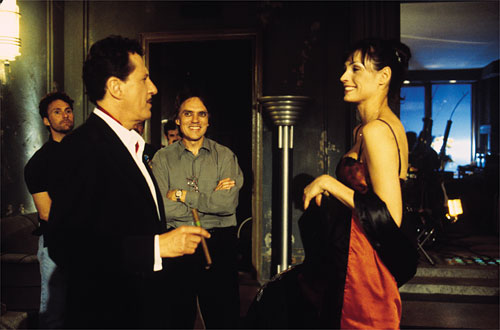
As they began researching the picture, which was owned by Warner Bros., they learned that Terry Castle, daughter of William Castle, was also interested in remaking the movie. They agreed to join forces on the production, which would become the premiere offering from Zemeckis' and Silver's Dark Castle productions, a new film company created "in the spirit of the late William Castle." Terry Castle enthusiastically joined the team as co-producer.
The filmmakers quickly set out to find the ideal director for their project. William Malone, a writer and director who is a veteran of the horror genre, was asked to help develop the film. Malone's history with Zemeckis went all the way back to Zemeckis' 1978 picture, "I Wanna Hold Your Hand," in which Malone played George Harrison. He had also, more recently, worked with both Silver and Zemeckis on episodes of "Tales From the Crypt."
Although Malone had offers at the time to direct other features, he felt "House on Haunted Hill" was the perfect type of film to remake, and the perfect opportunity for him.
"The original is fun," says Malone. "I had always been a fan of William Castle's film and felt that this particular project would be a great subject for a remake. Plus, I had a lot of interest in doing a haunted-house picture."
Screenwriter Dick Beebe, Malone and the filmmakers began to develop the screenplay. They decided to keep the premise of the original film, but felt it would be best to develop the plot to take advantage of today's great visual-effects technology. "In our movie, we pick up where the original left off, because we have a lot more special effects," adds Malone. "Everything, from the house to the underground basements, is bigger and more eerie."
Although many names were considered when casting the film, the filmmakers had always had Geoffrey Rush atop their list for the lead role of Steven Price.
"I always thought Geoffrey Rush would make a perfect Steven Price, but I never thought in a million years we would get him to play the part," says director Malone. "I was very pleased that we were able to get him for this film."
Says producer Gil Adler, "Geoffrey never watched the original movie because he didn't want it to influence the idea of his character. Yet Geoffrey really captures the twisted spirit of Vincent Price's characterization, while bringing along his own unique talents that make him a lot of fun to watch."
From there, the producers were able to put together a diverse ensemble cast, ranging from an improvisational comedian to the hottest young talent in Hollywood.
Famke Janssen, a native of Holland best known for her role as Xenia Onatopp in the James Bond film "GoldenEye," was selected to play the role of Evelyn Price. "Steven and Evelyn have a definite love/hate, intensely sexual relationship. They love each other, but you never know what their true motives are," says Malone. "Geoffrey and Famke were able to tap into that disturbed relationship and entertainingly play off one another."
Rising stars Taye Diggs and Ali Larter play the respective roles of the film's hero and heroine, Eddie the former professional baseball player and Sara, the former personal assistant who masquerades as her ex-boss. Diggs' and Larter's roles are central to the story, says producer Gil Adler.
"When you are watching a horror film, you want to root for someone you can sympathize with," emphasizes Adler. "Taye and Ali have the charm and wit to be able to pull those emotions from the audience with their performances."
For the role of the demented Pritchett, the producers to sought an actor who could give the character an edge of humor. They soon decided that the role was meant for "Saturday Night Live's" Chris Kattan. "Chris was the ideal choice, with his abilities as a top sketch comedian and a dramatic actor," says Silver.
Rounding out the cast are Peter Gallagher as Dr. Blackburn and Bridgette Wilson as Melissa Marr, the wannabe TV talk-show host.
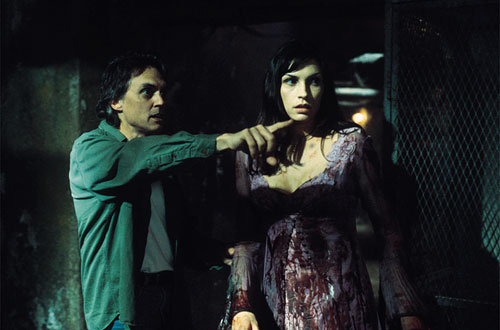
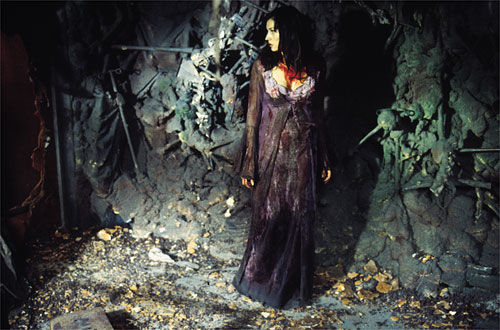
The filmmakers believed that one of the biggest challenges of the film would be to create the horrifically haunted insane asylum, essentially establishing the house as its own character. In doing so, production design would be a key element.
Malone's vision of the house was based upon an episode of "Tales from the Crypt" shot in an English psychiatric hospital. "We shot it in a former mental institution that was now being rented out as a film location," recalled Malone. "Before we could begin shooting the film we had to exorcise the location. That event instantly sparked my imagination: make the house a former mental institution turned into someone's home."
Rather than stick with the traditional Victorian-style haunted house associated with most horror films, production designer David Klassen created a house that looked as if it came straight out of the 1930s. Klassen designed the house in the monolithic style of Albert Speer, the infamous architect of the Third Reich. "It was very exciting to design a psychiatric institute for the criminally insane in this very looming, large and clean style," says Klassen. "It really draws the audience into the setting."
"David did an amazing job of recreating the house; once you were inside the sets, you felt like you were in the actual home," says Malone. "It really had a creepy feeling."
In addition to the design of the house, sound and visual effects play an integral part in the storytelling. Malone turned to the renowned visual-effects team of Bob and Dennis Skotak.
The Academy Award-winning Skotaks, who have worked on such contemporary classics as "Terminator 2: Judgment Day" and "Titanic," were very excited about the opportunity to work on a horror film. Says Bob Skotak, "Bill Malone's an old friend. I ran into him at a Halloween party last year and he told me he was going to do this movie. I thought it over for a few days and realized that I had never really done visual effects on a flat-out horror picture before and I wanted to give it a whirl. My brother and I and our digital artist, Helena Packer, discovered that this movie let us try things we'd never done before. It was a lot of fun."
The exterior of the house was created out a combination of matte painting and miniatures. "The only part of the house that was physically real was the entrance," explains Bob Skotak. "For that, we used the entrance to the Griffith Park Observatory in Los Angeles."
An entire amusement park, based on one that exists in Florida, was created in miniature for some of the early scenes in the movie, continues Skotak.
"But two of the most interesting things we created were what we called the Shape Shifter and the actual animation of the building itself," he says. "There's a supernatural presence in the house that shows up both as a sort of moving tangle of images and as a physical transformation of the walls and objects. In both situations, we used a combination of actual images and practical construction as well as digital compositing to create very disturbing moments onscreen. I don't believe what we did has ever been done before and we're very pleased with the results we achieved."
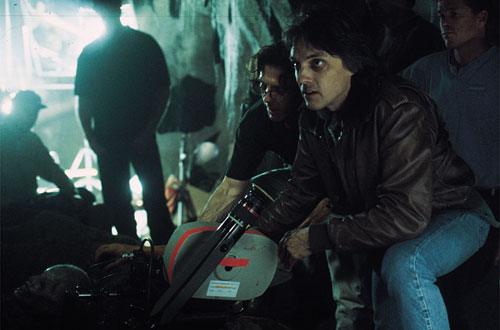
Supervising sound editor Dane Davis, who previously collaborated with Joel Silver on the sensational hit "The Matrix," also had the opportunity to achieve some technological "firsts" with "House on Haunted Hill."
"I think this is the first movie to use a completely virtual mix," explains Davis. "Using some brand-new software, I was able to capture and create sounds, combine special effects, music, dialogue and background, and keep the entire mix in the computer where each element could be manipulated. I could change the relationship between sounds, or control the timbre and intensity of a particular sound right up until the movie was ready to be locked into a final print. This gave the filmmakers a lot of creative flexibility in controlling the mood of the movie."
Davis gave a lot of thought to the auditory effects that characterized the Vannacutt Institute. "This building is a major character in the movie," he says. "It has its own voice, and we wanted it to be a unique one." Davis experimented with a mixture of various sounds that he recorded himself and manipulated electronically to get a background noise that was "organic-sounding, like something alive," as Davis describes it.
In summing up her feelings about the completed film, Terry Castle says, "The people who saw the original movie will now see something completely new, but they will also have some nostalgic moments. I hope this movie gives people a lot of sleepless nights, the way my father's film did 40 years ago."
Warner Bros. Presents A Dark Castle Entertainment Production: "House on Haunted Hill," starring Geoffrey Rush and Famke Janssen, Taye Diggs, Ali Larter, Bridgette Wilson, with Peter Gallagher and Chris Kattan. The film editor is Anthony Adler and the director of photography is Rick Bota. The co-producer is Terry Castle and the executive producers are Dan Cracchiolo and Steve Richards. The story is by Robb White and the screenplay is by Dick Beebe. "House on Haunted Hill" is produced by Robert Zemeckis, Joel Silver and Gilbert Adler, and directed by William Malone. It is distributed by Warner Bros., A Time Warner Entertainment Company.
back to Information