Mount
Everest
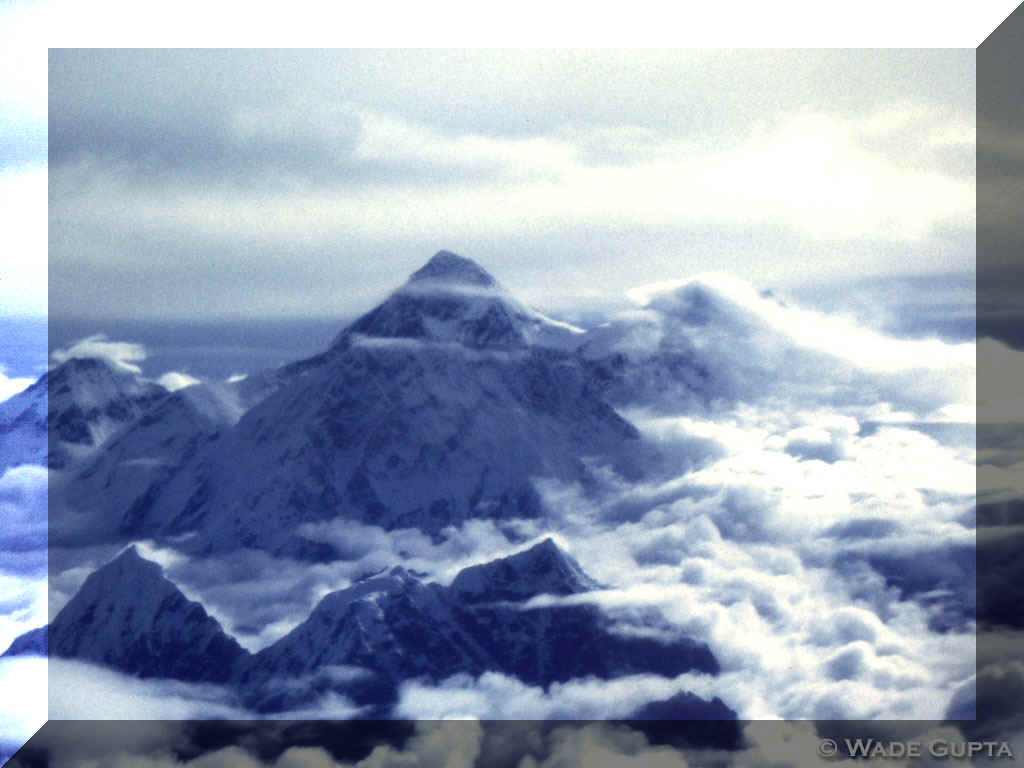
Mount
Everest, mountain peak in
the Himalayas
of southern Asia, considered the highest mountain in the world. Mount Everest is
situated at the edge of the Tibetan Plateau, on the border of Nepal and the
Tibet Autonomous Region of China.
The mountain was named for Sir
George Everest, a British military engineer who served as surveyor general of
India from 1829 to 1843, during which time the peak was surveyed. Everest was
the first person to record the location and height of the mountain, then known
as Peak XV. Most Nepali people refer to the mountain as Sagarmatha, meaning
“Forehead in the Sky.” Speakers of Tibetan languages, including the Sherpa
people of northern Nepal, refer to the mountain as Chomolungma, Tibetan for
“Goddess Mother of the World.”
The height of
Mount Everest has been determined to be 8,850 m (29,035 ft). The mountain's
actual height, and the claim that Everest is the highest mountain in the world,
have long been disputed. But scientific surveys completed in the early 1990s
continued to support evidence that Everest is the highest mountain in the world.
In fact, the mountain is rising a few millimeters each year due to geological
forces. Global Positioning Technology (GPS) has been installed on Mount Everest
for the purpose of detecting slight rates of geological
uplift
Geological Formation
Mount Everest,
like the rest of the Himalayas, rose from the floor of the ancient Tethys Sea.
The range was created when the Eurasian continental plate collided with the
Indian subcontinental plate about 30 to 50 million years ago. Eventually the
marine limestone was forced upward to become the characteristic yellow band on
the top of Mount Everest. Beneath the shallow marine rock lies the highly
metamorphosed black gneiss (foliated, or layered, rock) of the
Precambrian
era, a remnant of the original continental plates that collided and forced up
the Himalayas.
Mount Everest
is covered with huge glaciers that descend from the main peak and its nearby
satellite peaks. The mountain itself is a pyramid-shaped horn, sculpted by the
erosive power of the glacial ice into three massive faces and three major
ridges, which soar to the summit from the north, south, and west and separate
the glaciers. From the south side of the mountain, in a clockwise direction, the
main glaciers are the Khumbu glacier, which flows northeast before turning
southwest; the West Rongbuk glacier in the northwest; the Rongbuk glacier in the
north; the East Rongbuk glacier in the northeast; and the Kangshung glacier in
the east.
Climate
The climate of
Mount Everest is naturally extreme. In January, the coldest month, the summit
temperature averages -36° C (-33° F) and can drop as low as -60° C (-76° F).
In July, the warmest month, the average summit temperature is -19° C (-2° F).
At no time of the year does the temperature on the summit rise above freezing.
In winter and spring the prevailing westerly wind blows against the peak and
around the summit. Moisture-laden air rises from the south slopes of the
Himalayas and condenses into a white, pennant-shaped cloud pointing east; this
“flag cloud” sometimes enables climbers to predict storms. When the wind
reaches 80 km/h (50 mph), the flag cloud is at a right angle to the peak. When
the wind is weaker, the cloud tilts up; when it is stronger, the flag tilts
down.
From June
through September the mountain is in the grip of the Indian monsoon,
during which wind and precipitation blow in from the Indian Ocean. Masses of
clouds and violent snowstorms are common during this time. From November to
February, in the dead of winter, the global southwest-flowing jet stream moves
in from the north, beating the summit with winds of hurricane force that may
reach more than 285 km/h (177 mph). Even during the pre- and post-monsoon
climbing seasons, strong winds may arise suddenly. When such storms develop,
sand and small stones carried aloft, as well as beating snow and ice, pose
problems for climbers.
Precipitation
falls mostly during the monsoon season, while winter storms between December and
March account for the rest. Unexpected storms, however, can drop up to 3 m (10
ft) of snow on unsuspecting climbers and mountain hikers.
Base Camp,
which serves as a resting area and base of operations for climbers organizing
their attempts for the summit, is located on the Khumbu glacier at an elevation
of 5,400 m (17,600 ft); it receives an average of 450 mm (18 in) of
precipitation a year.
Climbing Mount Everest
Traditionally,
the people who live near Mount Everest have revered the mountains of the
Himalayas and imagined them as the homes of the gods. Because the peaks were
considered sacred, no local people scaled them before the early 1900s. However,
when foreign expeditions brought tourist dollars and Western ideas to the area,
people of the Sherpa ethnic group began to serve as high-altitude porters for
them. Because Nepal had been closed to foreigners since the early 1800s, all
pre-World War II (1939-1945) Everest expeditions were forced to recruit Sherpa
porters from Darjiling (Darjeeling), India, then circle through Tibet and
approach Everest from the north.
In 1913
British explorer John Noel sneaked into Tibet, which was also closed at the
time, and made a preliminary survey of the mountain's northern approaches, where
the topography is less varied than on the southern side. In 1921 the British
began a major exploration of the north side of the mountain, led by George Leigh
Mallory. Mallory's expedition, and another that took place soon afterward, were
unable to overcome strong winds, avalanches, and other hazards to reach the
summit. In 1924 a third British expedition resulted in the disappearance of
Mallory and a climbing companion only 240 m (800 ft) from the summit. More
attempts were made throughout the 1930s and into the 1940s. Then, with the
conquest of Tibet by China in the early 1950s, the region was closed to
foreigners again and the northern approaches to the mountain were sealed off.
In 1950, the
year after Nepal opened to foreigners, W. H. Tilman and C. Houston made the
first ascent from the south and became the first people to see into the Khumbu
cirque (a steep basin at the head of a mountain valley). A number of attempts to
reach the mountain's summit followed in the early 1950s. In 1952 the Swiss
almost succeeded in climbing the mountain from the South Col, which is a major
pass between the Everest and Lhotse peaks and is now the most popular climbing
route to the summit. On May 29, 1953, under the tenth British expedition flag
and the leadership of John Hunt, Edmund
Hillary of New Zealand and Sherpa Tenzing
Norgay of Nepal successfully completed the first ascent of Mount Everest via
the South Col. Several expeditions have since followed. In 1975 Junko Tabei of
Japan became the first woman to summit Mount Everest. Later, in 1978, Austrians
Reinhold Messner and Peter Habeler established a new and rigorous standard by
climbing to the summit without the use of supplemental oxygen, which, because of
the thin air at Everest's high altitude, is important for the energy, health,
and thinking skills of the climbers. In 1991 Sherpas, who had carried the
supplies for so many foreigners up Mount Everest, completed their own successful
expedition to the summit. By the mid-1990s, 4,000 people had attempted to climb
Everest—660 of them successfully reached the summit and more than 140 of them
died trying.
The
difficulties of climbing Mount Everest are legendary. Massive snow and ice
avalanches are a constant threat to all expeditions. The avalanches thunder off
the peaks repeatedly, sometimes burying valleys, glaciers, and climbing routes.
Camps are chosen to avoid known avalanche paths, and climbers who make ascents
through avalanche terrain try to cross at times when the weather is most
appropriate. Hurricane-force winds are a well-known hazard on Everest, and many
people have been endangered or killed when their tents collapsed or were ripped
to shreds by the gales. Hypothermia, the dramatic loss of body heat, is also a
major and debilitating problem in this region of high winds and low
temperatures.
Another hazard
facing Everest climbers is the famous Khumbu icefall, which is located not far
above Base Camp and is caused by the rapid movement of the Khumbu glacier over
the steep rock underneath. The movement breaks the ice into sérac (large,
pointed masses of ice) cliffs and columns separated by huge crevasses, and
causes repeated icefalls across the route between Base Camp and Camp I. Many
people have died in this area. Exposed crevasses may be easy to avoid, but those
buried under snow can form treacherous snow bridges through which unwary
climbers can fall.
The standard
climb of Mount Everest from the south side ascends the Khumbu glacier to Base
Camp at 5,400 m (17,600 ft). Typical expeditions use four camps above Base Camp;
these camps give the climbers an opportunity to rest and acclimate (adapt) to
the high altitude. The route from Base Camp through the great Khumbu icefall up
to Camp I at 5,900 m (19,500 ft) is difficult and dangerous; it usually takes
one to three weeks to establish because supplies must be carried up the mountain
in several separate trips. Once Camp II, at 6,500 m (21,300 ft), has been
supplied in the same manner using both Base Camp and Camp I as bases, climbers
typically break down Base Camp and make the trek from there to Camp II in one
continuous effort. Once acclimatized, the climbers can make the move to Camp II
in five to six hours. Camp III is then established near the cirque of the Khumbu
glacier at 7,300 m (24,000 ft). The route up the cirque headwall from Camp III
to the South Col and Camp IV at 7,900 m (26,000 ft) is highly strenuous and
takes about four to eight hours. The South Col is a cold, windy, and desolate
place of rocks, snow slabs, littered empty oxygen bottles, and other trash.
From the South
Col to the summit is a climb of only 900 vertical m (3,000 vertical ft),
although its fierce exposure to adverse weather and steep drop-offs poses many
challenges. The section between 8,530 m (28,000 ft) and the South Summit at
8,750 m (28,700 ft) is particularly treacherous because of the steepness and
unstable snow. From the South Summit there remains another 90 vertical m (300
vertical ft) along a terrifying knife-edged ridge. The exposure is extreme, with
the possibility of huge vertical drops into Tibet on the right and down the
southwest face on the left. A little more than 30 vertical m (100 vertical ft)
from the summit is a 12-m (40-ft) chimney across a rock cliff known as the
Hillary Step; this is one of the greatest technical challenges of the climb.
As the
popularity of climbing Everest has increased in recent years, so have safety
problems. To pay the high climbing permit fee charged by the Nepalese
government, many experienced climbers have recruited wealthy, amateur climbers
as teammates. The combination of inexperience, crowded summit conditions (more
than 30 have been known to summit the peak on the same day), and extreme weather
conditions has led to a number of tragedies in which clients and competent
guides alike have died attempting the climb.
Environmental Issues
The large
number of trekkers and climbers who visit Nepal and the Everest region
contribute to the local economy but also cause serious environmental impact.
Such impact includes the burning of wood for fuel, pollution in the form of
human waste and trash, and abandoned climbing gear. Although some climbing gear
is recycled by local residents either for their own use or for resale, it is
estimated that more than 50 tons of plastic, glass, and metal were dumped
between 1953 and the mid-1990s in what has been called “the world's highest
junkyard.” Up on the ice, where few local people go, the norm is to throw
trash into the many crevasses, where it is ground up and consumed by the action
of the ice. A few bits and pieces show up on the lower part of the glacier many
years later as they are churned back to the surface, although organic matter is
generally consumed or scavenged by local wildlife. At the high-elevation camps,
used oxygen bottles are strewn everywhere.
Efforts have been made to reduce
the negative environmental impact on Mount Everest. The Nepalese government has
been using a portion of climbing fees to clean up the area. In 1976, with aid
from Sir Edmund Hillary's Himalayan Trust and the Nepalese government, the
Sagarmatha National Park was established to preserve the remaining soil and
forest around Mount Everest. By the mid-1990s the park comprised 1,240 sq km
(480 sq mi). Trekking and climbing groups must bring their own fuel to the park
(usually butane and kerosene), and the cutting of wood is now prohibited.
Because the freedoms of Sherpas have been restricted by the park rules, they
have not been sympathetic to the existence of the park. Additionally, the
Sagarmatha Pollution Control, funded by the World Wildlife Fund and the
Himalayan Trust, was established in 1991 to help preserve Everest's environment.
Climbing activity continues to increase, however, and the environmental future
of the Mount Everest area remains uncertain.