The year is 1959. A
man in Congo dies of an unidentified cancer. What puzzled doctors wasn't
the cancer, it was the mans immune system, that seemed to have been
completely broken down and powerless to fend of the disease.
Its
1981, the CDC (The Centers for Disease Control and Prevention)
notices a high rate of otherwise rare cancer claiming more lives. Thus
begins the era of a new and undying bubonic plague that shattered
lives--countries--an entire civilization. As the 78th anniversary of AIDS
approaches scientist around the world still struggle to find a cure.
This
comprehensive article is brought to you in recognition of World
Aids Day that
falls on the 1st
of December.
AIDS (Acquired
ImmunoDeficiency Syndrome) is one of the worst pandemics the world has
ever known. HIV (Human Immunodeficiency Virus), the virus that causes
AIDS, was first discovered in 1981 in a remote area of central Africa.
It has since swept across the globe, infecting millions in a
relatively short period of time. AIDS has killed 21.8 million people
that we know of, with 3 million people dying in the year 2000 alone.
While many cases go unreported, the prevalence of the disease is
increasing. By comparison:
The flu pandemic of 1918 killed
approximately 20 million people worldwide.
World War II killed approximately
40 million people.
Clearly the AIDS pandemic has had,
and will continue to have, a significant and global impact.
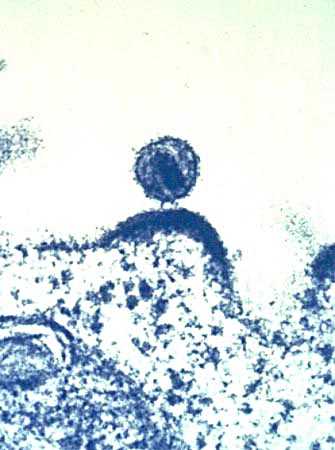
HIV, the virus that causes AIDS, is shown budding out of a human
immune cell.
.::How
AIDS Works::.
Unique
Features of HIV
The thought of contracting HIV is frightening. And there is good reason
for that fear -- the disease is presently incurable, it has a high
mortality rate, it spreads quickly and there is no vaccine to protect
against it. In today's world, that combination is rare. For example,
small pox is often fatal, but the disease has been completely contained
through vaccinations. Tuberculosis is often fatal but can usually be
cured with antibiotics if caught early.
AIDS has been able to infect and kill
so many people because of its unique makeup. Let's look at some of the
features that make this disease so unusual:
HIV spreads by intimate contact
with an infected person. Forms of intimate contact that can transmit
AIDS include sexual activity and any sort of situation that allows
blood from one person to enter another. Especially when you compare
it with the many viruses that spread through the air, it would seem
like the intimacy involved in the transmission of AIDS would be a
limiting factor. However…
A person can carry and transmit the
HIV virus for many years before any symptoms show themselves. A
person can be contagious for a decade or more before any visible
signs of disease become apparent. In a decade, a promiscuous HIV
carrier can potentially infect dozens of people, who each can infect
dozens of people, and so on.
HIV invades the cells of our immune
system and reprograms the cells to become HIV-producing factories.
Slowly, the number of immune cells in the body dwindles and AIDS
develops. Once AIDS manifests, a person is susceptible to many
different infections, because the immune system has been weakened so
much by the HIV it can no longer fight back effectively. HIV has
also shown the ability to mutate, which makes treating the virus
nearly impossible.
How HIV
Enters the Body
In the United States, given the current distribution of HIV in the
population, there is better than a one in 1,000 chance of contracting
HIV during an unprotected heterosexual encounter, according to the
Centers for Disease Control and Prevention (CDC). In some locations, the
chances are even higher. Unprotected sex is the most common way of
transmitting HIV. Your chances for infection increase with each new
partner. Here is a list of ways in which HIV can be transmitted:
Sexual contact
Sharing contaminated intravenous
needles
Breastfeeding (mother to baby)
Infected mother to fetus during
pregnancy or birth
Blood transfusions (Rare in
countries where blood is screened for HIV antibodies.)
HIV
And Mosquitoes
One of the most
prevalent myths about HIV transmission is that mosquitoes or
other bloodsucking insects can infect you. There is no
scientific evidence to support this claim. To see why mosquitoes
don't aid in the transmission of HIV, we can look at the
insect's biting behavior.
When mosquitoes
bite someone, they do not inject its own blood or the blood of
an animal or person it has bitten into the next person it bites.
The mosquito does inject saliva, which acts as a lubricant so
that it can feed more effectively. Yellow fever and malaria can
be transmitted through the saliva, but HIV does not reproduce in
insects, and therefore doesn't survive in the mosquito long
enough to be transmitted in the saliva.
Additionally,
mosquitoes don't normally travel from one person to another
after ingesting blood. The insects need time to digest the blood
meal before moving on.
There is also a slight chance of
transmission through kissing and biting. However, there have been very
few cases of HIV being transmitted through either method. In fact, the
CDC has investigated only one case in which HIV infection was attributed
to open-mouth kissing.
HIV does not transmit through the air
or surface contact like cold and flu viruses do. HIV is a fragile virus
and doesn't survive well outside the human body. This fragility makes
the possibility of environmental transmission very remote. Outside of a
host cell, HIV doesn't survive for very long. In laboratory studies, the
CDC has shown that once the fluid (blood, sweat, tears, etc..)
containing the HIV virus dries, the risk of environmental transmission
is nearly zero.
There is a lot of misinformation about
how HIV can be transmitted. So, here is a list of ways in which HIV is not
transmitted:
Saliva, tears and sweat - Saliva
and tears contain only small amounts of HIV, and scientists haven't
detected any HIV in the sweat of an infected person.
Insects - Studies show no evidence
of HIV transmission through bloodsucking insects. This is true even
in areas where there are many cases of AIDS and large populations of
mosquitoes.
Using the same toilet seat
Swimming in the same pool
Touching, hugging or shaking hands
Eating in the same restaurant
Sitting next to someone
In the next section, you will learn
what happens once the HIV virus enters the body, and how it attacks the
immune system.
The
Life-Cycle Of HIV
Like all viruses, HIV treads the fine line that separates living things
from nonliving things. Viruses lack the chemical machinery that human
cells utilize to support life. So, HIV requires a host cell to stay
alive and replicate. To replicate, the virus creates new virus particles
inside a host cell and those particles carry the virus to new cells.
Fortunately the virus particles are fragile.
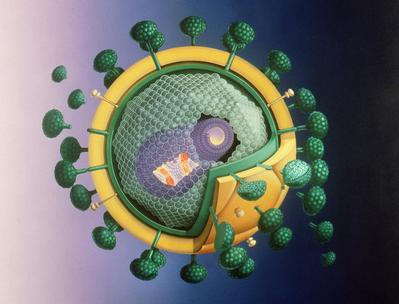
The model of the HIV virus
Viruses, like HIV, don't have cell
walls or a nucleus. Basically, viruses are made up of genetic
instructions wrapped inside a protective shell. An HIV virus particle,
called a virion, is spherical in shape and has a diameter of about one
10,000th of a millimeter.
HIV infects one particular type of
immune system cell. This cell is called the CD4+T cell, also know as a
T-helper cell. Once infected, the T-helper cell turns into a
HIV-replicating cell. T-helper cells play a vital role in the body's
immune response. There are typically 1 million T-cells per one
milliliter of blood. HIV will slowly reduce the number of T-cells until
the person develops AIDS.
To understand how HIV infects the
body, let's first look at the virus's basic structure. Here are the
basic parts of the HIV virus:
Viral envelope - This is the outer
coat of the virus. It is composed of two layers of fatty molecules,
called lipids. Embedded in the viral envelope are proteins from the
host cell. There are also about 72 copies of Env protein, which
protrudes from the envelope surface. Env consists of a cap made of
three or four molecules called glycoprotein (gp) 120, and a stem
consisting of three to four gp41 molecules.
p17 protein - The HIV matrix
protein that lies between the envelope and core
Viral core - Inside the envelope is
the core, which contains 2,000 copies of the viral protein, p24.
These proteins surround two single strands of HIV RNA, each
containing a copy of the virus's nine genes. Three of these genes --
gag, pol and env -- contain information needed to make structural
proteins for new virions.
HIV is a retrovirus, which means it
has genes composed of ribonucleic acid (RNA) molecules. Like all
viruses, HIV replicates inside host cells. It's considered a retrovirus
because it uses an enzyme, reverse transcriptase, to convert RNA into
DNA.
Once the HIV virus enters the body, it
heads for the lymphoid tissues, where it finds T-helper cells. Let's
look at how the HIV virus infects immune system cells and replicates:
Binding - The HIV attaches to the immune cell when the
gp120 protein of the HIV virus binds with the CD4 protein of the
T-helper cell. The viral core enters the T-helper cell and the
virion's protein membrane fuses with the cell wall.
Reverse transcription - The viral enzyme, reverse
transcriptase, copies the virus's RNA into DNA.
Integration - The newly created DNA is carried into the
cell's nucleus by the enzyme, viral integrase, and it binds
with cell's DNA. HIV DNA is called a provirus.
Transcription
- The viral DNA in the nucleus separates and creates messenger
RNA (mRNA), using the cell's own enzymes. The mRNA contains the
instructions for making new viral proteins.
Translation - The mRNA is carried back out of the nucleus
by the cell's enzymes. The virus then uses the cell's natural
protein-making mechanisms to make long chains of viral proteins and
enzymes.
Assembly - RNA and viral enzymes gather at the edge of the
cell. An enzyme, called protease, cuts the polypeptides into
viral proteins.
Budding - New HIV virus particles pinch out from the cell
membrane and break away with a piece of the cell membrane
surrounding them. This is how enveloped viruses leave the cell. In
this way, the host cell is not destroyed.
The newly replicated virions will
infect other T-helper cells and cause the person's T-helper cell count
to slowly dwindle. The lack of T-helper cells compromises the immune
system. When a person's T-helper cell count drops below 200,000 cells
per one milliliter of blood, he or she is considered to have AIDS. The
development of AIDS takes about two to 15 years, but about half of all
people with HIV will develop AIDS within 10 years after becoming
infected, according to the CDC.
No one dies from AIDS or HIV
specifically. Instead, an AIDS-infected person dies from infections,
because his or her immune system has been dissipated. An AIDS patient
could die from the common cold as easily as he or she could from cancer.
The person's body cannot fight off the infection, and he or she
eventually dies.
.::World
Impact::.
To understand the devastation of AIDS,
you have to understand the high mortality rate of people who develop the
disease. If you counted every person in the city of Chicago, which is
about 3 million, you would get the idea of how many people died
worldwide from AIDS in 2000. Basically, that means that each year AIDS
kills the same number of people that populate the third largest city in
the United States.
More than 40 million people are
infected with the HIV virus worldwide, with 25.3 million of those cases
in sub-Saharan Africa. Additionally, anther 5.3 million new HIV
infections occurred in 2000, which represents about 16,000 new cases per
day. The regions with the greatest number of people living HIV/AIDS,
according to the World Health Organization, include:
Sub-Saharan
Africa - 25.3 million
South and
Southeast Asia - 5.8 million
Latin America
- 1.4 million
North America
- 920,000
Eastern
Europe/Central Asia - 700,000
In the United States, 753,907 cases
had been reported to the CDC through June 2000. However, the CDC
estimates that as many as 900,000 Americans are living with HIV or AIDS.
HIV/AIDS
History (Timeline)
1926-46
- HIV possibly spreads from monkeys to humans. No one knows
for sure.
1959
- A man dies in Congo in what many researchers say is the
first proven AIDS death.
1981
- The Centers for Disease Control and Prevention (CDC)
notices high rate of otherwise rare cancer
1982
- The term AIDS is used for the first time, and CDC defines
it.
1983/84
- American and French scientists each claim discovery of the
virus that will later be called HIV.
1985
- The FDA approves the first HIV antibody test for blood
supplies.
1987
- AZT is the first anti-HIV drug approved by the FDA.
1991
- Basketball star Magic Johnson announces that he is
HIV-positive.
1996
- FDA approves first protease inhibitors.
1999
- An estimated 650,000 to 900,000 Americans living with
HIV/AIDS.
2001
- AIDS global death toll reaches nearly 22 million.
AIDS is clearly one of the worst
health crises facing the world today. Without any truly effective
treatment, most health experts are putting an emphasis on prevention to
stop the spread of HIV.
HIV and AIDS is a global
emergency claiming over 8,000 lives every day.
In fact 5 people die of AIDS every minute.
In 2002, 5 million people acquired HIV, which means there are now 42
million people living with HIV and AIDS
In the UK, fewer people are dying of AIDS but there are more people
living with HIV than ever before.
HIV is the one of the world's and the UK's biggest social, economic and
health challenges.
.::HIV/AIDS At
A Glance
The human immunodeficiency virus
(HIV) is a type of virus called a retrovirus, which infects humans
when it comes in contact with tissues such as those that line the
vagina, anal area, mouth, or eyes, or a break in the skin.
HIV infection is generally a slowly
progressive disease in which the virus is present throughout the
body at all stages of the disease.
Three stages of HIV infection have
been described.
1. The initial stage of infection (primary infection), which occurs
within weeks of acquiring the virus, is often characterized by a
"flu"- or "mono"-like illness that generally
resolves within weeks.
2. The stage of chronic asymptomatic infection (meaning a long
duration of infection without symptoms) lasts an average of 8 to10
years.
3. The stage of symptomatic infection, in which the body's immune
(or defense) system has declined so that complications have
developed, is called the acquired immunodeficiency syndrome (AIDS).
The symptoms are caused by the complications of AIDS, which include
one or more unusual infections or cancers, severe loss of weight,
and intellectual deterioration (called dementia).
When HIV grows (that is, by
reproducing itself), it acquires the ability to change (mutate) its
own structure. This mutation enables the virus to become resistant
to previously effective drug therapy.
The goals of drug therapy are to
prevent damage to the immune system by the HIV virus and to halt or
delay the progress of the infection to symptomatic disease.
Therapy for HIV includes
combinations of drugs that decrease the growth of the virus to such
an extent that the treatment prevents or markedly delays the
development of viral resistance to the drugs.
The best combination of drugs for
HIV has not yet been defined, but one of the most important factors
is that the regimen be well tolerated so that it can be followed
consistently without missing doses.
-Various Sources-
*In
recognition of World Aids Day that falls on the 1st of December*