
Since Novermber 1999, the greater Houston area has been labeled the smog capital of the U.S., past L.A. One of the major contributors to the smog dilemna is the petrochemical industry, which are grandfathered by the CAAA'70. The TNRCC, most recently, have now targeted motor vehicles first, along with industry, and proposals that will be introduced beginning March 2000 will affect all Houstonians. These are the proposed provisions:
1) Limited vehicle use (no-drive days)
2) Stricter emission testing of gasoline-powered vehicles
3) Highways in the Greater Houston area will have top speeds of 55
mph (this does not change rush-hour traffic)
4) Increased regulation of industry
5) The non-operation of construction equipment at certain times of
the day
6) The sale of California-standard vehicles
7) Cleaner fuels
Some of the topics that have been proposed are controversial, like the limited use of motor vehicles (no-drive days), and the 55 mph speed limit. Harris County is the only county that conducts emission testing, for vehicles 2 - 24 years of age. Anything that is 25 years old is grandfathered from emission testing, and exempted under state law. This includes classic musclecars of pre-1973 vintage, as well as oldies built before the 1968 mandate.
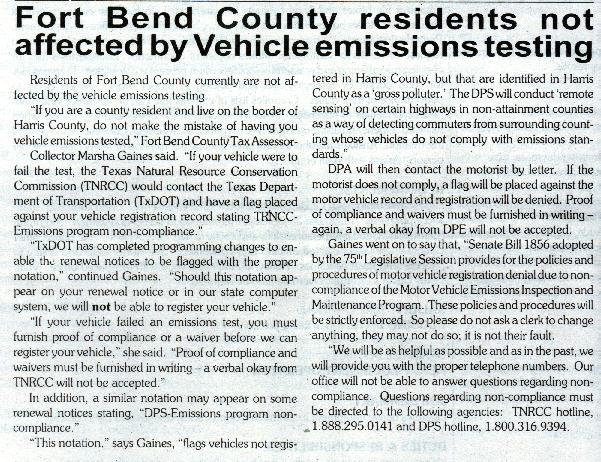
Here's an article that was posted in the Fort Bend County Precinct 2 Newsletter (Fourth Quarter 1999, Vol. 9, #4):
6/29/00 update: a survey in the Houston Chronicle (conducted by Rice University sociology professor Stephen Klineberg) had a few controversial remarks concerning the proposed 55 mph on all Houston-area highways and stringent emission testing (IM240). From my perspective, traffic-congested highways during rush hour will not benefit from a 55 mph speed limit, and yields no change. The last time a 55 mph speed limit was enacted into law was 1974, right after the 1973 Arab Oil Embargo, until President Reagan lifted the speed limit quotas in 1986, where interstate highways (except for metropolitan areas) had day/night speed limits (65/55). Currently, a 70/65 has been standard since 1996. Gasoline-powered motor vehicles have been targeted by environmentalists, and has been the first ones on the list concerning smog. In the Houston area, heavy industry is the culprit, not gasoline-powered motor vehicles.
If this was the law today, there would be an increase in teleconferencing and e-mail for Downtown-area businesses. ETR (employment-trip reductions) have been common since 1992 in the Houston area, where vanpooling to work is a way for large, downtown-based companies to comply with EPA regulations.
7/20/00 update: Here's another shocker: a proposal from the Air Quality Consensus Group (part of the HGAC) for recommendations for a new smog plan. Much like the Klineberg article from 6/29/00, the proposals include lowered speed limits by 5 mph on all highwaysin the Greater Houston area, and a construction ban.
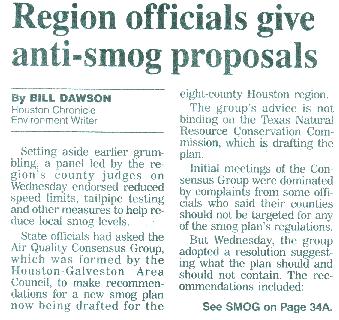
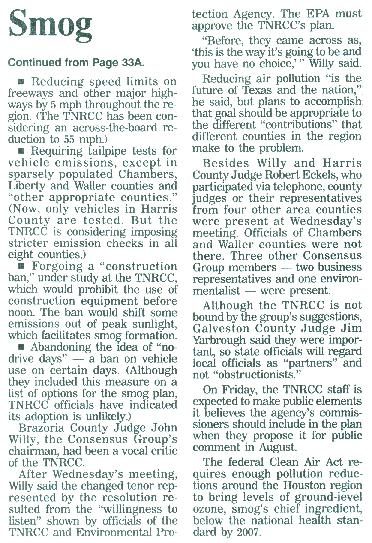
9/23/00 update: Lowering the speed limit to 55 will make the Houston area a time capsule stuck in the 1970s, and hope that no one ends up driving disco-era compacts like the Pinto or Vega again. Gasoline-powered motor vehicles only contribute to 1/4 of the smog problem, and why enforce regulations that are unnecessary and unwanted? Houston has regulated SOBs and outdoor festivals, and in the 8-county region (Harris, Ft. Bend, Waller, Montgomery, Galveston, Liberty, Chambers, and Brazoria), a 55 mph speed limit will do more harm than good, especially for buisness and residential development. Currently, there are several issues to recognize. Rising fuel prices since the start of the new millenium (from OPEC shutdown quotas and corporate mergers like ExxonMobil; Chevron-Texaco), along with reformulated gasoline, signaled a throwback to the 1979 energy crisis, sans the long lines and angry customers.
Right now, SUVs have replaced the passenger car as the mainstay of vehicle choice. The 1973 Arab Oil Embargo forced regulation by Congress (a la the DOT, downsizing, CAFE, along with inflation, unemployment, and deindustrialization), and throughout the 1980s, RWD, the traditional platform favored by the BiG 3, have been replaced with FWD, with reference to the VW Rabbit. The Rabbit might have been the role model of the modern automobile today, and only 2 automakers have went 100% FWD (Chrysler and GM). Why are a lot of rice burners with vinyl graphics on the streets today? RWD and V8 are history, and as a reference to Durkheim, change takes place over time.
Future projections from GM aren't as they seem, and are about to kill another vehicle line.
12/7/00 update: Starting May 2002, the shocker for all 8 counties: 55 mph max/40 mph minimum on ALL highways. In contrast to the Florida electoral college civil suits for vote recounts, where Bush ended up with 25 electoral votes, and a setback for Vice President Al Gore, a similar effect is likely soon, where motorists will be likely to instigate civil action, like in Florida this year, only that the 55 law is in place of vote recounts. Time to resurrect the dead Vegas and Pintos from the salvage yard, and the old-70s era land barges. The 70s throwback will take effect May 2002, and in this case, an 8-county region living in a 1974-era period, where 55 is max. For more on the whole 9: browse this page.
8/12/2001 update: In mid-April 2001, the TX Legislature struck down the 55 max speed limit in the Houston area and its 7 surrounding counties. The bad news is that a stiffer emission testing is on the horizon, which will be enacted on May 1, 2002. One area that will affect owners of pre-1973 oldies is the amending of the '25 model years" for a fixed year: 1966. The IM240 treadmill will be used, and much like the 2:1 margin for the rejection of the 55 MPH max, the TNRCC is about to regulate 1966+ vehicles, and grandfathering 1965/older antiques. One state has done this, until SB42 was signed by Pete Wilson. MARK YOUR CALENDARS: 9/13/2001, Houston City Council chambers, 901 Bagby. TVCC, COVA/CVAG members, enthusiasts, and private owners will voice grievances, much like the proposed 55 MPH that was rejected by the TX Legislature in April 2001.
Untuned vehicles that are poorly maintained are targeted. Vehicles that are out-of-tune, or expelling smoke (black, blue, gray/white) are the tell-tale signs that a gross polluter can be identified. Here's the breakdown on expelled smoke:
Black: vehicle is using too much fuel, or has a rich condition.
Reset timing, and have the carb or EFI unit serviced ASAP.
Blue: oil burning; this means that the valve guides or rings
are shot.
Gray/white: cracked head/block or water in exhaust; mostly occurs
during startup. Cracked heads/cylinder blocks might be the
culprit; open the radiator cap (if motor is up to operating temperature)
and check for bubbling, or foaming. This might indicate either a
cracked head or blown head gasket is the likely cuase.
To keep emissions low, here are the ways to combat the problem:
1) Use a vacuum gauge to tune a gasoline-powered motor vehicle. On older, non-computer controlled vehicles, mixture screws on the carb regulate the air/fuel ratio. Adjust the screws to the point where the highest vacuum readings are recorded. Computer-controlled vehicles might be a little complex, since the air/fuel mix is adjusted by the ECM. Always set the initial timing to the OEM specs.
2) Use high-octane fuel. High-octane fuel, according to some published reports, might not increase performance, but the increase in octane points will make a vehicle burn cleaner and more efficiently. The 93 octane fuel sold at your local gas station will have some chemicals added, and this has been known to those bringing a vehicle to a smog test by filling 93 octane fuel in the tank, along with a fuel additive.
3) Make sure the filters are replaced or serviced. This includes breather elements, air filters, and PCV valves. The PCV valve is considered a filter, since this keeps the motor oil in the crankcase clean.
4) Change the motor oil at their regular intervals. 3000 miles the the norm.
5) Synthetic oils: they have been known to reduce friction, and W & T, as well as increasing oil change intervals. Synthetic lube does not breakdown like conventional lubes, and have been known to increase MPG.
6) Running a 180 or 195 thermostat in place of the 160 unit will decrease emissions, due to higher engine temperatures. Anything over 210 isn't acceptable, and have the cooling system maintained.
7) Ignition system: Worn-out terminals, fouled plugs, burnt-out ignition wires, and faulty ignition parts can lead to high emission output. Have the ignition parts serviced regularly, even though the parts are guaranteed for 100,000 miles. Always use NEW ignition parts (e.g spark plugs, vacuum advance canisters, electronic modules, distributor cap/rotor, and plug wires), fresh out of the box. Second-hand components or Taiwan-manufactured components (e.g. Wells/Ampco products, Filko et.al.) will lead to side repercussions when the registration renewal or a reprimand from the TNRCC shows up in the mail.
If the above criteria are in compliance, a well-maintained motor vehicle should yield a low emission output. Some complications might occur, like tampered equipment, or non-stock engine swaps, which might fail a visual test, even if the vehicle yield low emissions. (The #1 cause of failure is tampered equipment, and a majority of these vehicles never make it to the dyno.) Tampered equipment can cause a vehicle emissions output to rise, but in some studies, the absence of such devices, as well as a properly-maintained motor vehicle, should yield low emissions, unless tailpipe smoke is a concern. Under federal law, all motor vehicles are governed by the CAAA'90.
Copyright 1999, 2000 LSC Publications. All Rights Reserved. Unauthorized duplication of any material is illegal and subject to criminal prosecution.
