
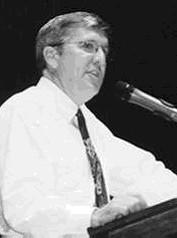
Professor of Chemistry
John Hutchinson, who also
is assistant vice president
for academic affairs
and director of academic
advising, delivers the
faculty address to the
Class of 2006.
Welcome to Rice!
Hutchinson advises freshmen on challenges ahead
...........................................................................
Orientation Week Faculty Address
by John Hutchinson
Professor of Chemistry
Aug. 20, 2002
I would like to say a few words, and here they are: nitwit, blubber, oddment, tweak. Thank you.
I’ve been planning that all summer. How many of you recognized those words of a wise man? Right, Albus Dumbledore from “Harry Potter.”
Today is a day of great challenges, for you and for me. My challenge is this address … and it is a challenge! Because today is a great day — your first full day of academic activities at Rice, and I am supposed to say something sufficiently profound and inspirational to match the importance of this moment in your lives. Since the day last April when [student director of O-Week] Mike Bader first asked me if I would give this address, I promise you that I’ve thought about this challenge every single day, planning, organizing thoughts, gathering pithy phrases. I have to say that, at the end of all of this thinking, planning and organizing, the temptation is very strong to simply quote Albus Dumbledore and leave it at that.
But I want to emphasize this point: I chose to accept this challenge. As hard as it has been to prepare and as uncertain as I am that I will succeed, I accepted this challenge. Fairly often, I have had to remind myself: I chose this challenge. What was I thinking? I’ve got nothing to say! They’re going to be bored out of their minds! What if I forget my speech and can’t remember what I wanted to say? I chose this challenge.
Why? I did so for a simple reason: What makes Rice University uniquely excellent and what inspires my love in Rice is not the scholarship of the faculty, nor the talented staff, nor the beautiful facilities, nor the elegant campus, nor even our unique college system, which undoubtedly attracted many of you here. Rather, what makes this university great is the extraordinary quality of the people who come here to study and to live, people like your advisers, fellows and mentors, people like those seated around you, people like you. I chose to seize this opportunity, because here at Rice I am granted the personal freedom to decide how I would respond.
You have already accepted an even greater challenge, by choosing to come to Rice, to tackle the curriculum here, to work in this community, to invest your hopes and dreams into these years. Remember the day you visited Rice, the day you applied to Rice, the day you heard that you were accepted, the day you decided to come here, the day you began receiving information from Dr. Camacho, your college masters, your college advisers, the registrar, academic advising. Remember those feelings as we discuss a few of the challenges you will face in your years at Rice. I will discuss, in broad terms, three. As we discuss them, I want you to keep in mind: You chose to accept these challenges, and you have the personal freedom to decide how you will respond. You chose to be here.
First, the most obvious challenge of Rice is the classes you will take. Based on my experience as a master at Wiess College, I expect that many if not most of you are questioning yourselves this week as to whether you will survive here. You’ve heard about how rigorous the curriculum is. You’ve heard rumors about weed-out courses and about endless weeks of all-nighters. And you’ve been told how smart everyone is who goes to Rice. [Will Rice senior] Matt Haynie made this point very well last night. But Matt followed that point with an even more important point, one worth emphasizing again today: Every one of you here today has the capability for academic success at Rice. You have the intellectual ability, and you have the work ethic; you could not have come this far, and you could not be here now if you did not.
The challenge then is in believing that truth about yourself. Because many, if not most, of you will find yourselves struggling in the next few months in ways that are unfamiliar to you. The homework will be more abstract and less direct, the exams will seem more obscure, almost obtuse, and somehow unrelated to the homework. Your professors’ assessments of your work will seem harsher, and your grades … well, let’s just say that I’ve known an awful lot of students, both at Wiess College and in my own chemistry class, who are more than a little disappointed by their first exam grades.
So why do students so often struggle in their first semesters at Rice? I can assure you that it is not because the faculty are uncaring or unfair. The opposite is true: Your instructors will want you to succeed and will make every effort to help you.
The reason for such difficulty is something different altogether: The skills you brought with you from high school and which served you so well there are not the skills you will need at Rice. Think back carefully about what your high school taught you, and two primary skills come to mind: how to consume information and how to solve problems. These are valuable skills, and you are all very talented at them; that’s what got you here, of course. But at Rice, our goals are different: We seek not so much to change what you know but rather how you know. By doing so, we hope to liberate you to choose for yourself what to think and how to think. We want you to think critically, analytically, creatively, expansively. We want you to learn to construct knowledge for yourself.
This is clearly a worthy challenge, and although it might not be the challenge you expected, remember that you chose to be here. So how will you respond? Faced with this challenge, many students begin to suffer extreme doubts about their abilities, their intellect and their chances of survival. These doubts are made worse by the feeling that you are the only one struggling. But you are not alone, not really. Most everyone struggles during their first year or even two. It’s just that no one talks about it.
My advice to you is threefold. First and foremost, be patient with yourself. Remember that you are developing a new skill, a new way of thinking, a deeper way of analyzing and understanding. Give yourself time to adjust. My experience is that students who have difficulty early on do very well at Rice in the long run. I have observed a transition in my students that occurs as they develop these new skills. That transition will come for you too. Be patient. Second, talk about the challenges you face and the difficulties you have. Go to see your professors, ask for assistance and insight. Talk with your college masters and resident associates. Recall that I said that the greatest asset at Rice is our students. Take advantage of the Peer Counseling Program in your college. Talk to each other , form study groups, work together, share your experiences. Third, believe in yourself. Don’t judge yourself on the basis of your early exam scores. Many students are all too quick to conclude that a low test grade or two is an indicator both of lack of ability and of lack of a successful future at Rice. This isn’t true. With time, I assure you, your grades will rise and you will make it. Again, most importantly, be patient with yourself. You chose to be here: You can do this.
Challenge No. 2 is the new freedom and independence that you now possess and which you will explore this week and in the months to come. Now, freedom may not seem like a challenge. It seems more like a gift. And it is a generous gift, from those who founded our country in proclaiming our endowed liberties, from William Marsh Rice and Edgar Odell Lovett in founding this university, and from your families in making it possible for you to come here. But exercising your freedom wisely and responsibly is a tremendous challenge.
You now have the freedom to define your own values, to speak your own words and to question all aspects of the world around you and virtually everything that you have been taught. And I strongly encourage all of you to exercise that freedom to its fullest in your time at Rice. I hope that you chose to come to college specifically to exercise those freedoms. One of my favorite attributes of college students is their irreverence. Now, I am not in any way referring to irreverence towards faith. I am instead referring to irreverence toward traditions and institutions, toward anything that you regard as pretentious or hypocritical, of anything that you find poorly conceived or ill-advised. Students in college, and at Rice in particular, will find fault in most anything and will find very creative ways to laugh at it.
Personally, I really like this. One of the highlights of my time as a student at The University of Texas was our election of absurdist candidates to lead our Student Association, whose only agenda for the year was to replace the words on the main library from “Ye Shall Know the Truth and the Truth Shall Set You Free” to “Money Talks.” One of the finest pieces of satire in last year’s Thresher was a commentary on the new university parking plan, including a depiction of the Humanities Building with a guard and a gate across the entrance, suggesting that the users of the building should pay for its usage. I love not only this humor, but also the ability to see the world with a clear eye. I find that I laugh the hardest, and not coincidentally learn the most, when I am in the company of my students. Life ought to be fun, particularly in college, and since we are fallible people, we ought to be able to laugh at our foibles and fumbles and even at our disagreements.
I seem to have strayed far from the idea of a challenge. However, it is important to apply this freedom of irreverence judiciously. It is one thing to laugh at an institution; it is quite another to laugh at an individual. When dealing with people, it is only a very short step from irreverent bemusement to insensitive ridicule. The line in between is very poorly defined, and only a wise person, more wise than I, can stay on the proper side without fail. I challenge each of you individually to find that wisdom, to choose wisely how to exercise your freedom.
Nevertheless, the free exchange of ideas must be the foundation of our great university. I was struck when I heard the words of Supreme Court Justice Kennedy, who said in an opinion earlier this year that “The right to think is the beginning of freedom, and speech must be protected from the government because speech is the beginning of thought.” Similarly, President Gillis repeated just last night something I have heard him say before: “We take as our mission not to make ideas safe for you, but rather to make you safe for ideas.” I’ve always been intrigued by and admired that phrasing, as I think it conveys that we should neither fear nor silence those ideas that offend our sensibilities. But it is the nature of life, indeed, the nature of these very freedoms, that we will disagree on this issue. In your years at Rice, I can assure you from experience that the greatest controversies will arise over the conflict between our need to protect the open exchange of ideas and our need to maintain an environment in which that exchange can occur. The conflict between these goals was captured famously by Lord Chief Justice Halisham, who told us “the only freedom which counts is the freedom to do what some other people think to be wrong. There is no point in demanding freedom to do that which all will applaud. All the so-called liberties or rights are things which have to be asserted against others who claim that if such things are to be allowed, their own rights are infringed or their own liberties threatened.”
So how should we respond when these controversies arise? I would direct you to the famous words of Supreme Court Justice Brandeis, with Chief Justice Holmes concurring: “[Those who won our independence] believed freedom to think as you will and to speak as you think are means indispensable to the discovery and spread of political truth.” Thus dedicated to the crucial importance of free speech, Justice Brandeis guides us to the correct resolution: “If there be time to expose through discussion the falsehood and fallacies, to avert the evil by the processes of education, the remedy to be applied is more speech, not enforced silence.”
The challenge to you as individuals then is to express yourselves and to find a voice for your irreverence, even when your thoughts are unpopular, but to do so responsibly, with the goal of encouraging “more speech, not enforced silence.” The challenge to us as a community is to protect the free exchange of ideas by rebutting those things that offend you or with which you disagree. Remember always: You chose to be here.
The third challenge is, I think, the most subtle, because its effects on you might be hard to recognize. It is the challenge of dealing with your future and the fear that the future creates. Ask yourself why you came to college, and ask yourself what you expect to get out of college. Now ask yourself whether you can disconnect these ideas from the need to get a job sometime in the future. Is there any one of you who can genuinely say that you have no anxiety about getting a job or getting into professional school after college? The pressure generated by that fear is immense and consuming. And even more painfully, it is compounded by unrelenting expectations from parents.
Faced with this pressure, students often turn their Rice experiences into vocational educations. When that happens, education becomes little more than ritual. You take the courses you are told to take, you read what you are told to read, you solve the problems you are given to solve. Each course becomes simply another in a series of hurdles in a long and arduous march to graduation and the future. There is little sense of accomplishment, even less sense of satisfaction and no sense of success. I have seen students terrified to make a B, even on a single exam. I have seen students terrified to drop courses that they find painfully unrewarding and uninteresting. All too many students remain trapped in a course of study and a major, disinterested and disenchanted with the material, pursuing a degree they don’t want, all from fear of an uncertain future and from fear of failing both their own expectations and the demands of their parents. Out of fear of an unhappy future, these students will miss the happiest of presents.
But remember, you chose to come here, and how you use your time here is very much your choice. So how should you respond? I would like you to share in a dream. One of my favorite movies is “Field of Dreams.” It came out in 1989, so I know that many of you have never seen it, and to those of you I strongly recommend it. If you haven’t seen it, it is a magical story of a young Iowa corn farmer named Ray, who plows under his crop to build a dream field where baseball players from an earlier age can return to play the game they love.
In my favorite scene, the great Shoeless Joe Jackson tells Ray, “I used to wake up in the morning with the smell of the ballpark in my nose, the cool of the grass on my feet. Have you ever held a glove to your face just to take in the smell? I would’ve played this game for food money. To hear the sound of the crowd, watching them rise as one when a ball is hit deep … I would’ve played this game for nothing.” For Joe Jackson, holding a glove to his face was dream enough for a lifetime. When he held a baseball mitt to his face, only then was he breathing deeply of the substance of life itself.
Every time I watch the movie, I conclude that I have something in common with Shoeless Joe, a dream so real that it defines my life. Nineteen eighty-nine, the year “Field of Dreams” came out, was a year of worldwide revolution, a year in which the streets of the capitals of the world filled with people demanding their freedoms. From Tiananmen Square in Beijing, to the streets of Prague, Gdansk and Budapest, to the legislature of Lithuania, to the top of the Berlin Wall, people stood together to demand their common freedom and a better way of life. In 1989, as I watched these people on television in headlong and dangerous pursuit of their dreams, I thought of Joe Jackson, and I thought more deeply about just exactly what dream these millions of people were pursuing.
I concluded that, more than anything else, what they wanted was something I already had but took for granted: the right to think and to share my thoughts in free conversation with others. This is the ultimate dream, and here at Rice University, in this room and throughout this campus, the dream comes to life. It is here that we witness the exercise, development and triumph of the mind; the creativity of a community of artists, authors, scholars and scientists. It is here in the classroom, with the energy and excitement that we feel now, that we can breathe deeply of life.
Here today, you have entered into a real-life field of dreams. Your challenge, as the students of Rice, is to bring forth all of your energy, talent and humanity. Don’t just survive this place: Dive into it, challenge it, attack it, become part of it, build it, live it.
You chose to be here: You can choose to dream. Your challenge at Rice will be not to miss this chance by failing to dream and by failing to join in the dreams of others.
So, to each of you individually, as I welcome you to Rice, I wish for you the grandest of dreams.
