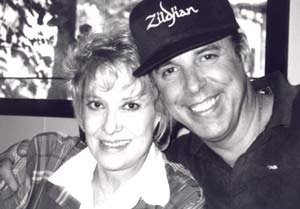
EP Unlimited: First off, Eddie, I want to thank you for participating in our interview series. I know you are an extremely busy man, and we appreciate your taking time to do this. Eddie, your early musical training was classical piano. It's quite a shift from that to Studio musician/drummer in country music. Did you have this as a "career plan" or did it just work out this way?
EP Unlimited: Have you ever been in a touring band, or has your work been strictly in the studio? Eddie: When I was 17, I toured as a keyboard player for a show band called Vince Brando and the Hits, "yeah baby," and I then went with a group called the Blues Crusaders. But mostly my time has been in the studio. EP Unlimited: The list of artists you have done studio work for reads like a list of "Who's Who" in Country Music from George Strait and Garth Brooks to newcomers like Alicia Elliott. Do you have any criteria you go by as to who you work with, or is it sort of "first come; first serve?" Eddie: The slate is pretty much wiped clean. I approach the project with an open creative mind, and see what happens. EP Unlimited: Do studio musicians share in the royalties from album sales, or is it a flat rate or sliding scale?
EP Unlimited: Who pays the musicians, the artist or the record company? Eddie: The truth is the artist, but the label fronts all monies to the artist, so if the album doesn't make it, it's not like the label comes to the artist and says they need to pay for the project. But if the artist is successful, there is what is called cross-collateral, that say if the first album didn't work and the second did, the money from the second goes to paying for the first as well as the second, so you can see it takes a lot to recoup expenses, so the artist really has to make their money on the road or hopefully they also write their songs and can achieve publishing money on their albums, which can mean a lot if they do well. EP Unlimited: When you look at the credits on a lot of albums, the same names seem to crop up on a large majority of them. How would a newcomer to Nashville go about getting into this apparently select circle? Eddie: I tell them to start becoming familiar with some of the studio musicians. We aren't unapproachable. If they have what it takes, we'll know it. We all got here somehow, and there wasn't any best made plan. Mine, as I said, was through Larrie, and playing live where several heard me, and also being hired on demos, because of being heard by several songwriters who heard me play live, and wanted me to do their song demos in the studio. The select circle is there because of proven capability in the studio. There is a chemistry between musicians that goes on, and it's what you hear on the end result on an album. It doesn't come by mistake. We are like several bands that work well together. You have to be capable of creating on the spot. When you recognize a song before the artist starts singing it on the radio, it's because one of our musicians wrote the intro that you are familiar with, which we refer to as a signature. You can't put together just any musicians, and this happens. There are select talents, that as they come in are tried, and hopefully rise to the occasion.
Eddie: Believe it or not, I just finished George Strait's new album on the first week of April, and everything was recorded "live," as we have always done on his albums. In most cases, the recordings we do have everyone there on the tracking date with the artist, except for maybe, background voices, strings, but the basic tracks are recorded live. It all varies with the production. I've done some sessions, such as George Jones and Tammy Wynettes last duet album, where everyone including background were there. I also recorded a Crystal Gayle Christmas album, where the whole orchestra was present with horns and background. There really isn't a set scenario. EP Unlimited: How much interaction goes on between the singer/artist and the studio musicians during a recording session and do the musicians have any input as to how a song is done? Eddie: We have total input and interaction. Some of the records you hear are truly the result of the musicians interaction.
Eddie: Business will always be governed by what is popular. If something breaks out, and is successful, then others follow the trend in hope that they can cash in. My feelings are that the ones who say this are ignorant to who we are. I would wonder if one couldn't read musician credits, would they be able to tell me who's playing. If you hear me on LeAnn Rimes new POP AC single, "I Need You," would you know that I'm the same drummer on George Strait's album or Alan Jackson's? Does LeAnn's record sound like George's? Would they know that the guitar player on "Chattahochie" is also on Shania's records? Do those records sound alike? We play music that is put before us, and the style is designated by the song and what the producer and artist want us to perform. The musicians in Nashville play every genre known, and perform it with integrity. I promise you, I could put any of these people who make these comments to a test, and they wouldn't be able to tell me who's who. The other comment I have is, if anyone listens to other genres of music, I think you might detect the same "cookie cutter" efforts there as well. It's called commercial music. EP Unlimited: While we are on the subject of critics, most if not all of them are strictly journalists. How does this qualify them to judge what is good or bad about what comes out of a studio? It seems to me that if someone is going to critique "our" music they should have some sort of musical background. What are your feelings on this?
EP Unlimited: With all the influence Pop is having on Country Music these days, what do you think the future of the "traditional" country sound is going to be? Is it going to be relegated to a smaller genre, somewhat like Bluegrass, or is it even going to survive?
Ep Unlimited: Another area that has been influencing the music industry as a whole has been the internet. You have an outstanding web site and I'm curious as to what, if any, effect the internet has had on you personally or your career?
EP Unlimited: In going through your discography in your website, I noticed that you played drums on 3 of Patty Loveless' albums, If My Heart Had Windows, Honky Tonk Angel and Long Stretch of Lonesome. This naturally leads to a question we ask of everyone we interview. What is your favorite song by Patty?
Eddie: I think you have me here. I have so many, that I wouldn't do any of them justice by listing them in any order.
EP Unlimited: Eddie, your new album.Players. The name is pretty descriptive, but I was wondering why you chose those particular 'players' to work with you on it?
Eddie: Through out my journey here in Nashville there are certainly many combinations I could have put together, but for this particular venture, I felt I wanted to incorporate those who love to perform live, and also the vocal capability, and of course the most important part, the original writing. I had worked on both of Brent Mason's major label deals. First when he was on MCA, and second on Mercury. I also had worked with him numerous times live, and needless to say, what an exciting performer. Paul Franklin and Michael Rhodes also having the same. For those who don't know, Paul was with Dire Straits and Michael toured with Shawn Colvin and Steve Winwood. John Hobbs brings his expertise in the production and arranging capability. Also for those who don't know, John produced and basically developed Colin Raye and is now producing Neal McCoy. For the past decade he has been musical director for the ACM awards show. Both Brent and John have songs on the CD they are singing.
EP Unlimited: Do you have a follow-up project planned? If so are you going to use the same people or go for a different set of 'players'?
EP Unlimited: Eddie, you have the respect of virtually every artist in Country Music, you have multiple CMA and ACM awards, Billboard records and other accolades too many to list here. It is obvious that you are at the top of your profession. Where do you go from here? What can we see from Eddie Bayers in the future?
Eddie: To hopefully continue the same path I have, but now with my wife, Lane Brody Bayers, as we share our spiritual and musical life together as one to glorify God before all that we do.
EP Unlimited: As a wrap up in our interviews we like to give the person we are interviewing some space of their own, to say whatever they want to say. No limits with the possible exception of our 5 meg size limit on our interview page. The floor is yours.
Eddie: All Glory to the Father, Son and Holy Spirit, now and ever and unto the ages of ages! Thank you EP Unlimited. It's always a blessing to have an outlet to speak, and you are all to be commended for making this possible to many of us, and to mention foremost, that the quality of your presentation is at the top of professionalism.
EP Unlimited: Once again, I want to thank you for participating in our interview series. The staff of Essentially Patty and EP unlimited would like to extend our best wishes and continued success for you and your wife Lane.
Like To Talk About This Feature?
Click To Join Our Discussion Boards!
|

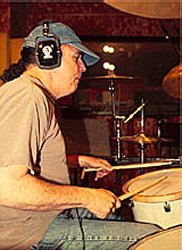 Eddie: It just happened. I can't say that I planned anything in my musical journey. I knew I had the love of music, and certainly my Father, who was a Navy fighter pilot, and veteran for 30 years, aided and abetted my progress. I came back to Nashville in 1973 as a piano player, and of course being out of college, I needed work. I heard they were auditioning for a piano player at the Carousel Club in Printers Alley. I went and got the job. It so happened that the drummer for the group was the legendary Larrie Londin. He and I quickly became close friends, and remained so until his untimely death. Your readers should certainly know of him, because he also played on Patty's albums. He inspired me to play drums, which after working in the band for about a year, I left and got a job playing drums in a top 40 band.
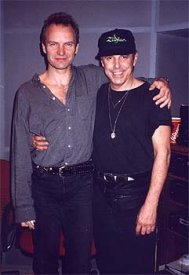
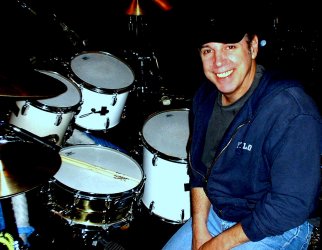 Eddie: We talked of this before, but I do feel it is necessary for someone to have been successful in music, or have full knowledge to be able to "critique." God knows I hate that word. Who, truthfully, could be worthy to call themselves a voice for people's musical choice. The only power they have is the outlet given to them. It's all opinion. It's not for us to judge what people like. I heard a critic once write about a Michael Bolton concert, "can 18,000 people be wrong? YES!!" What a ridiculous statement. How could they be wrong? Those people all loved it. This guy loves to look down on humanity, because of his inflated self worth, and of course because he's been given the job to do this. The true problem is these people have the power to stifle creative talent. Most of us have thick skin to critique, but newcomers are sensitive and can be hurt. No one knows what the potential of any artist can be until it's said and done, but by comments from some unqualified knucklehead, a creative person can be hurt, and shut down. I do realize it's always going to be, but I wish they would take a look at our sports world. They are incorporating more pros into this arena to comment, because they have played the game, and know why it works or doesn't work. I would rather hear a musical critique from someone who has had success in music and was hired by a publication to make those comments for their readers. But you know as well as I, it's still just his opinion.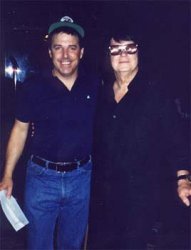
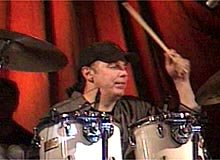 Eddie: As of right now, it enhances my endorsements, such as the companies that supply me with my (here comes a plug) cymbals and sticks (Zildjian), and my drums (Pearl Drums), and my drumheads (Remo) that do effect my career, but I'm sure that when I start selling instructional videos etc, it will create an even greater impact. Needless to say, as a way to personally hear from people worldwide it's great. I exchange email with many people daily, and I am able to pass on to our youth, what might help them in their musical lives.
 Eddie: As of now we don't have a follow up, but we are playing out live, and plan to do this more as time allows. We are planning a video in the future. Also, we are waiting on distribution to help augment our sales, then we can get out and promote. For right now, your readers can logon to http://www.country.com and there is a link to purchase the cd, or it would be easier to click on to my website at