Mythical Beings D through F
D
Death Knight
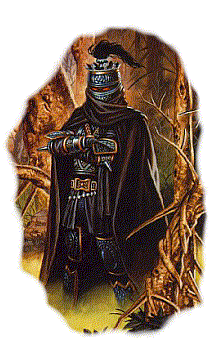
A death knight is the horrifying corruption of a paladin or lawful good warrior cursed by the gods to its terrible form as punishment for betraying the code of honor it held in life. A death knight resembles a hulking knight, typically taller than six feet and weighing more than three hundred pounds. Its face is a blackened skull covered with shards of shriveled, rotting flesh, It has two tiny, glowing orange-red pinpoints for eyes. Its armor is scorched black as if it had been in a fire. The demeanor of a death knight is so terrifying that even the irrepressible kender have been known to become frightened. A death knight's deep, chilling voice seems to echo from the depths of a bottomless cavern. A death knight converses in the language it spoke in its former life, as well as up to six additional languages. Death knights are former good warriors who were judged by the gods to be guilty of unforgivable crimes, such as murder or treason. (For instance, Krynn's Lord Soth, the most famous of all death knights, murdered his wife so that he could continue an affair with an elfmaid.) Death knights are cursed to remain in their former domains, usually castles or other strongholds. They are further condemned to remember their crime in song on any night when the moon is full; few sounds are as terrifying as a death knight's chilling melody echoing through the moonlit countryside. Death knights are likely to attack any creature that interrupts their songs or trespasses in their domains. Death knights have no physiological functions. They are sometimes accompanied by banshees, skeleton warriors, liches, and other undead who serve as their aides.
Dracolich
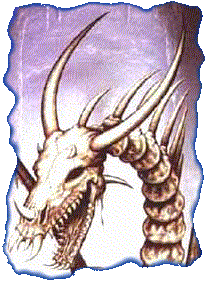
The dracolich is an undead creature resulting from the unnatural transformation of an evil dragon. The mysterious Cult of the Dragon practices the powerful magic necessary for the creation of the dracolich, though other practitioners are also rumored to exist. A dracolich can be created from any evil dragon subspecies. A dracolich retains the physical appearanceof its original body, except that its eyes appear as glowing points of light floating in shadowy eye sockets. Skeletal and semi-skeletal dracoliches have been observed on occasion. The senses of a dracolich are similar to those of its original form; it can detect invisible objects and creatures (inculding those hidden in darkness of fog) within a ten foot radius per age category and also possesses a natural clairaudience ability while in its lair equal to a range of twenty feet per age category. A dracolich can speak, cast spells, and employ the breath weapon of its original form; it can cast each of its spells once per day. Additionally, a dracolich retains the intelligence and memory of its original form.
Dryad
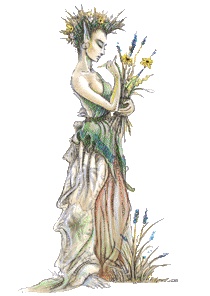 Dryads are beautiful, intelligent tree sprites. They are as elusive as they are alluring, however, and dryads are rarely seen unless taken by surprise -- or they wish to be spotted. The dryad's exquisite features, delicate and finely chiseled, are much like an elf maiden's. Dryads have high cheek bones and amber, violet, or dark green eyes. A dryad's complexion and hair color changes with the seasons, presenting the sprite with natural camouflage. During the fall, a dryad's hair turns golden or red, and her skin subtly darkens from its usual light tan to more closely match her hair color. This enables her to blend with the falling leaves of autumn. In winter, both the dryad's hair and skin are white, like the snows that cover the oak groves. When encountered in a forest during fall or winter, a dryad is often mistaken for an attractive maid, probably of elvish descent. No one would mistake a dryad for an elf maid during the spring and summer, however. At these times of year, a dryad's skin is lightly tanned and her hair is green like the oak leaves around her. Dryads often appear clothed in a loose, simple garment. The clothing they wear is the color of the oak grove in the season they appear. They speak their own tongue, as well as the languages of elves, pixies, and sprites. Dryads can also speak with plants. Dryads are shy, nonviolent creatures. They rarely carry weapons, but they sometimes carry knives as tools. Though a dryad can use this as a weapon in a fight, she will not resort to using a knife unless seriously threatened. Dryads have the ability to throw a powerful charm person spell three times a day. A Dryad always uses this spell if seriously threatened, attempting to gain control of the attacker who could help her most against his comrades. Dryads will only attempt to charm elves as a last resort because of their natural resistance to this type of spell. The dryad's use of her ability to charm is not limited to combat situations, however. Whenever a dryad encounters a handsome male, she usually tries to charm him. Charismatic victims of a dryad's attentions are taken to the tree sprite's home, where the men serve as amorous slaves to their beautiful captors. There is a fifty percent chance that a person charmed and taken away by a dryad will never return. If he does escape from the dryad's charms, it will be after one to four years of captivity. This tree sprite also has two other powers that are very useful in defense. Unless surprised, a dryad has the ability to literally step through a tree and then dimension door to the oak tree she is part of. She can also speak with plants. This enables the dryad to gather information about parties traveling near her tree, and even to use vegetation to hinder potential attackers.Some legends claim that dryads are the animated souls of very old oak trees. Whether this is really the case, it is true that dryads are attached to a single, very large oak tree in their lifetimes and cannot, for any reason, go more than 360 yards from that tree. If a dryad does wander farther away, she becomes weak and dies within 6d6 hours unless returned to her home. The oak trees of dryads do not radiate magic, but someone finding a dryad's home has great power over her. A dryad suffers damage for any damage inflicted upon her home tree. Any attack on a dryad's tree will, of course, bring on a frenzied defense by the dryad. Although dryads are generally very solitary, up to six have been encountered in one place. This is rare, however. All this really means is that a number of dryad oaks are within one hundred yards of one another and the dryads' paths cross. These dryads may come to each other's aid, but never really gather socially. Any treasure owned by a tree sprite is hidden close to her home tree. The gold and gems that make up a dryad's treasure are almost always the gifts of charmed adventurers. These tree sprites realize that most humans and demihumans fear them for their ability to charm, so dryads only deal with strangers on rare occasions. When approached carefully, however, dryads have been known to aid adventurers. They are a useful source of information, too, as they know a great deal about the area in which they live. Dryads are staunch protectors of the forest and groves in which they reside. Any actions that harm the area, and especially its plant life, are met with little tolerance.
Dwarf
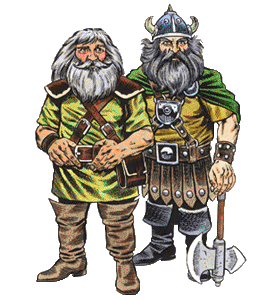 Dwarves are a noble race of demihumans who dwell under the earth, forging great cities and waging massive wars against the forces of chaos and evil. Dwarves also have much in common with the rocks and gems they love to work, for they are both hard and unyielding. It's often been said that it's easier to make a stone weep than it is to change a dwarf's mind. Standing from four to four and a half feet in height, and weighing one hundred and thrity to one hundred and seventy pounds, dwarves tend to be stocky and muscular. They have ruddy cheeks and bright eyes. Their skin is typically deep tan or light brown. Their hair is usually black, gray, or brown, and worn long, though not long enough to impair vision in any way. They favor long beards and mustaches, too. Dwarves value their beards highly and tend to groom them very carefully. Dwarves do not favor ornate stylings or wrappings for their hair or their beards. Dwarven clothing tends to be simple and functional. They often wear earth tones, and their cloth is considered rough by many other races, especially men and elves. Dwarves usually wear one or more pieces of jewelry, though these items are usually not of any great value or very ostentatious. Though dwarves value gems and precious metals, they consider it in bad taste to flaunt wealth. Dwarves usually live from 350 to 450 years. Dwarves have found it useful to learn the languages of many of their allies and enemies. In addition to their own languages, dwarves often speak the languages of gnomes, goblins, kobolds, orcs, and the common tongue, which is frequently used in trade negotiations with other races. Dwarves are courageous, tenacious fighters who are ill-disposed toward magic. They never use magical spells or train as wizards, though they can become priests and use the spells of this group. Because of their nonmagical nature, in fact, they are rather resistant to some types of sorcery. A dwarf's nonmagical nature can also cause problems when he tries to use a magical item. In fact, if a dwarf uses a magical item that is not specifically created for his class, there is a twenty percent chance the item malfunctions. As with magical attacks, dwarves are unusually resistant to toxic substances. In the thousands of years that dwarves have lived in the earth, they have developed a number of skills and special abilities that help them to survive. All dwarves have infravision that enables them to see up to sixty feet in the dark. When underground, dwarves can tell quite a bit about their location by looking carefully at their surroundings. When within ten feet of what they are looking for, dwarves can detect the grade and slope of a passage, new tunnel construction, sliding/shifting walls or rooms, and stonework traps, pits, and deadfalls. Dwarves can also determine their approximate depth underground at any time. During their time under the earth, dwarves have also developed an intense hatred of many of the evil creatures they commonly encounter. The small size of dwarves is an advantage against ogres, trolls, ogre magi, giants, and titans; because of that size difference and the dwarves' training in fighting such large foes. Dwarven armies are well-organized and extremely well-disciplined. Dwarven troops usually wear chain mail and carry shields in battle. They wield a variety of weapons. The composition of a typical dwarven army by weaponry is axe and hammer, sword and spear, sword and light crossbow, word and pole arm, axe and heavy crossbow, axe and mace, or hammer and pick. The commanders of the dwarven troops wear plate armor and carry shields. Usually constructed around profitable mines, dwarven cities are vast, beautiful complexes carved into solid stone. Dwarven cities take hundreds of years to complete, but once finished they stand for millennia without needing any type of repair. Since dwarves do not leave their homes often and always return to them, they create their cities with permanence in mind. Troops guard dwarven cities at all times, and sometimes dwarves also use animals as guards -- either several brown bears or a few dozen wolves. Dwarven society is organized into clans. A dwarven clan not already attached to a city or mine travels until it finds an outpost where it can begin to ply a trade. Clans often settle close together since they usually need the same raw materials for their crafts. Clans are competitive, but usually do not war against one another. Dwarven cities are founded when enough clans move to a particular location. Each dwarven clan usually specializes in a particular craft or skill; young dwarves are apprenticed at an early age to a master in their clan (or, occasionally, in another clan) to learn a trade. Since dwarves live so long, apprenticeships last for many years. Dwarves also consider political and military service a skilled trade, so soldiers and politicians are usually subjected to a long period of apprenticeship before they are considered professionals. To folk from other races, life within these cities might seem as rigid and unchanging as the stone that the dwarven houses are wrought from. In fact, it is. Above all, dwarves value law and order. This love of stability probably comes from the dwarves' long life spans, for dwarves can watch things made of wood and other mutable materials decay within a single lifetime. It shouldn't be surprising, then, that they value things that are unchanging and toil ceaselessly to make their crafts beautiful and long-lived. For a dwarf, the earth is something to be loved because of its stability and the sea a thing to be despised -- and feared -- because it is a symbol of change. Dwarves also prize wealth, as it is something that can be developed over a long period of time. All types of precious metal, but particularly gold, are highly prized by dwarves, as are diamonds and other gems. They do not value pearls, however, as they are reminders of the sea and all it stands for. Dwarves believe, however, that it is in poor taste to advertise wealth. Metals and gems are best counted in secret, so that neighbors are not offended or tempted. Most other races see dwarves as a greedy, dour, grumpy folk who prefer the dampness of a cave to the brightness of an open glade. This is partially true. Dwarves have little patience for men and other short-lived races (since man's concerns seem so petty when seen from dwarven eyes). Dwarves also mistrust elves because they are not as serious-minded as dwarves and waste their long lives on pastimes the dwarves see as frivolous. However, dwarves have been known to band together with both men and elves in times of crisis, and long-term trade agreements and alliances are common. Dwarves have no mixed feelings about the evil races that dwell below ground and in the Underdark, however. They have an intense hatred of orcs, goblins, evil giants, and drow. The dire creatures of the Underdark often fear dwarves, too, for the short, stout folk are tireless enemies of evil and chaos. It is a goal of the dwarves to wage constant and bitter war against their enemies under the earth until either they or their foes are destroyed. Since much of their culture is focused on creating things from the earth, dwarves produce a large amount of useful, valuable trade material. Dwarves are skilled miners. Though they rarely sell the precious metals and rough gems they uncover, dwarven miners have been known to sell surpluses to local human communities. Dwarves are also skilled engineers and master builders -- though they work almost exclusively with stone -- and some dwarven architects work for humans quite frequently. Dwarves most often trade in finished goods. Many clans are dedicated to work as blacksmiths, silversmiths, goldsmiths, armorers, weapons makers, and gem cutters. Dwarven products are highly valued for their workmanship. In human communities, these goods often demand prices up to 20% higher than locally forged items. Many people are still willing to pay a high price for a suit of dwarven mail or a dwarven sword. Humans know that the dwarf who forged the item made it to last a dwarven lifetime, so they'll never need to worry about it wearing out in theirs.
E
Elemental, Generic Information
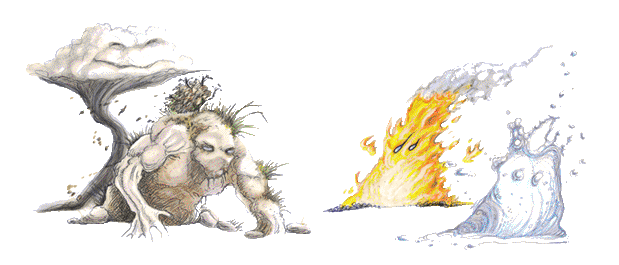 Elementals are sentient beings that can possess bodies made of one of the four basic elements that make up the Prime Material plane -- air, earth, fire, or water. They normally reside on an elemental Inner Plane and will only be encountered on the Prime Material plane if they are summoned by magical means. Each elemental must adopt a shell in the Prime Material composed of the basic element it represents, and once this shell is destroyed, the elemental will return to its native plane. While there are many more powerful and more intelligent residents of the elemental planes, the common elemental is the easiest to contact, and therefore the most frequently summoned. Their magical nature gives elementals great protection from attacks on the Prime Material plane. Elementals are not harmed by any nonmagical weapons or magical weapons of less than the finest enchantment. Though elementals do enjoy protection from many nonmagical attacks in the Prime Material plane, like all extraplanar and conjured creatures, elementals are affected by protection from evil spells. An elemental cannot strike a creature protected by this spell and must recoil from the spell's boundaries. However, the elemental can attack creatures protected by the spell as long as it doesn't touch them. For example, a fire elemental could set the ground on fire around the creature and wait for the blaze to spread. Each of the four types of common elemental has its own particular strengths and weaknesses, attack modes and method of movement, depending on its plane of origin. All common elementals share one major characteristic, however. They are basically stupid. This low intelligence makes it difficult for the elemental to resist a magical summons. But even the common elemental is bright enough to know it does not like being taken off of its home plane and held in the Prime Material plane. There are three basic ways to call an elemental to this plane, and the strength of the conjured elemental depends on the method used to summon it: by spell, staff, or summoning device. Obviously, the type of wizard or priest spell used to contact an elemental will greatly effect the size of the creature on this plane. Each individual's use of any spell, staff, or device in contacting the elemental planes produces a unique call. This unique summons will only be answered by the inhabitants of a particular plane once per day. Therefore, each of the methods of summoning elementals -- spell, device, and staff -- can be used by one person to call only one of any specific type of common elemental per day. If a staff is used four times in one day, for example, all four types of elementals must be called once. The only exception to this is an individual using more than one method to call elementals. Then, the conjurer can call a number of elementals of the same type equal to the number of methods he or she uses. This means a person with a device and a staff can summon two earth elementals. However, a person with two staffs can still summon only one elemental of any specific type in one day. Because the elemental will be furious at being summoned to this plane, concentration in conjuring the creature is vital. In calling an elemental, a person must remain perfectly still and focus all of his attention on controlling the being. Any distraction to the summoner, either mental or physical, will result in a failure to control the elemental when it arrives on the Prime Material plane. Elementals that are uncontrolled and acting upon their own desires are called free-willed. If a group is lucky, a free-willed elemental will immediately return to its plane. However, this occurs only a quarter of the time. In most cases, an uncontrolled elemental will immediately attack the person or party who conjured it, also destroying anything that stands between it and its enemies. There is no way to gain control of the elemental once it is lost, and there is nothing the objects of the elemental's wrath can do but defend themselves. The elemental's intense dislike of being away from its home plane is the only safeguard those conjuring an elemental can rely upon if the elemental runs wild. Because remaining on the Prime Material plane is painful to any common elemental, the uncontrolled elemental will always return to its plane of origin three turns after control is lost, whether it has destroyed the creatures responsible for calling it away from its elemental abode or not. There is always a slim chance that an elemental in the Prime Material will break control and attack the person who summoned it. Also, if a person is wounded, killed, or loses concentration while controlling an elemental, the creature will become free-willed. The elemental will first attack the person who summoned it and then destroy any living thing it can find after control is lost. The creature will then return to its home in the Inner Planes. A free-willed elemental can be sent to its home plane if a dismissal spell is cast upon it, but there is only a fifty percent chance of success for the spell in this situation. A successfully controlled elemental will stay on the Prime Material only for the duration of the spell that summoned it, and it can be controlled from a distance up to thrity yards per level of the person who summoned it. If under control, an elemental can be dismissed by the summoner when its task is complete. Control of a conjured elemental can be stolen from the person who summoned it by casting dispel magic specifically at the magical control over the creature (not the elemental itself or the person controlling it). Most of the normal rules for dispelling magic apply. If control of the elemental is stolen, the creature will follow the wishes of the new person controlling it as if he or she summoned it in the first place. If the dispel magic fails, the elemental will immediately be strengthened to its maximum health and the conjurer's ability to control the elemental will be greatly enhanced, making any new attempts to steal control of the creature impossible. Also, the elemental will recognize the person who sought to take control of its will as a threat. If the person currently guiding the creature loses control, the elemental will immediately attack the person who attempted to steal control of its will -- even before attacking the person who first summoned it.
Elves
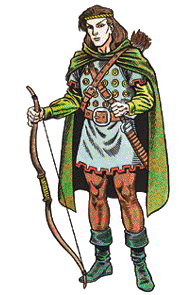 Though their lives span several human generations, elves appear at first glance to be frail when compared to man. However, elves have a number of special talents that more than make up for their slightly weaker constitutions. High elves, the most common type of elf, are somewhat shorter than men, never growing much over than five feet tall. Male elves usually weigh between ninety and one hundred and twenty pounds, and females weigh between seventy and one hundred pounds. Most high elves are dark-haired, and their eyes are a beautiful, deep shade of green. They posses infravision up to sixty feet. The features of an elf are delicate and finely chiseled. Elves have very pale complexions, which is odd because they spend a great deal of time outdoors. They tend to be slim, almost fragile. Their pale complexion and slight builds are the result of a constitution that is weaker than man's. Though they are not as sturdy as humans, elves are much more agile. Elven clothing tends to be colorful, but not garish. They often wear pastel colors, especially blues and greens. Because they dwell in forests, however, high elves often wear greenish grey cloaks to afford them quick camouflage. Elves have learned that it is very important to understand the creatures, both good and evil, that share their forest home. Because of this, elves may speak the tongues of goblins, orcs, hobgoblins, gnolls, gnomes, and halflings, in addition to common and their own highly-developed language. They will always show an interest in anything that will allow them to communicate with, and learn from, their neighbors. Elves are cautious fighters and always use their strengths to advantage if possible. One of their greatest strengths is the ability to pass through natural surroundings, woods, or forests, silently and almost invisibly. By moving quietly and blending into vegetation for cover, elves will often surprise a person or party. As long as they are not attacking, the elves hiding in the forest can only be spotted by someone or something with the ability to see invisible objects. The military value of this skill is immense, and elven armies will always send scouts to spy on the enemy, since such spies are rarely caught-or even seen. Although their constitutions are weak, elves posses an extremely strong will, such strong wills, in fact, that they have a terrific immunity to all charm and sleep spells. Elves live in the wild, so weapons are used for everything from dealing with the hostile creatures around their camps, to such mundane tasks as hunting for dinner. The elves' rigorous training with bows and swords, in addition to their great dexterity, gives them a natural lethality when fighting with a short or long sword, or when using a bow of any kind, other than a crossbow. Elves are especially proficient in the use of the bow. Because of their agility, elves can move, fire a bow, and move again, all in the same round. Their archers are extremely mobile, and therefore dangerous. Because of limitations of horses in forest combat, elves do not usually ride. Elves prefer to fight as foot soldiers and are generally armed as such. Most elves wear scale, ring, or chain mail, and almost all high elves carry shields. Although elves have natural bonuses when they use bows and swords, their bands carry a variety of weapons. The weapons composition of a band of elves is: spear, sword, sword and spear, sword and bow, bow, or two-handed sword. Elven women are the equal of their male counterparts in all aspects of warfare. In fact, some bands of elves will contain units of female fighters, who will be mounted on unicorns. This occurs rarely, and only ten to thirty elf maidens will be encountered in such a unit. However, the legends of the destruction wrought by these elven women are rampant among the enemies of the elves. Elves value their individual freedom highly and their social structure is based on independent bands. These small groups, usually consisting of no more than two hundred, recognize the authority of a royal overlord, who in turn owes allegiance to a king or queen. However, the laws and restraints set upon elven society are very few compared to human society and practically negligible when compared to dwarven society. Elven camps are always well-hidden and protected. In addition to the large number of observation posts and personnel traps set around a camp, high elves typically set a dozen giant eagles as guardians of their encampments. Because elves live for several hundred years, their view of the world is radically different from most other sentient beings. Elves do not place much importance on short-term gains nor do they hurry to finish projects. Humans see this attitude as frivolous; the elves simply find it hard to understand why everyone else is always in such a rush. Elves prefer to surround themselves with things that will bring them joy over long periods of time-things like music and nature. The company of their own kind is also very important to elves, since they find it hard to share their experiences or their perspectives on the world with other races. This is one of the main reasons elven families are so close. However, as friendship, too is something to be valued, even friends of other races remain friends forever. Though they are immune to a few specific spells, elves are captivated by magic. Not specific spells, of course, but the very concept of magic. Cooperation is far more likely to be had from an elf, by offering an obscure, even worthless, (but interesting) magical item, than it is with two sacks of gold. Ultimately, their radically different perspective separates the elves from the rest of their world. Elves find dwarves too dour and their adherence to strict codes of law unpleasant. However, elves do recognize dwarven craftsmanship as something to be praised. Elves think a bit more highly of humans, though they see man's race after wealth and fleeting power as sad. In the end, after a few hundred years, all elves leave the world they share with dwarves and men, and journey to a mysterious land where they live freely for the rest of their extremely long lives. Elves produce fine clothes, beautiful music, and brilliant poetry. It is for these things that other cultures know the folk of the forest best. In their world within the forest, however, elves hold in check the dark forces of evil, and the creatures that would plunder the forest and then move on to plunder another. For this reason alone, elves are irreplaceable.
Grey Elves (Faerie)
Grey elves have either silver hair and amber eyes, or pale golden hair and violet eyes (the violet-eyed ones are known as faerie elves). They favor bright garments of white, gold, silver, or yellow, and wear cloaks of deep blue or purple. Grey elves are the rarest of elves, and they have little to do with the world outside their forests. They value intelligence very highly, and, unlike other elves, devote much time to study and contemplation. Their treatises on nature are astounding. Grey elves value their independence from what they see as the corrupting influence of the outside world, and will fight fiercely to maintain their isolation. All grey elves carry swords, and most wear chain mail and carry shields. For mounts, grey elves will ride hippogriffs or griffons. Those that ride griffons will have a dozen griffons for guards in their camps, instead of giant eagles.
Wood Elves
Also called sylvan elves, wood elves are the wild branch of the elf family. They are slightly darker in complexion than high elves, their hair ranges in color from yellow to coppery-red, and their eyes are light brown, light green, or hazel. They wear clothes of dark browns and greens, tans and russets, to blend in with their surroundings. Wood elves are very independent and value strength over intelligence. They will avoid contact with strangers most of the time. In battle, wood elves wear studded leather or ring mail, and half of their band will be equipped with bows. Only a few of wood elves carry swords, and most use spears. Wood elves prefer to ambush their enemies, using their ability to hide in the forest until their foes are close at hand. In most cases, wood elf camps are guarded by several giant owls or by a couple giant lynx. These elves speak only elf and the languages of some forest animals, and the treant. Wood elves are more inclined toward neutrality than good, and are not above killing people who stumble across their camps, in order to keep their locations secret.
Half-Elves
Half-elves are of human stock, and have features of both the elf and human parents. They are slightly taller than common elves, growing as tall as five and a half feet and weighing up to one hundred and fifty pounds. Though they do not gain the natural sword or bow bonuses from their elven relatives, but they do have normal elven infravision. A half-elf can travel freely between most elven and human settlements, though occasionally prejudice will be a problem. The half-elf's life span is their biggest source of grief, however. Since a half-elf lives more than one hundred and twenty five years, he or she will outlive any human friends or relatives, but grow old too quickly to be a real part of elven society. Many half-elves deal with this by traveling frequently between the two societies, enjoying life as it comes; the best of both worlds. Half-elves may speak common, elf, gnome, halfling, goblin, hobgoblin, orc, and gnoll.
I am dreadfully sorry but the tome is still being written, please come back again another time.

