
Welcome to the tour of the USS Mystic
This tour will cover most of the ships primary areas but may jump around on the ship, for an accurate deck layout please see the Ship Information section under the SHIP Button. We will start our tour on the Bridge.
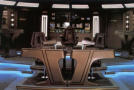
The Bridge of this USS Mystic is reflective of a standard Sovereign class design though all comnsoles can be switched to 24th, 25, or 26th century layouts for ease of use by personel from different time periods. The consoles can also be customized with a combination layout comprising of aspects from multiple layout forms.
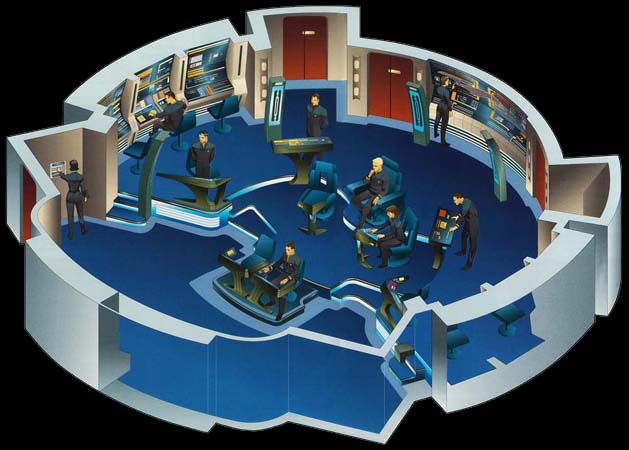
Bridge Layout: The
central area of the Main Bridge provides seating and information
displays for the Captain and two other officers. The Captain's Chair is
raised from the rest of the Bridge Officers, to that of the Surrounding
level which includes Tactical and Operations. The Captain's chair was
reengineered to recline just like the chair that was on the Old USS
Mystic. The two Officer seats are equipped with fully programmable
consoles for a variety of uses. Directly fore of the command area is the
Flight Control Officer, who faces the main viewer. The FCO is equipped
with a console that proceeds around at a ninety degree angle.
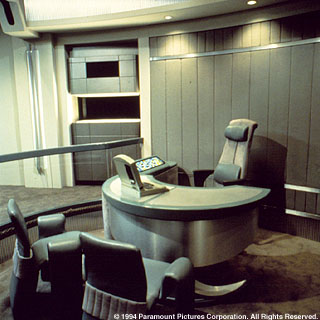
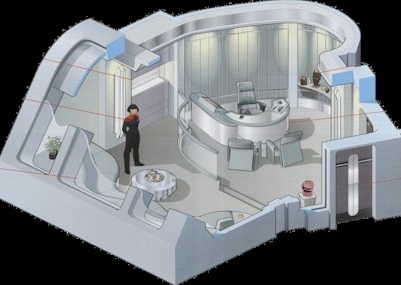
While a sovereign class
vessel, the captains ready room is more reflectant of that found on an
Intrepid class vessel, for details on the
Captain's ready room visit the

In the confrence room all seats feature a countertop-style computer terminal on the table which is hooked to the large screens on the side walls. This allows images on the walls to be pulled up by individuals for closer observation and permits officers to find important information while in meetings. through a side door of the confrence room is the First Officer's Office.
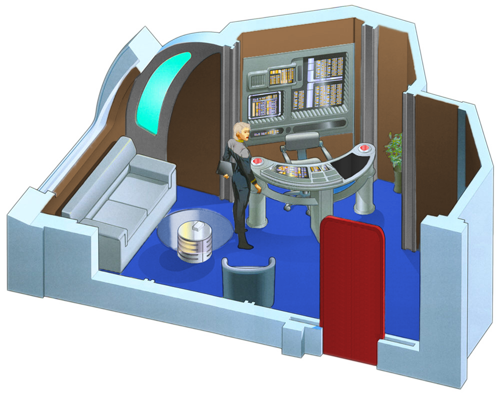
As with all Chief / Head Officer's offices there is a countertop computer terminal on the desk and a large display terminal behind the chair and desk. There is a secret compartment under the large-screen wall terminal that can hold a Phaser rifle and a D'K'tagh knife in case of emergencies.
On deck 18 is the Battle Bridge with a simple layout; the Captain seat in the middle with Conn & Ops in front, Tactical located behind the Captain, Science to Tacticals Left, Security to Tacticals Right, and Engineering sceens and wall consoles to the back of the bridge.

This Concludes our tour of the Bridge... next stop, Sickbay and its related facilities.
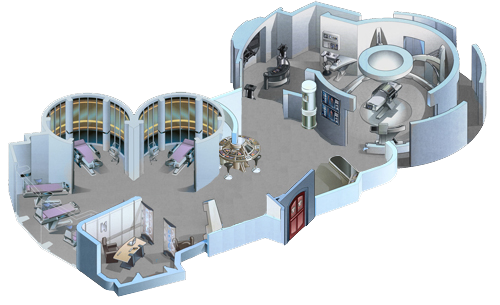
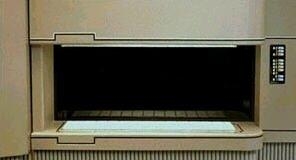
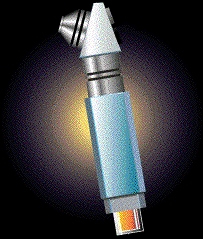
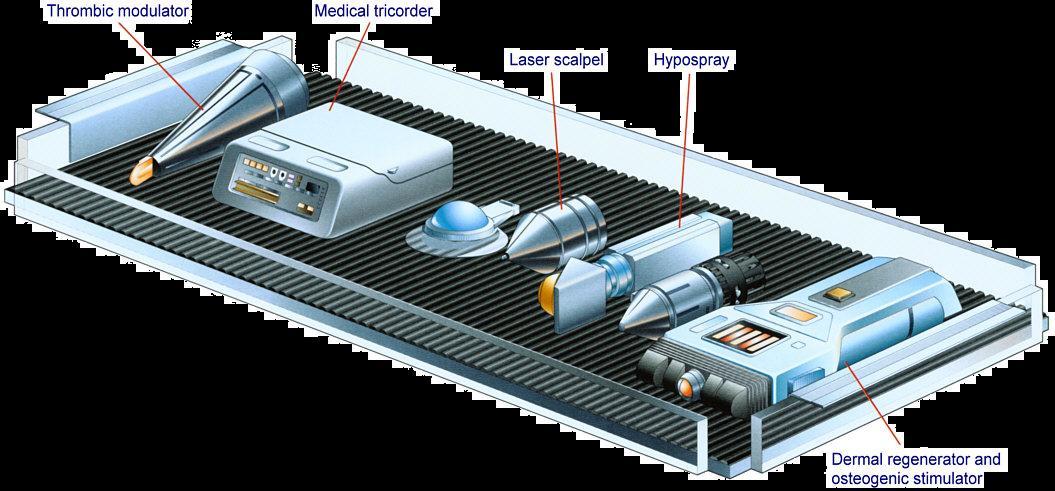
Main Sickbay is one large facility, located on Deck 7, which serves as the primary care facility on Sovereign-class starships. Equipped with six standard and one advanced bio-bed, Sickbay is also home to the Chief Medical Officer´s office and a small lab used for routine analysis of patients. The room itself is considered to be general-purpose, often the location of regular crew physicals, appointments, and various medical emergencies, it can effectively handle the majority of situations that a starship crew will face. Surrounding Sickbay are more specialized areas, including two intensive-care wards, various isolated medical laboratorys, a nursery, three surgical suites, a null-grav therapy ward, a morgue, a biohazard isolation unit, and a dental care office. Also pursuant to Medical Protocols, all Medical Facilities are equipped with holo-emitters for the usage of the Emergency and Long Term Medical Holograph Systems. The Chief Medical Officer's office has a countertop-style computer terminal and a large wall-display terminal. There is a secret compartment under the large wall-display terminal that can hold a Phaser rifle and a D'K'tagh knife in case of emergencies.The picture below is just a small sample of sickbays facilities.

Not far from Main Sickbay are the Primary Science Labs which include a medical research facility which has one huge full wall-display terminal and two side sitting terminals with wall monitors. Located in the back room are the testing areas and experiment storage. The Counselor´s Office tends to be located near the main sickbay facilities. A modest room approximately the size of a standard living room compartment, it can easily be moved somewhere within the residential areas of the ship at the Counselor´s discretion. While decorated to the tastes of the staff using it, the office tends to be equipped with comfortable seating and colors to better relax its visitors. The room has a standard replicator and a hidden panel behind the counselor's desk that can hold a Phaser rifle and a D'K'tagh knife in case of emergencies. Three smaller counseling offices like the picture below can be found scattered thru the ship but are rarely used. These rooms have a bed for patients to lie on with a chair at the head for the counselor to sit in. If a patient will not lie down then they can use the chair to sit opposite the counselor at the desk. The desk has a countertop-style computer terminal.
Located on Deck 9 the Marine/Airmen Deck is a Secondary Sickbay that has some medical staff at all times but in cases when no staff are present a Medical Hologram activates. This hologram is based on the old Voyager EMH design that was nicknamed "Doctor." Up to three holographic nurses can be summoned by the Medical Hologram. These emergency nurses and doctor programs are also available in primary Sickbay areas but are only used there in times of urgency and distress.

All sickbay areas have one specialized replicator that can dispense medication and tools by authorized medical personnel only. The Captain and First Officer are the only two who can override the medical replicator's command authorization codes.

This concludes our tour of Sickbay and its related facilities... next stop, Science and its facilities.
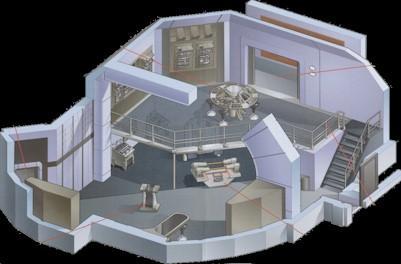
Even though the original emphasis on the Sovereign class was tactical engagements, the vessel is equipped with a modest amount of scientific research space, in keeping with the mandate of the United Federation of Planets and Starfleet. There are twenty-five science labs on the Sovereign class; five Primary labs on deck 7 adjacent to Sickbay along with 2 multifunction labs, 5 bio-chem-physics labs that can also be reconfigured for Medical labs on deck 8, 10 labs on deck 16, and 5 microlabs on deck 17. The 5 Primary labs on deck 7 are a mixed batch; three are bio-chem-physics, one is an XT (extra-terrestrial) analysis labs, and one eugenic lab. The five smaller labs on deck 17 can be configured for astrophysics/astrometrics and stellar cartography studies though one stellar cartography bay is located on deck 11, with direct EPS power feed from engineering. All information is directed to the bridge and can be displayed on any console or the main viewscreen. The Chief Science Officer´s office is located next to the Stellar Cartography bay. While not as impressive or large as the Galaxy-class Stellar Cartography Bay, the emphasis on the design was one of function over form. The bay more closely resembles the Intrepid-class Stellar Cartography bay and deals with system charting, maps, courses, and large data transfers.

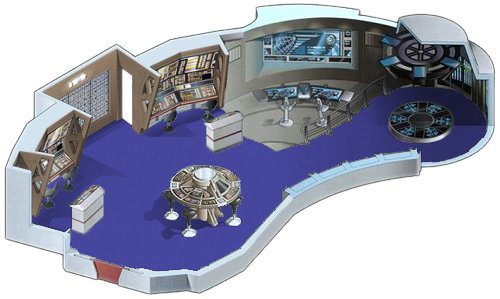
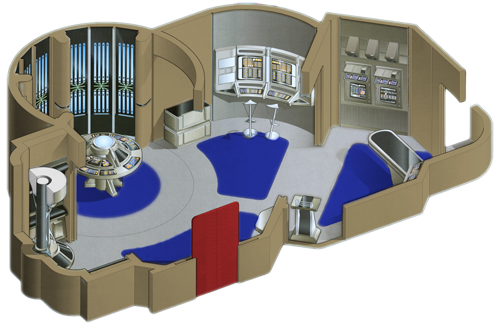 Three other note
worthy science staff monitored areas
are Hydroponics and Airponics which grow fresh food for the ship, and the Arboretum. (indoor biosphere).
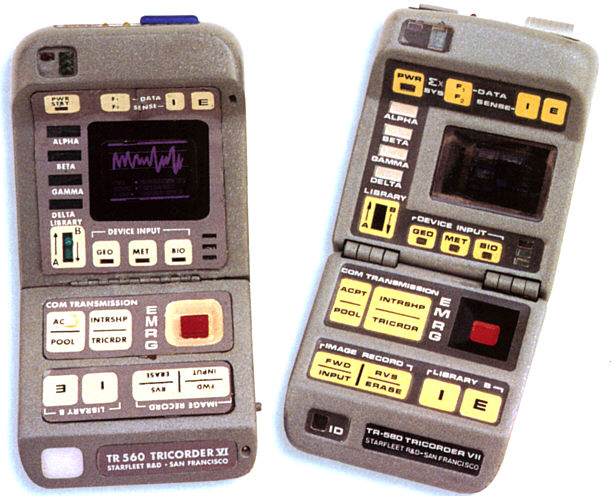
Most science officers are allowed to wear a tricorder at all times
especially scine they use them more then any other department.
Three other note
worthy science staff monitored areas
are Hydroponics and Airponics which grow fresh food for the ship, and the Arboretum. (indoor biosphere).
Most science officers are allowed to wear a tricorder at all times
especially scine they use them more then any other department.
 The Chief Science Officer's office is
much the same as the First Officer's office, there is a countertop
computer terminal on the desk and a large display terminal behind the
chair and desk. There is a secret compartment under the large-screen
wall terminal that can hold a Phaser rifle and a D'K'tagh knife in case of emergencies.
The Chief Science Officer's office is
much the same as the First Officer's office, there is a countertop
computer terminal on the desk and a large display terminal behind the
chair and desk. There is a secret compartment under the large-screen
wall terminal that can hold a Phaser rifle and a D'K'tagh knife in case of emergencies.
This Concludes our tour of Science and its facilities... next stop, the Recreation Areas.
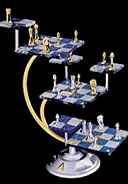
The Lounge (Bar), Kitchen, and Mess Hall are all located on deck 4. The lounge serves as the social center for the starship and is often used for large gatherings and functions. It has a very relaxed and congenial air about it; the Ship´s Lounge is the only place on the ship where rank means nothing - "sir" need not be uttered when a person of lower rank addresses an officer, and everyone enjoys equal footing. Opinions can be voiced in complete safety amongst fellow crewmates, offering a place where people can let loose after a long day. It hosts a bar with 7 bar seats to the front of the bar and 2 platforms with tables to the sides of the bar. The left platform hosts 2 tables with 2 chairs a piece with a game in the center of each of them along with a lounge bench, while the right platform has 3 central tables and 2 lounge benches. The games on the two tables are 3D Chess and 3D Checkers, though 2D versions along with other 2D games can be aquired from the Bartender.
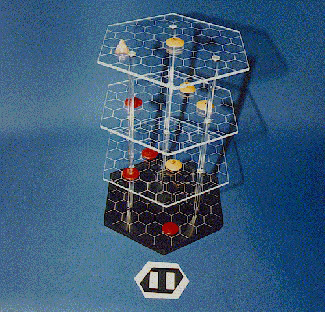
On the back wall across from the bar are 4 booth-like tables that
sit lower to the ground and sport a more relaxing feel. In the center
between the 4 booths is a dart board set up for recreation or tournament
play. The bar has 22 openreplicatorss, 2 dedicated behnd the bar
replicators,and aa bartender supervisedvariety
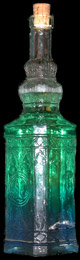
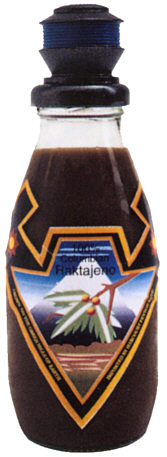
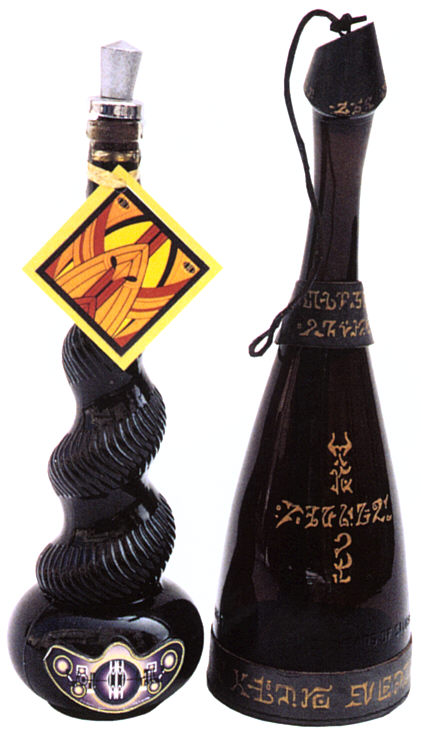
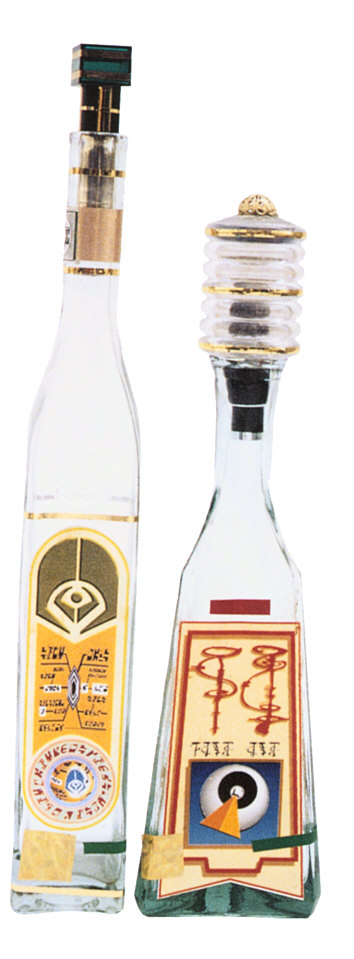
of beverages includingg but not limited toRchech´tluth,
Aldebaran whiskey, Saurian brandy, Tzartak aperitif, Tamarian Frost, C&E
Warp Lager, Warnog, Antarean brandy
TheThe Kitchen and Mess Hall is reminiscent of a design made popular by the USS Voyager in the late 24th century; it sports 4 replicators that can replicate any food or drink if you give it enough information. To the sides of the area are the 2 main doorways into the area. In the center is an elaborate kitchen, with a smaller side room for the Captain's mess.

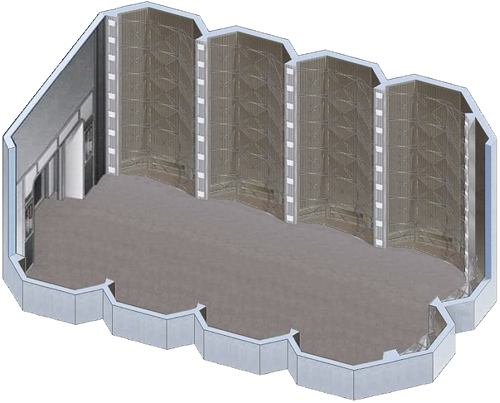
There are 6 main holodecks located on deck 5, although 6 smaller holosuites can be found on deck 4 and another 6 on deck 9. The archway located at the entrance to each holodeck / holosuite has a compartment with a helmet interface for the holodeck controls. This interface allows less mistakes when programming holoprograms and promotes greater safety, security, and accuracy by scanning the subjects active mind while they describe what they want. While the holodeck computers are connected to the rest of the ship they can be severed quickly in the event of a variety of problems arising either inside or outside the holodeck.

The gymnasium is also located on deck 5, next to
the Holodecks. This gymnasium has full body building and exercise
apparatuses available for your disposal; any kind of exercise can be
performed here, be it Terran, Klingon, Vulcan (it isn´t logical to let
your body atrophy), Bajoran, Trill, or others. Some Starfleet personnel
can find solace from the aggravations of day-to-day life in exercising
their bodies. There is also a wrestling mat in the weight room, which
can be used for wrestling, martial arts, kick-boxing, or any other sort
of hand-to-hand fighting. There are holo-diodes along the walls and
ceiling which generate a holographic opponent (if you can´t find someone
to challenge), trained in the combat field of your choice. The computer
stores your personal attack and defense patterns as it gains experience
on your style of fighting, and adapts to defeat you. All personnel must
go through a full physical fitness and hand-to-hand combat test every
six months. There are also racks of hand-to-hand combat weapons, for use
in training. Ancient weapon proficiencies for Starfleet personnel are
recommended by the ship´s security division; phasers may not always be
available for use in contingencies. Terran, Klingon, Betazoid, Vulcan,
Bajoran, and other non-energy weapons are available for training.
Sometimes though the only way a Starfleet officer or crewman can vent his frustration is through the barrel of a phaser rifle; the firing range is located on decks 8 and 9. The firing range is heavily shielded, the walls being composed of a highly refined Duranium alloy, which can absorb setting 16 phaser blasts without taking a scratch. There is also a long side room designed for practicing with old cartridge weapons kept secure but available due to the Mystics history with the Temporal Borg.
Normal phaser recreation and practice is used with a type II phaser set to level 3 (heavy stun). The person stands in the middle of the room, with no light except for the circle in the middle of the floor that the person is standing in. Colored circular dots approximately the size of a human hand whirl across the walls, and the person aims and fires. After completing a round, the amounts of hits and misses, along with the percentage of accuracy is announced by the ship´s computer. The phaser range is also used by security to train ship´s personnel in marksmanship. During training, the holo-emitters in the phaser range are activated, creating a holographic setting, similar to what a holodeck does. Personnel are "turned loose" either independently or in an Away Team formation to explore the setting presented to them, and the security or marine officer in charge of testing will take notes on the performance of each person as they take cover, return fire, protect each other, and perform a variety of different scenarios. All personnel are tested every six months in phaser marksmanship. There are 25 levels of phaser marksmanship. All personnel are trained in the operation of phaser types I and II up to level 14. All security personnel must maintain a level 17 marksmanship for all phaser types while Marines must maintain a level 20 markmanship. The true marksman can maintain at least an 80% hit ratio on level 23.
This concludes our tour of the Recreation Areas... Next stop, Security/Tactical Areas
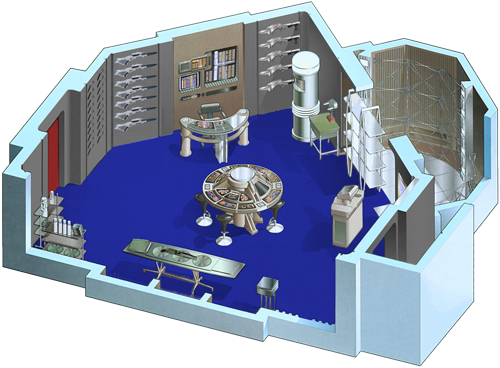
This multi-room department is located in a Restricted area on deck 8. Within it are the entrances to the firing range (accessible upon request), the Brig, the Secondary Weapons Control room and to the Ship´s Secondary Armory, as well as the Chief Security / Tactical Officer´s office. Given the original nature of the Sovereign class, the tactical department facilities are larger than most starships of its size. Not only do the Department Offices include additional office space for security staff, but they include additional briefing rooms and staging areas for security personnel. The CSTO´s office is decorated to the officer´s preference. It contains an ample central work area, a personal computer space an wall computer terminal, a variety of phasers and phaser rifles and a personal replicator. Due to its contents, nature, and computer access this office requires secruity clearance to access unless invited in by the CSTO; even then the sensors in the room scan for hidden weaponry.
Also located on deck 8, the brig is a restricted access area whose only entrance is from within the Security department. The vessel has 10 double occupancy cells, which contain beds, a retractable table and chairs, a water dispenser, and a toilet. The cells are secured with a level 10 forcefield emitter built into each doorway. Located on deck 20 a Secondary brig has 5 single occupancy cells that are a special high risk brig / interrogation room combo designed to allow the questioning or handling of prisoners without risking security personnel safety.
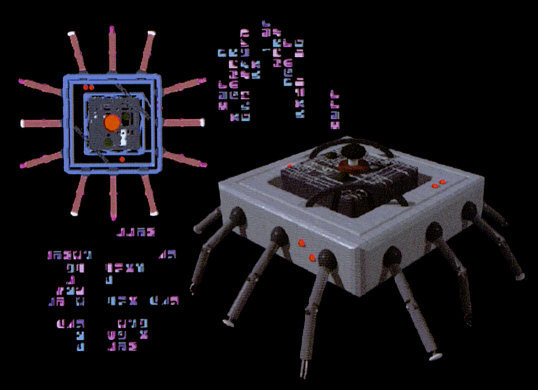
The concept utilizes small tractor beams, Borg nanoprobes that can be inhaled by the inmate, and holograms when needed. The nanoprobes go straight to the brain where they can influence the mind, the pain center of the brain, or be used to heal the prisoner without getting close to them.
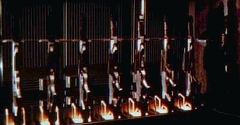
The Ship´s Primary Armory is located in a restricted area on deck 20 with its Secondary Armory located in a restricted area on deck 8 both under constant guard / surveillance. Both rooms are sealed with a level 10 forcefield and can only be accessed by personnel with top level security clearance. Inside the armory is a work area for maintenance and repair of weaponry as well as multiple sealed weapon lockers. The ship carries enough type 1 and type 2 phasers (both types) to arm the entire crew. Type 3 phaser rifles of all types are available, with more than enough Type 3 Mark 3 phaser rifles exist to arm all of Shadow Ops, the Marines, and JSOC. Heavy ordnance in the form of grenades and explosives are available in limited quantities and are reproduced as needed.
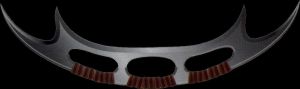
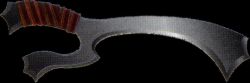
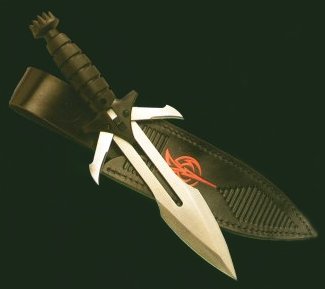
All Armories carry Klingon hand weapons, especially since they proved
effective in protecting the old USS Mystic. Each armory has
Bat'leth's, Mek'leth's, D'K'tagh knives with sheaths, along with
sheathed Kitanas and Wakisashis due to their popularity among human crew
members.
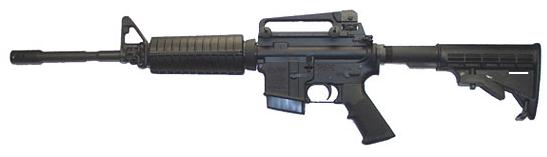
A new addition to the armories are H&K MP-5 sidearms based on the old Earth military design and M-4's also based on the old Earth military design. Multiple clips and limited amount of ammo are kept in each weapons locker along with the means to make more ammunition just in case. These weapons are strictly for use on the Temporal Borg.
This concludes our tour of Security/Tactical Areas... Next stop, Engineering.
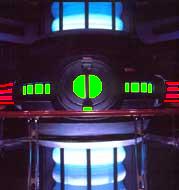
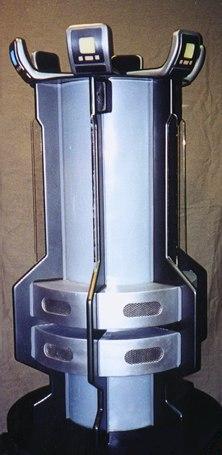
This is an aproximation of what the three cores look like without the casing that contains and separates them. In addition to this core design, the engine requires an Engine Division Regulator (a variant of the Heisenberg compensators) that accounts for the unknown variables that could cause the core to overload or fail. The most unique thing in Main Engineering however is the Main Engineering Station, which is a 31st century Borg Engineering station capable of sentient thought thanks to its unique Advanced A.I.. This station calls itself Terminal X, when the old Mystic was considered not repairable Terminal allowed himself to be removed and hooked up the the new Mystic in order to assit Mysty. Terminal works 10 times faster than a Temporal Borg Drone (also 31st century) and has his own personality to boot. He has proven his loyalty to the Mystic several times over and now shares in the hatred of the Temporal Borg hoping to help eradicate them.
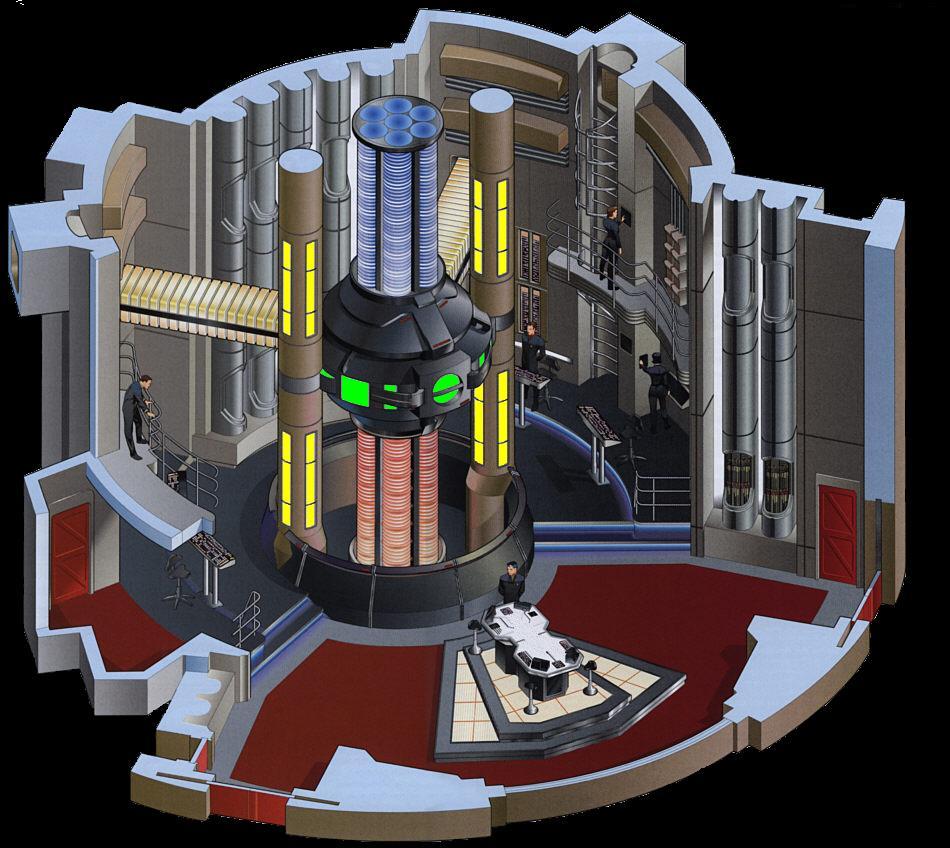
Directly behind the Main Engineering Station is the Tri-Core Engine and main control systems. Circular in shape, the room is an outgrowth of the Galaxy class design, but exceedingly functional to save space inside the ship. Usable consoles are mounted on every piece of 'real estate' around the circumference of the room and provide primary control access for the engineers and technicians. Additionally, there are numerous ladders and access panels to Jefferies tubes, leading throughout the starship - the Sovereign class being the first series of starship to take full advantage of these access spaces for more than extraordinary maintenance. The technical complexity of the starship dictates the use of these spaces to maintain peak efficiency and affect proper repairs. Off to the starboard side of Main Engineering is the Chief Engineer's Office, which is equipped with a diagnostics table, assembly and repair equipment, a small replicator that can replicate average engineering parts and tools with the correct authorization, a personal use console with built-in private viewscreen, and a hidden compartment that can hold a Phaser rifle and a D'K'tagh knife in case of emergencies.
A second tier rings the upper level of Main Engineering on deck 16; two ladders on the opposite ends of the catwalk provide access. Numerous consoles and replicators line this section, serving as auxiliary consoles for Main Engineering, along with providing engineering research space. Access to the Jefferies Tubes is provided in various places on both the first and second tier Engineering spaces.
The Temporal Core's engine room is small and located on deck 17, directly behind main engineering for convenience, and practicality. The Temporal core also has its own Multiphasic Shield array on an independent power source. Auxiliary Warp Core Engineering is small and practical but similar to Main Engineering, located on decks 10 and 11. There are many areas of the ship scattered on many decks that require engineering to staff them or are used by the engineers. Amoung these, located on deck 19 are multiple Misc. Workshops, the Primary Machine Shop, and the R&D labs which act as their own autonomous department. Research & Development engineers tend to be cross trained in other departments to assit in multiple research fields. The R&D Area has Medical, Science, and Engineering Labs as well as space for designing or producing Shuttlecraft items. This area also has diagnostic rooms, assembly bays, reinforced testing rooms, and other useful areas like a Cybernetics lab.

There are 7 transporter rooms throughout the ship and all transporter rooms are manned by Engineering staff. Every transporter room has small storage lockers for general parts as well as a small assortment of weapons in a small locker that requires top level authorization to open.

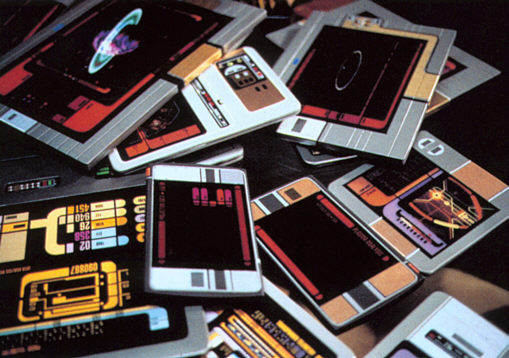
While evey department has an utilizes them, out of every department, Engineering uses padd's the most, although most senior staff members' desks tend to resemble the above picture at any given time... especially the Captain's desk. Engineering aslo has the ability to make new padds using their replicators which tends to lead to departments not returning padds once they receive them.
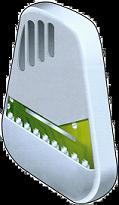
Engineering also stores and maintains the Portable Holoemmiters that the ship has to use. They have 12 devices at any given time, and can make more, though it is a long time consuming task to do so. These devices were highly experimental when the USS Mystic left the late-25th century, since Starfleet was just beginning to be able to make them in a portable fashion.
The most remarkable feat of experimental engineering, combined with computer programming is located on decks 25 and houses the Ship's Advanced Artificial Intelligence Unit & Avatar System nicknamed Mysty. A fully installed space for a Secondary Artificial Intelligence Unit & Avatar System is also found on this deck, though there is not one installed at this time. Access requires access codes from two senior officers as well as retinal identification from said officers. The AI unit the Mystic has was considered experimental and while it was active for years before instillation it was still considered to never be fully tested and shouldn't have been installed in a ship. The original Captain of the Mystic however grew up along side Mysty and pulled some strings to get "The Best Advanced A.I. in existence" put on his ship since then she has proven her loyalty and dependability above and beyond the orginal designers imagination.

This concludes our tour of Engineering... next stop, the Operation / Flight Control Offices
On deck 13 one can find the Operations / Flight Control offices which consist of 2 mission planning rooms, a briefing room for flight control officers and Airmen, a decicated holosuite for use as a flight simulator, and the Chief Ops Officers office. The Chief Operations Officers office is much the same as the First Officer's office, there is a countertop computer terminal on the desk and a large display terminal behind the chair and desk. There is a secret compartment under the large-screen wall terminal that can hold a Phaser rifle and a D'K'tagh knife in case of emergencies.
The operations staff is also instrumental in working alongside engineers to maintain the computer cores and Advanced A.I. systems on the ship. While the Supply Officer does not have their own office they can work out of any area on the ship to keep track of the supplies, equipment, and resources the ship has and needs making them one of the most usefull officers the COO has at their disposal.
This concludes our tour of the Operation / Flight Control Offices... next stop, Shadow Ops
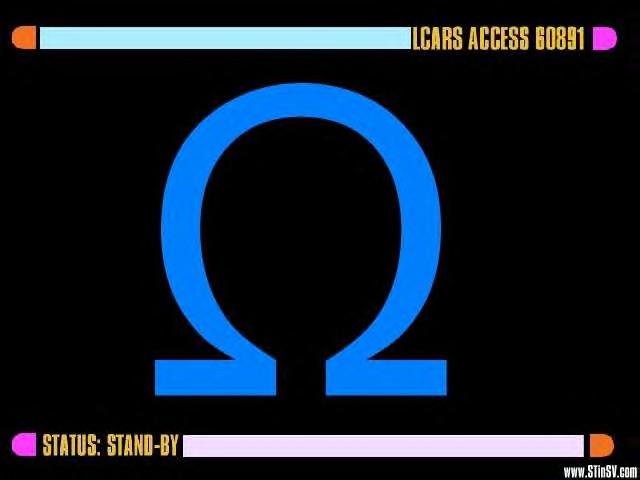
On decks 21 & 22 is the 2 deck special authorization area known as Shadow Ops accessible only by Shadow Ops personnel, the XO, and the CO. No one else has authorization to enter unless authorize by the Captain or two authorized access codes provided to give the new person clearance. No one is quite sure what Shadow Ops looks like or even what all equipment is contained there-in; they can do intelligence, secretive building projects, and assignments that are deemed "Classified." Shadow Ops is basically a Covert Ops department with freedom of secrecy.
This area also contains the rooms for the Omega Particle Holding Tank and Neutralization Units. These rooms require top level clearance to enter, and are usually locked down when the ship isn't dealing with an Omega Directive Incident. The areas have an independent power source for the Holding Tank and Neutralization Units capable of mantaining the equipment, and thus an particles inside, in case of power disruption or an outage. Shadow Ops also contains its own Armory and 2 single occupancy special high risk brig / interrogation room combo cells.
The Head of Shadow Ops has their own office laidout much the same as the First Officer's office, there is a countertop computer terminal on the desk and a large display terminal behind the chair and desk. There is a secret compartment under the large-screen wall terminal that can hold a Phaser rifle, a D'K'tagh knife, and a S.O.C.I.S. in case of emergencies.
This concludes our tour of Shadow Ops... next stop, the Cargobays and Shuttlebays.
There are two cargobays on deck 6 and another on deck 14, each cargo bay has shelving going around the walls that use force fields and miniature tractor beams to move and keep cargo in place. While most cargo is moved around the cargobays and ship with antigrav sleds, some cargo is still physically carried around.
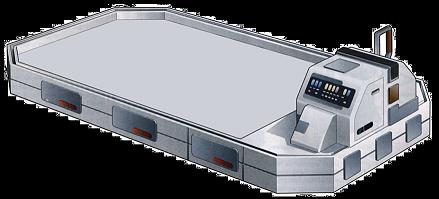

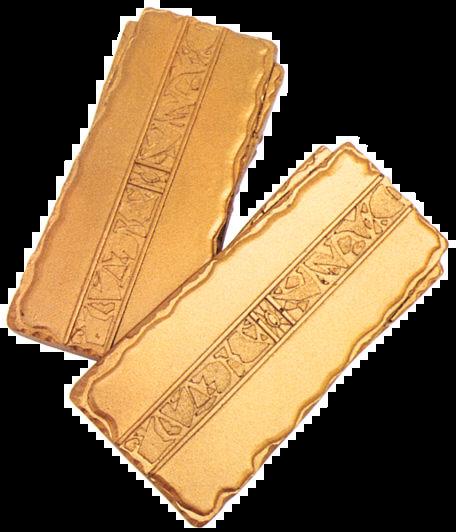
Of all the cargo the Mystic carries on a regular basis, it carries antimatter containers full of antimatter in high-security storage closets. This is kept aboard so the Mystic doesn't have to find a port to return to when antimatter reserves are low. With the amount of things that use power on the Mystic, this is a must have. Also in the cargo bay on deck 14 is a secure vault that can hold up to 10,000 bars of gold-pressed latinum or assortments of other tradable valuables. The current contents of this vault is only known to and accessible by the Captain and Mysty the ship's AI.
The ship has two shuttlebay facilities, one on decks 8-11 on the aft side of the Saucer Section, the other on decks 15-18 on the aft side of the Secondary Hull. The Shuttlebays of the Mystic were redesigned thanks to Section 31 after construction to incorporate elements from the old USS Mystic. One main reason for this is the shuttle storage bays on the side walls. (Exact compliment numbers found on the
SHIP information page) Craft can be flown into a bay and the passenger beamed out, or the shuttlebay operator can use a series of tractor beams located throughout the shuttlebay to place the craft.
View the craft currently in the 
This concludes our tour of the Cargobays and Shuttlebays... next stop, personal quarters.
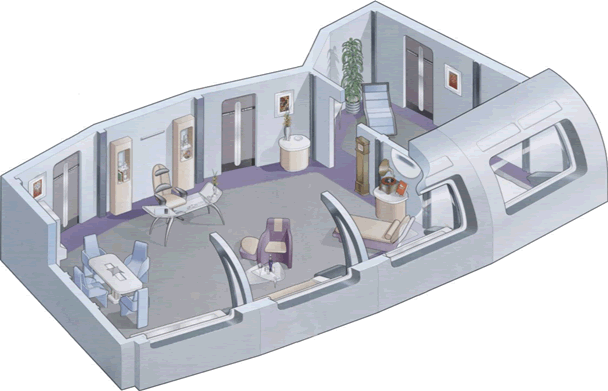
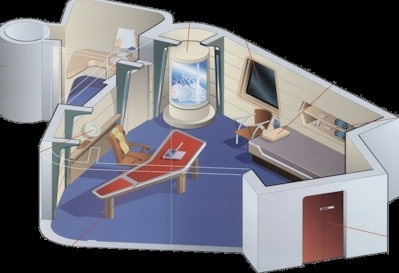
While not all quarters have window views like the above, most are similar in layout though lower ranked officers and NCOs tend to have smaller quarters or in some cases share quarters. There are three doors on average, one leads to a hall, one to the bathroom, and the other to closet space. These locations vary depending on where in the ship it is located. Working left to right in the sample picture.... There is a dining area and replicator, a desk with a countertop-style computer interface, a lounge area with anywhere from 1-3 chairs and a couch, a lounge-style sofa for relaxation, and tables & shelves around the room for adornments and other objects. The next room over is the sleeping room, it has a reclining chair, built in dressers and a bed ranging from single or bunk style to King size, depending on the occupants. Quarters can be obtained with additional rooms for those with a larger family, and areas installed for those with pets. Any other modifications can be made by request to the Captain and First Officer, and are carried out when the engineers become available.
Visit the

This concludes our tour of personal quarters... next stop, the Marine / Airmen Deck.
The deck areas dedicated to the Marines and Airmen are rarely visited by those not living on this deck except for maybe the Captain and First Officer or in times of emergency.
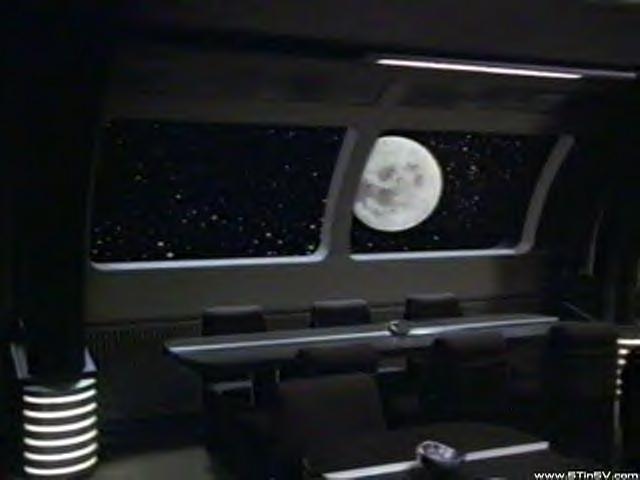
The Marine deck contains quarters for all the Marines and Airmen and is adjacent to 6 holosuites and the Secondary Sickbay. Other than normal recreational uses the holosuites on this deck tend to get used alot for training and practice missions. One of the ships two firing ranges is secured on this deck and sees use far more by the Marines living nearby. To reduce action response time this area has its own Armory, set up in much the same fashion as the Primary and Secondary Armories but specifically for the Mariens and Airmen and much larger quantities of grenades, explosives, and ammunition for the old earth style cartridge weapons.
The main hall on this deck is oval in shape, making it a perfect track to run on; in fact the floor is set up for this purpose. There is also a small gymnasium, though nowhere near as exstensive a setup as the primary one; and a messhall, though this one does not have a kitchen. The last major feature is that of a mission planning office for the Marine CO and XO that is also shared by the Leader of JSOC. Similar in set up to the CSTO's office it contains an ample central work area, a personal computer space an wall computer terminal, a variety of phasers and phaser rifles and a personal replicator. Due to its contents, nature, and computer access this office requires secruity clearance to access unless invited in by the MCO, MXO, or JSOC Leader ; even then the sensors in the room scan for hidden weaponry.
This concludes our tour of the Marine / Airmen Deck and ends our tour of the ship. Technical data on the ship and its support craft can be found on the site under SHIP. Definitions on some TECHNOLOGY, SPECIES, and OTHER things can be found under DATABASE.
Thank you for accompanying me on this tour and I hope to see you around.
Click here to return to the top of the page.
Return to the

