Site hosted by Angelfire.com: Build your free website today!

Class S/T -Suprajovian/Ultrajovian-

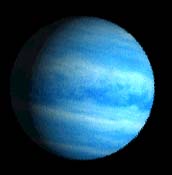
Class S Suprajovians and Class T Ultrajovians boggle the mind as to their size, which can easily exceed 1,000-12,000 times that of a Class M World!
  • Typical Age: 2-10 billion years
  • Diameters: Class S: 10- 50 million km
  • Diameters: Class T: 50- 120 million km
  • Orbital Positioning: Hotzone/Ecosphere/Coldzone
  • Typical Gravity: 5+g
  • Surface: Tenuous, composed primarily of gaseous or lqiuid hydrogen and hydrogen compounds. Radiates considerable heat.
  • Atmosphere: Zones varies in temperature, pressure and composition.
  • Life Forms: Unknown
  • Example: Beta Proxi B II
  • Notes: Considered to be "Failed Stars,", Suprajovians and Ultrajovians often conform to the various Jovian Subclasses.

  • Class V -Greenhouse-

    Rocky worlds, not unlike most Earth-like planets, that are too hot to support most forms of life. They often possess boiling or near-boiling seas and tend to have a great deal of water vapor in the atmosphere.
  • Typical Age: 4-10 billion years, although some are believed to be much older.
  • Diameters: 10,000- 20,000 km
  • Orbital Positioning: Ecosphere/Hotzone
  • Typical Gravity: .5 to 1.5g
  • Surface: High surface temperature; near-boiling surface water..
  • Atmosphere: Primarily carbon dioxide and water vapor.
  • Life Forms: Primitive single-celled. Adapted with pressure domes.
  • Example: Seshereen
  • Notes: Adapatble for Human settlement using pressure domes.

  • Class Y -Demon-

    Class Y worlds are particularly harsh and uninviting to Humanoid life and thus, tend to be completely avoided.
  • Typical Age: 2-10 billion years, although some are believed to be much older.
  • Diameters: 5,000- 50,000 km
  • Orbital Positioning: Hotzone
  • Typical Gravity: .3 to 2.5g
  • Surface: Extremely high surface temperature, exceeding 500K.
  • Atmosphere: Turbulent. A soup of thermionic radiation and toxic chemicals.
  • Life Forms: Mimetic (Delta Quadrant), Tholians
  • Example: Tholia (?)
  • Notes: Extremely hostile to humanoid life.

  • Class Z -Cryogenic-


  • Typical Age: 2-10 billion years, although some are believed to be much older.
  • Diameters: 10,000- 20,000 km
  • Orbital Positioning: Cold Zone
  • Typical Gravity: .5 to .1.5g
  • Surface: Rocky, nonporous; -220+ degrees celsius
  • Atmosphere: Very turbulent; Liquid Helium, Hydrogen and Neon. Often exhibits ammonia tornado activity
  • Life Forms: None
  • Example: Alpha Trianguli
  • Notes: Class Z worlds are considered to be completely uninhabitable by carbon-based life due to the harsh, turbulent, toxic atmosphere and extreme cold.

  • Planetary Subclasses-

    These subclasses apply to Non-Jovian worlds. Jovians have their own subclassification systems.

  • Subclass One:: No deviation. These worlds are textbook examples of their planetary class.
  • Subclass Two: Ringed. By standards of geologic time, Subclass Two is a temporary class. Rings degrade over time.
  • Subclass Three: Trojan. The world has an orbiting partner world. Either they orbit a common center as they orbit their star, or the smaller or less dense orbits the other.
  • Subclass Four: Unusual Composition. The world is either far denser or far lighter than a textbook model, due to lack or abundance of heavy metals. Often this effects planetary size and gravitation. Many such worlds do not possess a traditional Iron-Nickel core.
  • Subclass Five: Unusual Atmospheric Component. The world is textbook in most regards, except that it possesses an unusually high abundance of atypical gases. Benzar is an excellent example of this subclass.
  • Subclass Six: Tachyon Core Composition. Thought to be impossible in the 20th century, Tachyon core worlds are torus (donut) shaped. Often times, they spin so fast that it creates a time differential between orbit and surface. These are extraordinarily rare.

  • Minshara-Class World Notes-

    Almost all recorded Minshara-Class worlds possess at least one large stellar body/moon in orbit. Minshara- do not develop as frequently without the protection of a moon, as space debris tends to hamper the development of life. Thus, almost all Minshara Class have one large moon, or two smaller moons.
    Oddly enough, it is also quite rare to find a Class M world with more than three moons. Most worlds with this feature tend to be Class O. The tidal effects created by multiple moons can often be extreme.
    It is highly unusual to find Minsharas with rings. Dust rings are possible, but rings with larger solid composition tends to adversely affect the evolution of life, as it increases dust content from surface impacts. Many such worlds are not Class M, but Class P.


    The planetary classification system as well as several of the planetary pictures, belong to Star Trek/Paramount. This website isn't intended for commercial use.