
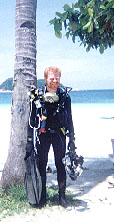
Well after 4 long years I managed to make my way back to Pulau Redang on the east coast of Malaysia. This was my third visit here (previous visits in 1992 and 1994) and quite frankly I can honestly say that despite the increase in tourism etc., the condition of the reefs and marine life that I observed has not deteriorated, and the diving was as enjoyable as I had experienced in the past.


DIVE SITES VISITED (1998)
HOUSE REEF
MARINE PARK WRECK
S. POINT of P. PINANG
MAK CANTIK
CHE ISA
I dived that house reef 7 times, as it is an easy shore dive, and so much action there. "No need to go out in a boat lah!"

So what to see ?
CORALS
Lots of Staghorn, beautiful soft corals (Dendronephthia Sp.), Table Corals (Acropora Sp.), Brain Corals (Faviidae), Porites as well as Gorgonian fans and Whip Corals. Many of the hard corals were festooned with Christmas Tree Worms (Polychaeta Sp.) and various tube worms. Many of the fans had feather stars hanging on.
OTHER INVERTEBRATES
Of those who know me well, NUDIBRANCHS were high on my list of subjects, but alas none on the house reef. MAK CANTIK was best with various Phyllidia Species (varicosa & fissuratus) Flabellina Species and the BLUE DRAGONS (Pteraeolidia ianthina). CLAMS were everywhere, as were pillow stars, amazingly though very few Crown of Thorns (Acanthaster planci - there were hundreds around 4 years ago but thanks to clean up campaigns the population of these critters has decreased)
FISH

Wow so much fish life, where do I start? Black Tip Reef Sharks (C. melanopterus), Blue Spotted Rays (Taeniura lymma), plus a big grey one on the house reef (Diamond Shaped). A nice big Moray on MAK CANTIK that JEMY liked to stroke, and a big shoal of Yellow- Tail Barracuda also at MAK CANTIK. Other Shoaling fish included Jack, Snapper and Rabbitfish. There were many groupers around including one monster on the house reef.
I only spotted one type of Butterflyfish, 8-banded (C. octofasciatus), but 3 types of Angelfish. Many Vermiculated (Chaetodontoplus mesoleucus) and Blue Ringed (Pomacanthus annularis) and one pair of 6-Banded (P. sextriatus) on the outer part of the HOUSE REEF.
There were many anemones, some of them lumenescent looking, incredible. I found 4 types of anemonefish: Tomato (Amphiprion frenatus), Pink (A. perideraion), False Clown (A. ocellaris) and Clarks (A. clarkii).
Lots of wrasse and parrotfish, including 3 Bumphead Parrotfish (Bolbometopon muricatum) on the MARINE PARK WRECK and another on the HOUSE REEF. Lots and lots of small stuff too, the 105mm lens essential.
Redang is famous for turtles, I found several Hawksbills on the HOUSE REEF, plus a Green Turtle with 2 Ramoras attached to it.
I'll be back, this is a superb area for the photographer, easy to do 4 dives per day nad just walk off the beach with 2 cameras as the HOUSE REEF has most subjects to offer. I used the 60mm Micro lens most frequently, however some wide angle opportunities exist (next time). Viz was generally around 10M, but sometimes less. Personally I rate Redang as 7 on a 1 - 10 scale.
Again many thanks to the staff of REDANG BAY RESORT (Tel:(+60)9-620-3200 Fax: (+60)9-624-2048). Thanks also to Ian Jackson who buddied with me on MAK CANTIK and CHE ISA.

REFERENCES:
1.Indo Pacific Coral Reef Field Guide, by Dr. Gerald R. Allen & Roger Steene
2.Nudibranchs and Sea Snails, Indo-Pacific Field Guide, by Helmut Debelius
3.Field Guide to Anemonefishes and their Host Sea Anemones, by Daphne G. Fautin
& Gerald R. Allen.
4.Marine Life in the South China Sea, by Margaret S. Gremli & Helen E. Newman
SHARKCAGE | DIVE SITE MENU | MALAYSIA
