 |
 |
|
|
|
| |
|
|
|
|
|
MITSUBISHI
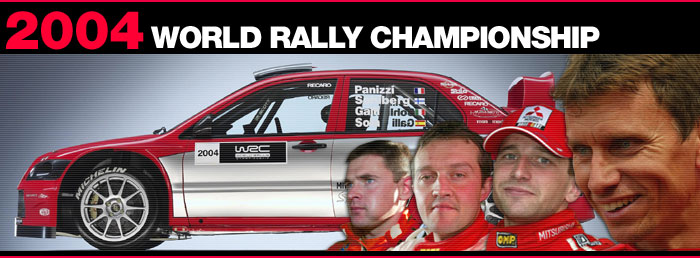
MOTORS UNVEILS A NEW LANCER WRC |
|
|
|
Mitsubishi Motors motor
sports subsidiary, MMSP, unveils the car that will spearhead
its 2004 FIA World Rally Championship campaign, the Mitsubishi
Lancer WRC04. A completely fresh design, the new car forms an
integral part of a meticulously conceived long-term plan to
build on MMSP’s distinguished record in the World Rally
Championship. It will compete on all 16 rounds of the
series.
|
World Rally Car rules
demand that the competition car is derived from a family of
showroom cars, made in quantities of at least 25,000 per year.
The Lancer WRC04 is therefore based on the standard Lancer,
but as its dramatic appearance indicates, it has little in
common with previous Mitsubishi World Rally Cars. Once again,
it draws on Mitsubishi Motors’ worldwide resources, combining
Japanese and European capabilities, but it reflects a fresh
design strategy and has been created by a new, youthful
engineering team. The project has been overseen by MMSP
Limited Managing Director, Mario Fornaris at MMSP’s base in
Rugby, in Great Britain.
MMSP will treat the 2004
season as a learning process, in which it creates a car and a
driving team ready for success in the years ahead. For that
reason, it has gone back to first principles to create a
Lancer World Rally Car that is a sound basis for a rally
winner in all conditions. 2004 will be an exercise first and
foremost in laying the foundations for future
success.
"The car is quite different from our previous
World Rally Car. We have made something like 6,000 new parts.
We have taken advantage of the freedom permitted by the World
Rally Car regulations, but my philosophy is to do very simple
things and to have a good understanding of the car before we
introduce more advanced systems", Fornaris
explained.
|
 |
|
|
|
The Lancer WRC04’s
appearance reflects the increasing importance of aerodynamics
in World Championship rallying. MMSP spent almost three weeks
testing in the Lola racing team’s wind tunnel, re-designing
the bonnet, along with the front and rear wings, as well as
the rear aerofoil. The first priority was to gain more down
force, but close attention was also paid to airflow through
the engine bay to maximize cooling. It is a perfect
illustration of the strenuous yet conflicting demands that the
World Rally Championship imposes. Down force is a vital
element of a competitive car on high-speed rallies, but good
cooling is a key requirement on a turbocharged rally car, as
the ambient temperature on rallies can exceed 30 degrees
Celsius and it is often highest on the rallies held at the
lowest average speeds. Airflow beneath the car was also
considered.
|
|
In designing the chassis,
the emphasis has been not just on good handling, but on
strength, simplicity and ease of maintenance. The car uses
McPherson strut suspension all round. It is a robust system
and to make servicing straightforward, components are often
interchangeable not only front and rear, but left to right as
well. Most suspension components will be made of steel, to
ensure reliability. The Lancer WRC04 will use specially
modified Ohlins dampers, like its recent predecessors,
building on a fruitful past relationship. The steering rack
and cross members are also new designs, partly because the
engine has been relocated, tilted 20 degrees rearwards to
improve weight distribution.
The 16-valve, twin-cam,
two-liter engine belongs to the 4G6 family used so
successfully in previous Lancers. It employs the well proven
cast iron block and an aluminium alloy cylinder head, but it
has also benefited from significant alteration. First and
foremost, it is based on the version of the engine fitted to
the new and highly popular Lancer Evo VIII showroom car, but
with a new turbocharger, fitted with the regulation
34-millimetre intake restrictor, new intake and exhaust
manifolds, and new internals. Although the bore and stroke
remain unchanged, the crankshaft, connecting rods and pistons
have been lightened and the electronic management systems are
new. MMSP has turned to Magneti Marelli to supply its
electronics for the first time, using an advanced engine
management package that doesn’t rely on fuses or circuit
breakers. There are two control units, one for the engine and
one for the chassis. As the system is fully integrated, each
is capable of controlling all electronic functions throughout
the car. The system saves weight and enhances
reliability.
The transmission also reflects MMSP’s new
strategy and has nothing in common with the four-wheel-drive
systems used on previous Lancers. The 2004 car will use a
transversely mounted five-speed gearbox supplied by Ricardo.
The gear change will be manual and all three differentials
will be passive, an epicyclical center differential splitting
torque front to rear. The front and rear differentials will
also operate on mechanical principles.
"With the
current regulations in the World Rally Championship, because
the engines have quite small restrictors, the power curve and
the torque are so good that it makes it possible to use a
five-speed gearbox. Why have six gears when you can have five?
We will analyze different possibilities as we develop the car
and will introduce new features as necessary", Fornaris
explained.
|
|
The decision to use
passive differentials is unusual, but reflects MMSP’s
determination to ensure that the chassis is fundamentally
sound and effective before introducing refinements. A
semi-automatic gear change is likely to be developed during
2004, once MMSP is satisfied that the Lancer WRC04 is living
up to its potential, in terms of both performance and
durability. Active differentials are also under consideration,
but are not an immediate priority.
Brembo will supply
brakes and once again, MMSP is placing the accent on
simplicity. The braking system will not incorporate water
cooling initially.
The Lancer WRC04 began testing in
mid-October and will undergo a comprehensive development
program in readiness for its first appearance on the 2004
Monte Carlo Rally, when French star Gilles Panizzi leads an
all-new driving team. In its first three months, the new
Mitsubishi will face tarmac and ice in Monte Carlo, snow in
Sweden, and dusty loose-surface stages in Mexico.
"We
are not expecting too much from the car at first. At the
moment, it is too early to say anything about performance. It
is very new and we have had very little time to design and
test it. We can expect a few problems in the test period, as
you would with any prototype car, because the test schedule is
very tight. The idea was to do something quite simple to start
with. We know we have plenty of things to learn. I hope it
will be a little bit faster than the old car at first. We will
try to develop the car step by step and I hope in the second
half of the season that the car will become more competitive.
We can make progress faster this way, but we are not expecting
instant results. We are competing in a tough environment",
Fornaris stated.
|
|
| |
|
 |
|
|
|
MITSUBISHI LANCER WRC04
CAR* |
|
|
|
OVERALL LENGTH |
4360 mm |
|
OVERALL WIDTH |
1770 mm |
|
WHEEL BASE |
2600 mm |
|
FRONT TRACK / REAR TRACK
|
1550 mm |
|
WEIGHT |
1230 kgs |
|
ENGINE MODEL |
4G63, 4 cylinder, 16 valves DOHC
turbo charged |
|
BORE & STROKE |
85,5 x 86,9 mm |
|
DISPLACEMENT |
1996 cc |
|
ENGINE MANAGEMENT SYSTEM
|
Magneti Marelli, multi injection
|
|
MAXIMUM OUTPUT |
300 PS / 5500 rpm |
|
MAXIMUM TORQUE |
55 kg-m / 3500 rpm |
|
CLUTCH |
Carbon triple plate |
|
TRANSMISSION |
Ricardo/MMSP 4 wheel drive, 5
speed, limited slip differentials front center and
rear |
|
MAXIMUM SPEED |
220 kph |
|
SUSPENSION |
Front and Rear McPherson strut,
coil springs, anti roll bar |
|
STEERING |
Power-assisted rack and pinion
|
|
BRAKES |
Brembo, ventilated disks - 370 mm
diameter tarmac, 300 mm gravel, 328 mm snow
8
pot caliper tarmac, 4 pot gravel and
snow |
|
WHEELS |
ENKEI magnesium cast 8x18 tarmac,
7x15 gravel 5,5x16 snow |
|
TYRES |
Michelin |
|
FUEL TANK CAPACITY |
90 litres |
|
SEATS |
Recaro composite |
|
COCKPIT |
Components Sabelt |
|
INTERCOM SYSTEM & HELMETS
|
Stilo |
|
CAR DESIGN |
Using PTC Pro Engineer
| |
|
|
|
| *Submitted to FIA
homologation | |
|
| | |





.gif)


