  |
|
|
Perhaps it was
coal dust that smelt so strongly in the Jishou morning air, or perhaps
the unfamiliar scents of the dense mountain shrubs drifting down from the
hills above the apartment. I slept late every day, often until after 11.00
am: Bonnie moving about in the other room, myself just coming to on the
couch after another late night hunched over the computer in Hamish's study,
trying to complete the third draft of the novel I'd finished in Tianjin.
Hamish occasionally had his mornings free, he would still be lazing in
the bedroom even at that time. I would twist the thick coarse duvet around
my body and pick through the pile of scattered VCDs on the table to find
an appropriate soundtrack. Wang Fei's Fables was a common morning
item... the rich, lazy violin chords of the first track seemed in keeping
with the mood - on others, the newly discovered Mongolian rock VCD I'd
lucked upon whilst hunting for cheap, sturdy farmer's boots, nearly impossible
to buy after winter has passed, which it just had. In Shenyang I'd been
entranced by an MTV I'd seen of a woman singing Arabic chants above dance
rhythms; the singer, Zhou Yan Hong, proved to be so unpopular that not
a single store stocked her, but a valiant search for her music had led
me to Si Qin Ge Ri Le, decked in a cool open-necked
white shirt and black suit, carrying an acoustic guitar - she was out in
the open grasslands on Mongolia, and she smiled triumphantly as she leaned
back to chant in her native dialect. Heavy electronic backing chirruped
and beat as she soared - Hamish would crawl out of bed and stand in the
lounge watching with some curiosity.
I loved the
mornings when we'd take breakfast in the student's dining hall. Steam from
huge cauldrons at the malatang tables would circulate gusts of chillies
and herbs; fresh bread rolls with red bean lace were laid aside tubs of
orange cordial on wobbly wooden benches; thick-doughed dumplings and noodles
of an almost sweet or nutty pasta would be fried or boiled up in seconds
- I would often select a deep-fried fritter of sugary bread which they
would serve in a plastic bag, or sometimes I'd prefer a bowl of angry,
red noodle soup. I loved sitting at those tables and watching the staff
and students, especially the former who lived in the small booths set around
the edges of the hall, which itself resembled a deteriorating aeroplane
hangar. The walls were stained with oil smoke, the ceiling tiles askew
on the crosshatching. These little Miao women spooning thin soup into the
student's tin mugs had spent years in this place; for them, the city, and
the world, extended to the perimeter of this one hall. A plain, 17 year
old girl with apples for cheeks would give me extra dumplings with my malatang.
She told me that she was pleased to work in the University grounds, as
there was a chance she could be able to study as a benefit, an opportunity
unlikely for workers elsewhere in Jishou. There was no time to study just
then, however, as her sister needed her to work every day - a duty that
she didn't seem to find burdensome, her having the broadest smile in the
room. There were many families living on campus who were members of the
University Work Unit, a collective administrative body that hearkens to
commune days. Whilst some lived in the apartment blocks shared by the families
of academic staff, others worked farms and lived in stone huts within the
university, the revenue from which benefited the student body in a particularly
Chinese way of ameliorating university funds.
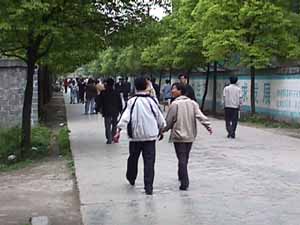
Into Central Jishou On occasion, a lack of supplies unreplenishable from the University's interior dairies required a trip to the city; at times an inconvenient necessity to leave the womb of academic laze, at others an essential break from the repressive sameness of the stubbornly pretty campus. It would consistently take a good quarter-hour to leave the grounds themselves: wandering along the dirty path between the lakeside grass and trees, students would often hail and stop their unusual English teacher and his funny childhood friend for some moments of naive conversation, and then there was always the whooping from the classrooms of the middle school near the front hospital entrance, whose wonder at seeing the same foreign faces every day never ever diminished in any way.
Outside the gates, minibusses stop regularly to crowd in extra passengers, each of whom pay less than a kuai to be taken to the nearby town centre. The bus stops are irregularly spaced, and for all purposes are meaningless anyway, as the driver's sole concern is to carry as many people as possible per trip, and so will toot at any passer-by at any point of the route who shows the remotest sign of needing a ride. Points of disembarkation, similarly, are at the discretion of the driver - to stop the bus, passengers shout a loud and happy tai zhou, a local phrase unintelligible to Chinese speakers from other regions. Neither Hamish nor I could get it right; whenever it was time for our stop, our tai zhous were never hearty or raucous enough to have any other effect than to incur the penalty of laughter from fellow passengers. No matter how many different spoken methods we picked up to get the bus to stop, almost always the only effective method would be to tap the conductor on the shoulder and point outside. The town was always humming. Men were
dark-skinned and their chins were shadowed in insufficient stubble, women
were uniformly small and black-eyed. The country folk, particularly the
Miao, were recognisable for their stature and their traditional blue smocks,
as well as their famously Southern Chinese conical hats. The typical inner-city
pedestrian was a resident of one of the apartment stories identical to
those across the whole nation: four-by-six dominoes of little flats, smoggy
stains on the outer walls, interiors as plush as the modest income of the
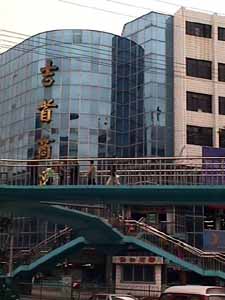
inhabitants could allow. We navigated by reference to the blue and green
overpasses; otherwise the cyclical sequence of shoe and clothing stores
amidst food and CD outlets might prevent any other marker being found.
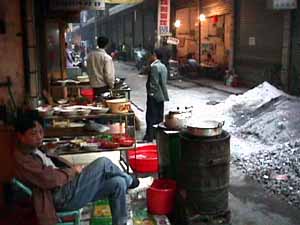
A favourite backstreet was a den of cheap local food, VCDs and electrical appliances. Rows of steamy Malatang tables opened out to walkways of greyish clay; you could brush the soot off your trousers as you stepped up from one squatty dining-table and walk straight across the street to buy a fashionable new pair. Thin metal stairs led up a tier above the shops where the city's most reputable sex industry is housed; here might be found the higher-class hookers and massage girls pedalling a range of services from charged conversation to kneetop karaoke, with more intimate services available by negotiation with the girl concerned or with the chubby, decent-enough looking pimps profiting from them. Elsewhere in town whorehouses are uninspiringly disguised as hairdressers with interiors bathed in pink neon light, where the more luckless and desperate daughters of poverty kick their cross-legged thighs hopelessly on old couches. Twilight
On some evenings, as the sun was beginning to set over Jishou, Hamish and I would walk out of the campus and stroll towards the less populated areas of town. Jishou, and moreover Xiang Xi County, is above all else a community of peasant farmers, and their old homes lining Jishou's back roads preserve a China lost to larger cities, and often lost to China's overseas visitors who find their 'authentic China' in the stylised Qing-Period false rooves of Beijing's and Shanghai's restaurants. One new supermart complex, oddly out of place, was deserted in the dusk, threatening, almost. Some women were out washing clothes at the wells even this late, and the occasional post-box sized home of a god watched them over grey stubs of burned-out incense in little ornate pots of ash and rice. Out here, the homes were more liberally sized affairs of stone and litter and dirt slopes. Families would share multi-levelled terraces and townhouses, sopping shirts and panties draped over rope lines, coal smoke lifting out of little square chimneys. I could smell wet tobacco plants and soot. We stopped above the tracks on a concrete bridge to watch a familiar green train swiftly chug towards Changsha, perhaps jealous of the passengers. On another evening we followed those train tracks back from the city centre to the university. The tracks follow a line of short hills and sit between private housing blocks, some of these old, ornate homes of unusually gaudy glamour, perhaps former residences of rich, educated landlords. Some homes are generously adorned with spacious terraces and broad gardens which are farmed according to the local philosophy of not wasting a square inch of soil. Hunanese architecture steals elements from across the country and across Chinese history too, but occasionally stylistic references are so intermingled they are difficult to pick. Bathroom tiles on outer walls are standard fare in the South in general, as are walls with wavelike curves which contrast with the straight brick lines of Northern homes and temples. The housing settlements are thickly clustered, steep, thin staircases leading back behind tight rows of houses to further levels of shacks and pretty homesteads, all draped over with hanging wet garments. Many locals use the tracks as a walkway, and on this particular evening there were no few, stepping expertly on the slats and dodging the occasional toilet tissue discarded by inconsiderate train passengers who are theoretically required to wait until the train is between city areas before using the amenities. Between the homes there are the requisite quartets of elderly men playing Chinese Poker, Mahjong, or Chinese Chess, and each with their handfuls of eager onlookers grinning and smoking delightedly. The sides of the tracks are overgrown in ivy and are liberally littered - a few stinking shallow pools of garbage and vegetation, next to seemingly abandoned buildings, went unkempt by the walls of tended plots. Soon we found ourselves by the university gates, where a favourite local store, the Bing Yuan superette, provided our regular fix of chewing gum, alpine butterscotches, and chewy QQ soft fruit lollies. We sauntered into the university grounds and passed the student canteen, just serving the last dinners, outside of which desserts of fried bananas and steamed bread brushed in chilli sauce can be bought for a couple of kuai. We bought a quarter-pineapple on a stick and slowly made our way towards the long bamboo-lined drive leading up to the teacher's apartments, leaving Jishou to cool in the late evening air. |
||||||