  |
|
|
At the base
of a row of scrubbish hills in West Hunan lies a dense oil-painting of
a city, hauntingly overbearing, where the nightly thunderstorms and explosions
of dynamite from the quarries bark in counterpoint; where black-suited
young men squat in the dust behind sky-blue truck carriages like scarabs;
where clouds, reflected in the irrigated pools where rice shoots coarsely
break the water, seem to smoke back out of their images; where the sodden
vegetable scraps pack soggily into the corners of concrete slabs into which
wells have been set, women young and old in lemon pyjamas scrubbing clothes
with old washboards and yellowy gelatinous soap; where banks of terraced
apartment blocks saddle a rail line, pedestrians scattering for dark green
trains; this chaffed old settlement which has the look of being constructed
now, neither a destination of choice for a visit or an extended stay, and
still the most satisfying yet of all the cities in China where I have traced
within myself a foreign place and thus claimed the privilege of knowing
it, for a time, as home.
The rights to
my Jishou are tenuous at best; a license to exist for a time as a visitor
in as remote a place as a metropolitan city can get, without due employment
or local host. Jishou is visited, usually, by just two foreigners in a
year, the two teachers who instruct the university's English majors in
their language classes. Jishou belonged to my longtime friend, Hamish Dewe,
for a full year's contract - at times, I considered myself an interloper
who was trespassing on his territory, where he had taken pains to carve
out a niche in a difficult place. He'd found a fiancée there, had
developed a reputation amongst the students and the townsfolk for whom
he had been an uncommon curiosity. And yet, despite everything I owe to
Hamish, there is a part of Jishou which is solely my own. Sitting once
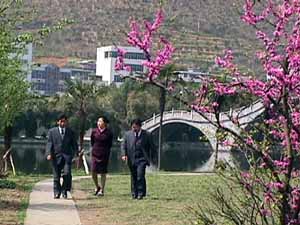
alone at night on the splendid marble bridge that crosses the lake around
which the campus lies, it seemed to me that every impression of the city
was postcarded in lead within me. I spent almost two months based in Jishou,
and left with a rich burden which comes back at unanticipated moments to
remind myself of my connection with this vividly oppressive and simple
place.
Hamish had aged
perceptibly when I met him at the rail station. I'd last seen him at the
Auckland Airport, handsome and enthusiastic; now, gaunt and irritated,
changed by incommunicably acute conditions, Hamish commented distractedly
and dispassionately on the surroundings as we taxied through the main streets
towards the campus. He was tired; in every photo he showed me of himself
and his students, he stood dazed and unsmiling. Bonnie, his partner, was
away, and so we had a few days to catch up undistracted. I began to become
familiar with the campus grounds, and the small steamy food outlets outside
the gate, members of the industries which survive on the student population.
The university is Jishou's sole claim to fame in the region, which is otherwise
littered with small farms and insignificant town centres. Squatting on
mid-calf-high stools at these restaurants (which were more garages with
stoves), necessarily wiped of settled grime and oil before being seated,
we picked through generous servings of chillied pig's ears and sliced eggplant
on bottomless bowls of warm white rice. The food in small town Hunan is
monotonously regular, but fortunately delicious. I quickly took to purchasing
dry buns for breakfast, however, not having the local's stomach for beginning
the day with immensely spicy meats.
We also took
to visiting the only café of note in town, the Wanlilong,
a franchise that serves sweet breads, hot milk and barbequed chicken legs
throughout Hunan. Wandering through the muddy pavements in the centre of
town, the Wanlilong seemed an obligatory retreat from the attention afforded
us by the locals - any foreigner in this country is accustomed to stares
and the salutatory 'hello' or 'lao wai' that callers throughout
the provinces shout excitedly as if it is a novel kind of joke; in Jishou,
however, there is something disconcerting about the stubbly groups of black-coated
youths who maliciously holler distorted hellos from a block away.
Near Wanlilong
are the town's food markets, where hoardes of merchants slap their wares
on plain slabs, vegetables and fatty meats, eggs and dried chillies, the
stone is black with coal dust captured in old fat grease, toothy old women
with gigantic meat cleavers mew at bickering townsfolk for their patronage.
The place is packed; hygienic standards are appreciably low, although locals
assured me that sterilisation was a normal part of the food preparation
process. Whether or not this was true depends on the townspeople's conceptions
of what sterilisation entails.
Perhaps of unusual
note were the main road's (Ren Min Lu) two Sky Bridges, painted
a gaudy pastel blue and green, and which took pedestrians above the main
intersections in the inner city centre. An afterthought to the dull architecture
of the commercial buildings, all uniformed with white bathroom tiles on
every outer wall, the bridges were splendid affairs, twisting creatures
with four legs, a naught and a cross in perpetual stalemate on a single
central artery which leads directly from the train station to the campus
and beyond.
I met some of his students, typically over enthused naive boys and girls for the most part, older than 20 but with the ideas of a puritanical 17 year old in the West. Here there is an odd species of freedom, though, exemplified by the fact that although students are forced to live in dormitories with 10.30pm curfews, many rent rooms across the way by the railside for 'privacy', and climb fences late at night under the disinterested observation of the university guards. On my first night we were tugged along to a social dance, where old ballroom techniques are still alive. I was paired with a Chinese girl called Michelle: I bluffed being able to waltz, explaining that it was her responsibility to follow me as I was the man - crazily, this tactic worked, despite the fact that her, and Cindy, with whom I also shared a turn, were excellent dancers. The Jishou Nice Life
The return of
Hamish's fiancée Bonnie consolidated our unusual family, three playmates
sharing Hamish's teacher's flat. I was in Jishou for an unspecified time
to come, and the absence of any kind of agenda led to decadence very quickly.
Bonnie, a playful and distinctly unusual Chinese girl, with near-flawless
English, was without need of attending classes for at least a month, and
with Hamish valiantly completing her homework there was no need to get
out of bed before 12.00 pm. Hamish had a workload of a paltry 7 hours per
week, teaching mornings only, and so was the sole early riser. By the time
Bonnie and I crawled out of our respective beds, he had returned and was
similarly without responsibility for the remains of the day.
Jishou was mildly
temperate in the springtime, the sun invitingly warm and the grass by the
lake comfortably blanketing the soft soil. Hamish, Bonnie and I laid out
a rug of old newspapers in the sunshine and lazed, indulging for a time
in foreign chocolates, sesame seeds (a Chinese obsession - count how many
Chinese people have grooves in their front teeth from excessive gua
zi shelling), and the only moderately acceptable brew of beer we could
find - Old City. It is said that the beer brewed in the South of
a country is almost uniformly inferior to that of the North - New Zealand
perhaps being an exception. Old City, at two kuai per 600ml bottle
(about 50 NZ cents) is an unpopular brand in Jishou but is the least teeth
clenching for the foreign palate. Under its influence, the view of the
splendid bridge over the university lake seemed sublime and the springtime
blossoms seemed to sparkle out from the branches like fireworks. In Tianjin,
I'd been frustrated at my lack of drive; Jishou seemed an end in itself,
and just to be there, in such a remote place, lying in the sun and photographing
the most eye-catching girls who passed by seemed to be the sole reason
why I came to China.
I redoubled my efforts to purchase music, blowing a few hundred kuai on CDs and VCDs that I hadn't found in Shenyang. Trotting down to the local music shops became an almost daily responsibility, and our morning routines extended to fit in the watching of music videos. I had managed to convince Hamish that the single best way for a beginner to study Chinese characters was to watch karaoke videos and attempt to sing along. This is actually true, according to my opinion - karaoke forces one to read as fast as one can sing, and for a student of the language it just doesn't get more remedial. We started to write down the lyrics of songs we liked so that we could participate in future karaoke events - these being one of the only evening pastimes in the country, and certainly it was so in Jishou. Our chance came very quickly. Hamish, partly as a gimmick and partly as a way of avoiding the responsibility of planning classes, invited me to speak to his students and encourage them with their language studies. Initially, I posed as a foreign student who spoke no English but a little Chinese, and lurked at the back of the classroom with the other students, asking what they thought of Hamish and his teaching. Towards the end of the lessons, I conversed freely with the students and discussed various methods of studying English. After the classes, Hamish and I decided to encourage a break from the formalities by offering to host a karaoke evening at a local venue. On the night itself, we nervously arrived late, clutching a folder of romanised lyrics we'd prepared in order to carry off singing in Chinese. The room, typically, was a darkened, understocked bar with a few tables arranged around a large television screen, microphone cords snaking between tables and thick folders of song lists casually placed throughout the room alongside stocks of song order sheets, which were to be filled in and handed to the DJ in the side room. Singing in Chinese was in part a way of avoiding being summoned to perform from the abominable repertoire of English language numbers, a collection of cringe-inducingly archaic dirges and schmoozy ballads, for some Chinese people their only experience of foreign songs and thus an account for the nationwide musicological poverty frequently noted by visitors to China. The opening bars of Wang Fei's Se Jie sounded; Hamish and I sat at the front and shuffled through our cheat sheets. Despite what must have been awful pronunciation and some outright fluffed lines, we were strongly encouraged in our efforts and rewarded by numerous shouts of watery beer. It is said that a foreigner who can hold their drink, sing, and speak Chinese can go very far in China. After a few bottles, however, nature's delicate finger on the bladder proved an irresistible summons. We were told that the bathroom lay behind an unusual, and locked, side door. It was not without some trouble that we managed to convince the staff to unlock it for us; however the other side turned out not to be a lavatory but a tennis club, which we found ourselves in the middle of after wandering along a cobbled path that led not between but underneath a row of ill-placed bushes. I presumed that the bushes themselves were the toilets we'd not been conditioned to recognise: fortunately, the bemused owner of the tennis club took us to the porcelain, and invited us to enjoy a match sometime in the future. |