  |
|
|
Tianjin is no
stranger to Westerners, and much of its modern-day appeal comes from the
legacy of its previous foreign inhabitants. Central Tianjin revolves around
the old concession zone, where foreign powers once dirty-dealt their way
in to colonise small areas from which to keep tabs on the Qing dynasty
and facilitate their sale of opium. Here, as in other small colonies established
on the East coast, villages of high European architecture were cordoned
off from the sweaty huts which the locals endured. Much of those buildings
remain now, making the city centre something akin to stately British lanes.
I felt at home
in Tianjin immediately. The dialect of Chinese was much closer to that
which I had been studying, I watched the leafy streets lined in attractive
gray villas and mansions and the view across the Hai river from the window
of a bright yellow 'breadloaf' taxi. I was headed right for the heart of
the city, Nanjing Lu, where Donna now runs a New Zealand studies consultancy
from an upper storey apartment of a block stylised after the American White
House.
It had seemed
like a long time since I'd last seen Donna in New Zealand. Frustrated by
the lack of opportunity at home, she'd decided to try her luck back in
her native city. It was plain that she had made a success of the move from
the second I walked in - not only did Donna look great, healthier and happier
than I'd ever known her, but her apartment was the most spacious and spotless
that I'd seen in China yet. The view of the old concession zones beneath
and out across the river and the cityscape was refreshing and welcoming
after an exhausting sleepless night on the railcar's hard bunk.
I settled in immediately, and stayed inside for two weeks. My lifestyle in Tianjin was everything travel shouldn't be about. I'd come to China for the opportunities to study Chinese, to work on my writing, and to see new places and new people. I did very little of these things in the White House - I enjoyed luxurious bed linen and hot showers with working adjustable-spray shower roses, I sat with Donna talking about old and new times in English, and we made each other fresh espresso coffees. I wasn't in China anymore, and it didn't bother me much. I let my writing slip away, put off the Mandarin study until some later time, and made and abandoned plans to visit significant locations of interest in the stretches of Tianjin beyond the comfortable distance of the local shops. I played dice games and cards with Donna's PA, Sophie Cun, which meant that the only Chinese I picked up over the fortnight was the names for the different suits of playing cards. Upon reflection, I was, in a sense, re-enacting the history of the area in which I was staying. I was the arrogant and privileged foreigner, oblivious to the relative poverty outside (and the standard of living in Tianjin is, by Western standards, still rather low) and refusing to interact with the culture of the environs. But it was less this than personal uneasiness with luxuries which made my lifestyle seem so frustrating despite its hedonistic leisures. There were days when I'd pull out my laptop and start work, only to be distracted a few lines later, the project forgotten for the remainder of the day. There were half-hearted attempts to explore as well, such as the day I accompanied Sophie whilst shopping on the broad pedestrian mall, Bin Jiang Dao, where I posed against the French trellises whilst indulging in toffeed bananas. I had to say I liked Tianjin. Poised at the edges of the European maisons, the office towers and blockish apartment complexes made polite conversations with the Northern winds tumbling their way down from the Gobi Desert out into the Bohai Gulf. The gray colour was delightfully formal, making a smooth polish on the varying architectures of the roads off Nanjing Lu. Women, too, were gorgeous in a way that they hadn't been in Dongbei or Beijing, the handsome Han women with slender figures and dark eyes; crossing the road became dangerous again thanks to the distractions amongst fellow pedestrians. There were no foreigners, too: whilst in most cities, this would result in stares and the accusatory hollering of HELLO at every footstep, in Tianjin I wasn't glanced at twice by anyone, which came as no disappointment, except in the case of the women... I spent my birthday in Tianjin, turning 26, for which I was escorted to the finest restaurant in the city by Donna, her local friends making up the ranks. We dined in a wide private room on local delicacies, from rare fish to camel hump; an enormous birthday cake was produced with a trick candle mechanism which managed to play Happy Birthday long after I'd given up trying to dismantle it. The meal was followed by late-night karaoke in an expensive hostess bar across town - Donna and I yodelled Chinese pop hits and drank genuine vodka with lemonade; I politely refused intimate encounters with the hostesses as our troupe relaxed in our private lounge, consuming watermelon slices and playing the dice games the hostesses generally use to distract boundary-crossing customers with. Return to Beijing I had missed Beijing without really understanding why, and so I was thrilled when Donna invited me to accompany her to the Capital on business. Her work involves liaising with the New Zealand embassy in Beijing to assist students with their permits, and so she is frequently travelling there, in a chauffeured vehicle, no less. Travel to Beijing used to take a day, although recently improved rail links make the journey by train in just a few hours. This is nothing since the expressway was opened, however, meaning that a car journey between the two cities can be made in just over an hour. We left early, whilst the morning sunshine was still lemon yellow on the flat farmlands to either side of the expressway. I dozed whilst listening to Chinese pop on my discman, until the sight of nearing skyscrapers roused me with interest, and within what seemed like moments we were there on the fourth ring road, heading south into the new Central Business District, nearby Guo Mao where I had met Liu Fei and consumed expensive Starbucks coffees altogether too often. I passed sights which made me feel as if I'd returned home, the ring road on the bus route from Hua Jia Di, the steady line of embassies around Chaoyang, we even drove through Sanlitun and past the Cross Bar where Matt and I had spent half the night with Wang Shi Yan, the reluctant xiaojie. Our stop at the New Zealand embassy was relatively brief, hardly worthy of the extravagant glazed duck meal that followed it, at a restaurant attended by semi-friends of Donnas who face-gamed their way through the meal. We escaped to Guo Mao to coffee and shop afterhand, myself wandering through too familiar territories within the mall complex. The sights and sounds were back again, the warm dusty weather, the constant bantering of touts wanting foreigners to buy their pirated CDs. We wandered through the silk markets, where a glance at an item of clothing on sale was interpreted by the merchants as a deep-set desire to purchase it. I was only back for a day; soon I found myself in the passenger seat once again in the outer Beijing croplands, Na Ying on the car stereo, me with a Kazuo Ishiguro novel set in Shanghai wondering at my connection with Beijing. It was a place I'd struggled to befriend whilst living there under various guises - but the spirit of Beijing is hard to exorcise and tends to infect anyone who has more than a casual acquaintanceship with the place. Unexpectedly, there is something incomparably warm in the atmosphere of the Capital that isn't found elsewhere in the China I'd experienced thus far. Amidst the standard corn of the cultural relics, amidst the noise and arrogance of the foreign businessmen and self-congratulatory students, amidst the poverty gulf, the hardline politics and propaganda, the desperacy of the emerging elite, amidst all of these is something genuinely Chinese in the way that the Great Wall and the Forbidden City is not - it is the self-determination of modern Chinese culture, and it was something I found myself aware of and in love with. Sophie
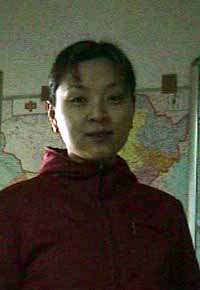
Donna was constantly busy and moving around the city, and Sophie Cun accompanied me on most of my jaunts around the locale. Sophie's a 35 year old divorcee who speaks no English and was almost constantly present at Donna's office / apartment for lack of anything more interesting to do. She was good practice for my Chinese for a start, but also became a friend rather quickly. She accompanied me to a job interview at a local school which turned out to be unsuitable, we'd been supermarket shopping with Donna for a cartload of cartons of milk to support our cafe au lait habit, she also took me on walks along Nanjing road when the card games started to get a little boring, once visiting the local memorial which remembers one of the most cataclysmic earthquakes in China's history, centred on Tangshan (not far away from Tianjin) in 1976, causing the deaths of hundreds of thousands of people. Sophie remembers the earthquake, at the time a small child, although she barely remembers the fear. She invited me to go jogging with her one evening whilst I was failing to work on my book, having gotten through three lines before giving up. I pointed out that her habit of jogging for fifteen minutes once a week was hardly of enormous benefit to her health, but our pacing to the local KFC and back was a diversion at the least. She had thought to change into a tracksuit, I could only wear the T-shirt and thick black leather jacket I'd been carrying since setting out for Dalian, my cheap Shenyang farmer-style cloth shoes already fraying at the soles. Running through the late evening dim in my prescription sunglasses, I was unlikely to have been interpreted as athletic by passers-by. Sophie has a strong chiselled look from the side, and a soft, chubby-cheeked smile from the front, she lives in her magenta windbreaker jacket and long black trousers; she is amongst China's tallest women. I invited her to dinner after our jog, where I managed to communicate my views about love and marriage in Mandarin. She told me about her ex-husband, with whom she had seperated a few years beforehand. Her modest apartment across the road from the White house belongs to him; she continues to wash his laundry even still. I was surprised at the depth of her sense of hurt and love, when I visited her apartment a few days later I noticed that she avoids sleeping in her bed, preferring the discomfort of the couch. Tianjin appears to haunt her in some ways, and since working with Donna she dreams of a loveless remarriage to a New Zealander so that she can live in Auckland, although some probing revealed the potential to love again buried somewhere beneath even her own awareness. We took the bus to the other side of the city one day where she had promised to take me on a shopping adventure in a new women's market, or so I understood from what she said in Chinese. I was sceptical of the potential for the fun she promised, but enjoyed the scenery of Tianjin's inner suburbs, as she pointed out the various places she knew, including where her husband had worked during their marriage. We arrived at the Olympic Stadium complex which resembles a flying saucer; the market was in a nearby hall which had an admission fee upon which, despite the fact that the logic of charging admission to a store made little sense to me, they attempted to add a foreigner's surcharge. Inside, we both wandered disinterestedly around the cheap lingerie, towels and snack food. I was accosted by a salesman who made repeated and insistent attempts to sell me a duvet; he was little deterred in his price dropping by my pointing out that I wouldn't want the bloody thing if it were free. Neither Sophie nor I bought a thing, but we'd both found the amusement we were looking for. A far more noteworthy excursion presented itself later in the afternoon, thankfully - we'd made our way back to Bin Jiang Dao for a Korean Barbeque lunch, where I realised that the antique markets my guide book had detailed were close by on Shenyang Lu. It was as quirky as the book promised; the postcards of ballerinas with handguns from The Red Lantern, the fu-manchu glasses, the coins and socialist journals - I found one which depicted the new train station in Beijing, for me a familiar loitering ground, being close by a favourite Starbucks cafe. It was a good half-hour's evening walk back to the White House, through the scrubby backstreets behind Nanjing Lu. Sophie wasn't easy to lose, being a head taller than almost everyone else; I watched her negotiating the crowds with the poise of a butler, her arm bent at a 90 degree angle, her small handbag swinging rigidly at the elbow. |