  |
|
|
Once upon a
time I was a somewhat fan of the realtime strategy computer game called
Age
of Empires. Gameplay put you in control of the development of an historical
people through the course of their civilisation, the point being to beat
your opponent by successfully defending a culture through to their world
prominence, or by wiping out everyone else on the map. I was good at building
up great civilisations, but terrible at fighting battles; my strategy was
invariably to hide from other players until I was rich enough to build
massive armies who didn't fight well but were able to overcome my enemies
by their sheer number. This is not easy, as it's impossible to hide forever
on what was really a glorified chessboard, and at some point I began work
on a new strategy - the big wall.
Early on in
the game, I would send my minions out in search of stone to quarry, and
enlist a significant proportion of them to claim a sizable territory and
wall it in. Then, to protect the wall itself, I would build a series of
guard towers along its length which would fire arrows at anything which
moved close enough to the boundary of my lands.
The strategy
was awful - never once did I pull it off. For a start, once my enemies
had developed anti-wall technologies, catapults and the like, my wall would
be attacked from various sides and I would have to divide my armies to
protect it, meaning that if any one division failed the enemy could enter
the relatively unprotected central territories. Early attacks would saunter
past my unfinished sections; sometimes a foreign villager would sneak in
and manufacture their own soldiers from within. Any entry of enemy soldiers
was always disastrous, because having spent so much time and energy and
manpower on the wall, I had had little opportunity to develop my culture's
technological ability and military resources.
Which is the
problem in a nutshell - the wall was incredibly bad economics. Lots of
money on a grand idea which could have gone towards units which were good
at killing other people. Small walls around cities were good, walls around
territories were high maintenance and in the end failed.
More subtly,
the mentality behind my wall idea betrayed the weakness in my perspective.
As I built my villages, with their farms and cute mills and universities,
I was pleased and proud of my little communities and just wanted everyone
else to leave me alone. The wall was a false security; as long as it was
standing, I could think I was the centre of the world and not worry about
anything else outside it. The wall not only marked the edge of my empire,
it marked the borders of my thinking.
So, when I was
asked by my new friend Apple what my feelings were when finally arriving
at the Great Wall, I couldn't help making a connection between my own limited
thinking in Age of Empires and that of old Imperial China in general.
As far as I'm
aware, the Great Wall is every brick a failure. It didn't keep significant
invaders out, by and large, and it did nothing to protect the Emperors
from enemies within. The Wall, in my mind, represents everything that reduced
the world's most powerful and advanced culture to a struggling, developing
nation in modern times. It's the endemic flaw in Chinese thinking - don't
bother with the foreigners because they're not part of our reality, just
put a barrier between us and them. Meanwhile, people with less vision outside
the wall are shuffling some pretty mean chess pieces.
This aside,
the Wall is still around, and it really has found its most suitable niche
now as a tourist attraction. There's a saying by Mao which is carved into
pillars at the part of the wall we visited - Until you've been to the Great
Wall, you're not a real man. I consented to being photographed next to
the pillar grinning magnanimously.
We'd arrived
in the late afternoon. I'd discovered my sleeping habits to be of some
advantage as far as sightseeing was concerned - although I only managed
to see one attraction per day, I was always almost the only person there,
and the golden sunsets I was witness to as I wandered through the entrance
gates lent a natural splendour to the old monuments. Today was no different
- Apple, her husband, his workmate and I were the only four people at Juyongguan,
the most visited section of the Great Wall and the most proximate to Beijing.
They were originally a little unimpressed by my lateness in contacting
them when we'd planned to make a day of it; being as it was we had the
Wall to ourselves, room to move and rest as we attempted the several thousand
stair climb up the mountainside.
I'd met Apple
a few days before in Chaoyang's Full Link Plaza, and had been to dinner
that evening with her and her husband. Apple is in the advertising trade,
and is one of those who thrives on the creative side of the job and manages
to stay away from the sleazier aspects of this business. She described
her work with storyboarding as giving expression to all the hot bits that
she found in her mind when thinking clearly. I'd enjoyed conversation with
her (her husband was friendly also but spoke no English) and found her
a lucid thinker, one of the few people I've met who can actually give valid
reasons why she thinks Mozart is a good composer.
Sanlitun (1)
Sanlitun carries a certain notoriety amongst Beijing's expat community and foreign visitors alike. It's the place to be seen if you're a wealthy or desperate, beautiful Chinese, it's the place for the non-Chinese to take full advantage of the myths that circulate about how exciting foreigners are. As expensive as any international pubbing district, here lies the gritty, decadent lifestyle of the young and affluent; it is to Sanlitun where girls go Greencard hunting and Americans go lapdance hunting. My first visit was made in ignorance of the above. I'd agreed to meet another Beijing contact, Lily Wang, one evening in Chaoyang, and was keen on the idea of visiting a Kiwi pub I'd read of in a rather good local guidebook I'd picked up in a bar next to Guo Mao. Having not really communicated with a countryman for a good six months, I was enthusiastic about visiting it; its name gave its origin away - Tanewha - the Maori word for dragon. Lily was a quiet and agreeable graduate waiting out a hiatus in study, a Beijing native and a good source of vocabulary. We chatted for a while in the Full Link Plaza Starbucks before heading out to find the bar. Sanlitun North Bar Street was packed on a Wednesday night. White people were everywhere, touts were out in force encouraging passers-by to enter the particular bar that employed them. Children insistently peddled flowers, refusing to accept no for an answer. We made the mistake of wandering up and down, giving the impression that we didn't know what we were looking for - we were followed at close distance by the touts, bellowing the virtues of their respective venues, the fine food and beverages, the splendid decor and polite staff. We soon worked out that Tanewha must be located on the South Bar Street, a more unusual stretch hidden, as it were, beneath a stuffed residential area of apartment buildings. It was quieter and clearly more accommodating for non-tourists or semi-tourists like myself. We quickly found the bar - an ethnic joint owned by a nice boy from Wellington called Jack who enlisted us in the nightly pool competition. Woody and warm, laden with Steinlagers and cigarette smoke, groove reggae soundtrack and comfortable White & Asian Americans lazily getting drunk in neighbouring booths. I had found myself in the consulate region nearby here earlier in the day, where all of the foreign embassies in Beijing sit over the fence from each other in their own diplomatically immune district. The NZ consulate I'd been unable to find by chance, and I had no reason to actively seek it out - I was hungry and was trying to find a restaurant that wasn't either serving Western food or selling bland overpriced Chinese food to Westerners. I veered towards the hutongs (alleyways) coming off the second ring road, and promptly found myself in a Russian suburb, all signs in Cyrillic characters, Russian owned businesses and office blocks. A few streets in and I was back in China - not the gleaming mirrorglass of the buildings lining the long road, but unpretentious hovels of coal and rusty bikes. Not a foreigner in sight. It's a fair observation that the third ring road is Beijing's real Great Wall. All of the opportune, the educated, the financially advantaged and the politicians live inside, and the rest of China is outside - same way it's been for centuries under the dynasties. Even inside, the privileged congregate around the main roadways. Go three blocks left or right off the long road, and you'll wind up in the struggling backwaters, the China that's still trying to stand up after an age of foreign opposition and dubious management. Heading back
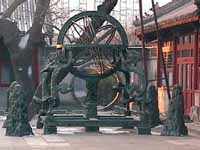
towards Tiananmen on the long road, I finally located the sole attraction
that had captured my interest whilst distractedly browsing the guidebook
over my morning (mid afternoon) coffee - an Astronomical Observatory the
site of which dates back to the Khans, and currently occupied by a structure
which dates back to the Ming Dynasty. It's history grabbed me in that it
had been given over to Jesuit control during the Qing period, after a few
monks impressed the Emperor with some pretty nifty predictions. What's
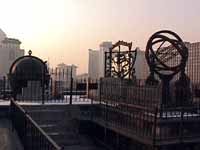
interesting about the museum today is the assortment of curious iron measuring
instruments atop a squat fort-like cube of a building that are supposedly
rare and wonderful - having finally paid the entry ticket and made my way
up a polite flight of even stairs, I had to agree that they were as cute
as the guidebook promised. Framed as they were in the apricot sky of a
setting sun, the accompaniment to all my ill-planned sightseeing excursions,
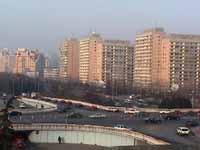
they crowned a complex that was claimed to be fascinatingly out of place
amidst the modern Chaoyang skyline. Considering the terrain of hovels still
on coal immediately behind the grand office towers, I was unable to concur
on this point.
|