  |
|
|
Any illusions
one has about Beijing are quickly dispelled by a walk eastwards along the
lengthy street that horizontally bisects the entire city at Tiananmen gate.
Parallel with the Forbidden City, Wangfujing street is host to elegant
and enormous shopping plazas featuring international prices. Further East
is the city's proper commercial centre, focussing on Guo Mao, the International
Trade Centre, at the corner of the third ring road.
Guo Mao was
easy to find; taxis, bars and foreigners orbited a district of flashing
skyscrapers and hotel towers. It was here in a Starbucks café where
I had arranged to meet Liu Fei, an executive at a multinational operating
in this area of Beijing.
Fei was a bright
graduate of a university in Wuhan who felt qualified enough to hunt for
opportunities in Beijing, and was successful in finding work that paid
well (although she is still paid less than her American colleagues) and
provided the chance to travel. Although her intention is to emigrate (a
dream shared by many Chinese) she has witnessed in the past few years enormous
changes in the way Beijing does business. Money has provided the new white
collar class with a freedom that politics has not, traditional values sacred
a decade before are relics that belong to a distant culture. Fei prefers
to retain a mysterious oriental flair about her self-image, yet freely
admits she has an international outlook which is fundamentally Western
in origin. As we spoke, a passer-by accidentally knocked her chair; they
apologised to each other without hesitation, using English.
Fei told me
of the expansion of foreign corporations within the city, now amongst the
most powerful and influential businesses here. She told me that if I'd
arrived in 1993 I would have been an unusual spectacle; now the presence
of lao wai is endemic, and the whole feel of affluent Beijing has
remoulded around them in an opportunistic embrace.
Beijing has
rapidly come to see itself as a modern metropolis, which seems to have
brought upon the confidence to make a bid to host the Olympic Games in
2008. Since the bid was announced, the hive of the city hub has swiftly
commenced cleaning, constructing, sweeping coal dirt up behind colourful
billboards of olympic promise. Fei was sceptical about the whole affair;
money diverted from genuine city-wide betterment to an international face
gaining exercise which would make a fraction of the inner city look more
attractive whilst the rest of the country suffered inferior plumbing.
Later, I took
the time to wander the Guo Mao plaza and surrounding streets. Foreigners
really were everywhere, and the conversations between them which I managed
to overhear were illuminating. Many were directly involved with the Olympic
bid, which gave me cause to wonder whether the idea was introduced to the
government by foreign businessmen with interests in Beijing. Most were
cocksure and arrogant about their position in Beijing, an attitude that
was easy to recognise in that it was so unabashedly projected in character,
dress and speech. Sitting writing alone in another Starbucks I was similarly
opportune to hear a conversation between an expat musician and his English-speaking
Chinese lunch partner.
Expatriates
are as old as colonisation, and everything I have read of them depicts
them as self-important, wealthy layabouts, or more directly, a bunch of
wankers. The expat scene in Beijing is no different to that of Hong Kong
or any of the colonies historically spread throughout Australasia and Africa,
lax in morality and sense, educated without responsibility. Expatriates
are typically upper-class middle achievers who discover themselves to be
taken seriously overseas and settle. This particular individual was a conductor
engaged in criticism of the government with regards to their discriminatory
distribution of performing licences and in patronising his lunch date with
difficult English mockery which he was aware she couldn't understand.
I was in Beijing
to try to get inside; by being automatically associated with the resident
foreigners, the expats and businessmen, I found myself to be in a niche
in which I felt quite uncomfortable.
Zhang Na had
taken me to Wangfujing street a few days earlier, here I had encountered
an old street totally refurbished in plazas. They are enormous; I was quickly
lost in Sundongan Plaza which contained an obligatory 'Chinese History
Street' with replicas of the kind of buildings they'd knocked down to build
this one; within, one could buy imitation Chinese clothing and souvenirs
at magnified costs. At the bottom of Wangfujing stretched an even larger
complex called the Oriental Plaza, which I was told was the pet project
of a lone, fantastically wealthy Hong Kong businessman's heir.
One old alleyway
retained a genuine flavour, where snack foods from a variety of China's
ethnic cultures served as an alternative to the enormous McDonald's in
Wangfujing. I was quickly bored with the whole region, however, which would
have made an exciting shopping holiday were I in the market for that sort
of thing.
Tiananmen and the Forbidden City
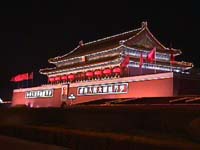
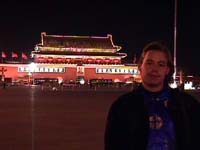
I had delayed a trip to Tiananmen Square and the Forbidden city for a number of reasons. For a start, I was rather bored with sightseeing; Beijing is cram packed with grand historical sites complete with the obligatory stalls and merchants haranguing tourists. I was enjoying myself in my little apartment, dragging my laptop halfway across the city every day and writing in Starbucks. Which, I suppose, made me something of an expat myself. It's also an odd pilgrimage for those who make a connection with China: the centre of Chinese Being is here, its dynastic and contemporary history sit rather uncomfortably on the blocks of stone tiling the Square and within the odd assortment of luxury buildings beyond it. Any Westerner nowadays associates Tiananmen with the massacre of June 1989, which is still underplayed in the propaganda. The Chinese are all sick of hearing Westerners bring the topic up - our lot generally tend to preach about the benefits of the free world and are desperate to make sure Chinese people really know what happened - trust me, most do, I've not met one who believes the party line. I've had a growing
interest in China for the last four years now, and to approach Tiananmen
one evening at last was a mark of how far I'd come in making a very unusual
escape route a reality, and I was not without some emotion. There was the
big fat Mao picture over the Emperor's gate, there was the broad flat public
square housing his body and his legacy. I wandered through Tiananmen until
the feeling went away, and was left passing through an ordinary park on
my way home. A more significant brand of inclusion, perhaps.
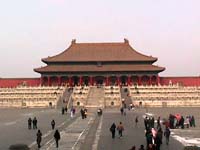
Zhang Na and I visited the Forbidden City itself beyond Tiananmen Gate a few days later: said by all to be a fascinating labyrinth of detail, to me it was a succession of nearly identical red buildings with curly rooves. It was in the middle of a cold snap, and I'd left my gloves on the metro, my new pair were overpriced and ineffective. People were few in the complex and it was late in the afternoon due to a lifestyle of oversleeping and late nights in the smoky netcafe in Hua Jia Di trying to beat a bad connection down. I got through a two-day's worth attraction in just over an hour, having seen it all before in Shenyang where the Qings came from in the first place. I swiftly moved on to the more immediately aesthetically appealing Jing Shan, a man-made hill to the north of the Forbidden City which served as a lookout, windbreaker and northern defence layer for the Emperor, who for geomantic reasons was obliged to reside in the Northernmost area of the palace rather than in the more defensible centre. Jingshan is capped by a gorgeous short temple with a stunning view of the Forbidden City and Northern Beijing. From the top, I noticed a curious white pinnacle which turned out to be the Lamaist Dagoba of Beihai Park, where Zhang Na and I headed next. The park is a luxurious and quiet wander around a lake, the site of the original Xanadu. The Dagoba sits on an island in the centre and is additional to the park entry fee, however, an unguarded gate to the back brought us a fairly close examination of the structure. We'd lunched at KFC, which locals regard as an eyesore squatting on their cultural heritage; McDonald's, and more recently Starbucks, spoil other sites of National importance. Rather more appealing than all the historical areas was the adventure in interpreting the bus map to find a direct route home. It didn't prove to be difficult, and the streets to the north of the Forbidden City are genuinely appealing, old grey stone houses and stores, the smell of cooking on the street, colourful alleyways and dusty, tree-lined boulevards. |