  |
|
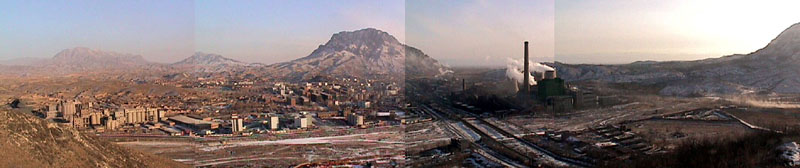
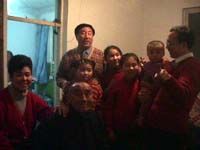
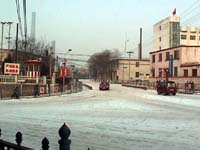
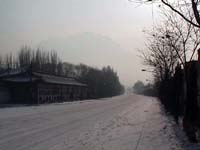
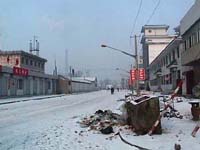
A composite
cityscape of central Zhang Jia Kou
|
Around 80 years
ago, two rivals in Zhang Jia Kou made a heavy gambling bet; one's entire
fortune against the other's daughter. The father who lost was bound to
surrender his then fourteen year old girl to the victor, who arranged for
her marriage to his son, Zhang Ku, as soon as she was of marriageable age.
It was to be a life of hardship and obedience for the girl, who would live
to see the political lions of Chinese history wage against each other for
the future of the entire country around her little stone home, and notice
no difference to her daily routine of maintaining a husband she had never
loved and their children. She is an old and leathered woman, she lost an
eye in a medical accident and has but few browned peg teeth. Today, one
might never imagine that this woman who had lost an entire lifetime in
a father's gamble, attempted suicide as recently as three years ago, never
content with a situation in which she'd never had the freedom of choice.
She was difficult
to understand, speaking a rare dialect of standard Northern Chinese, but
I could make out some words. She told me that she remembered the Japanese
occupation of the area; they'd been responsible for the massive coal processing
plant that dominates the city back in 1937, and had been cruel administrators.
She'd met a survivor from a nearby village that had been wiped out by them,
although her own community had been treated lightly. Then came the nationalists,
the Kuo Ming Tang and their struggles with the Communists. Both had confiscated
food; only the Communist troops had had the decency to ask politely and
return what they had used after more supplies arrived.
The evening
had been memorable, I had been involved in the preparation of the dumplings
which were scoffed as soon as we had come back in from watching the fireworks,
and had spent most of the night playing at cards with Zhang Na and playing
games with her small cousins whose energy was surprising given the late
hour. 'Red Pockets' had been distributed by the adults, annual gifts of
money given by the older generation to the younger. Na's Nai Nai handed
me a 10 yuan note which protocol required I accept, she grinned toothlessly
as I shook my hands together in the traditional gesture of thanks.
After some sleep,
I was shown around the town in the crisp morning air. Not much was open,
given that it was a public holiday, but the centre of town was a humble
collection of shops and businesses which made small, defiant temples of
modernity within the bare huts surrounding the railway. We visited a small
park, a pretty affair of Qing Dynasty stylised walkways around a lake.
What appealed most as I wandered around the city was the beckoning short mountains surrounding the town - I imagined the view from the crest to be a pretty good reason to attempt one of the more manageable ones. Zhang Na and I set out after lunch, avoiding her uncle, drunk on Bai Jiu, who wanted to hold my hand and tell me how wonderful it was that I was visiting them. It was a splendidly bright day - the mountain (called 'Chimney Mountain') wasn't too difficult to climb, and after a few minutes it became clear just how rewarding a view it was going to be. The tall grass was yellowy straw, the wind blew the cold off the snow up to the summit where we sat chewing long stems and looking out over the city. There seemed to be several centres over the plain in addition to ours at the railside, long roads around the bases of the mountains connected them a steep taxi fare away. The soil was poor from centuries of mineral extraction and millennia of agriculture, deep pits of eroded soil slid away from distant roadsides. Dominating the horizon was another mountain around three times the elevation of ours, which was named by the famous Dowager Ci Xi during her flight from the Nationalist takeover of Beijing. Zhang Jia Kou was the terminating station of the first railway from Beijing, and provided a natural escape route as popular revolution forced closure on the centuries of Manchurian dynastic rule. She was a notorious nasty, having surrendered without significant resistance Chinese lands, and diverting money for her own vainglorious projects at a time when the military forces were struggling with foreign onslaught. After staying the night in Zhang Jia Kou, she apparently walked out to a view of the mountain which seemed to her to resemble a crowing rooster (a connection I failed to make myself) and thus named it Ji Ming Shan which means 'Crowing Mountain'. It was a challenge that seemed difficult to meet, but I resolved to discover more about it once we returned home. We were late, having taken a detour around the river behind the coal factory, shallow and thinly iced over. Na was in trouble with her father, apparently wolves roam these parts, although attacks are reportedly rare. Furthermore, her drunken uncle had decided that I was too important to be staying in the family home, and had organised my accommodation in a nearby luxury hotel via a friend of a friend. My stay was to be free, the reward appeared to be the acquisition of face by all involved in being seen to be helping a foreign friend. I was unenthusiastic, but bound by politeness to accept the invitation; a promised warm shower was an appealing idea. I shook hands with a few official looking businessmen who arrived to escort me there. The hotel was hardly first-class, but it was a marked improvement on Lan Ting in Shenyang, with three rooms and several beds. I hoped Zhang Na and her mother would join me in the neighbouring room, which was allowed, but Na's uncle was insistent that only foreigners were important enough to stay there. I rather resented the impolite preferential treatment, but was again obliged to consent. Oddly, I appeared to be the only occupant of the hotel. I asked how such a business could possibly sustain itself - the idiom in Chinese which was given by way of reply meant 'falsely ostentatious state-owned enterprise'. The whole business was itself an exercise in face for the Government, who supported it in the hope of impressing the scarce foreigner who chanced upon it. Ji Ming Shan
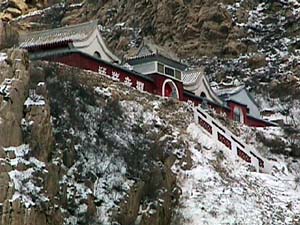
Fortunately, someone else had had the same idea as I'd had when looking out towards Ji Ming Shan - climbing it - only they'd had the idea a thousand or so years beforehand and had gone to the trouble of making it a little bit easier by carving rough pathways along the side. It was still a terribly dangerous climb for a layman, but soon became an attraction not to be missed once I'd heard that there were various Buddhist structures near and on the summit. Apparently, the mountain had been a favourite holy resort for an earlier Dowager in Chinese history, and the structures built on the side date back to the Ming Dynasty several hundred years ago. Zhang Na and her now sober uncle joined me on the climb. A lower point of ascent was punctuated by a few smaller halls for prayer and rest; after almost an hour we reached a large temple on a crest halfway to the peak. There were two plain clothed devotees present who showed us around the temple grounds, which presented a cold view of the coal dust blanket cloaking Zhang Jia Kou. Here, above the smoke, the air was relatively pure and cold. Life at the temple is not without some luxuries though - we were invited into the quarters of the resident monks who were absent at that time, shopping in the town at the base. Equipped with prayer gong, thermos, telephone and colour TV, prayers were evidently interspersed with Qing period soap operas. The ascent to the summit took more than an hour, slippery with untouched snow and sharp drops, breath was careful and cold, steps were hesitant and slow. One cavern contained red rubble believed to cure any disease; it failed to make an effect on Na's uncle's halitosis. Signs printed in Chinese and mangled English reminded travellers to take care on the climb, one encouraged us to be 'fumily happy'. At the top, a bridge carefully connected two neighbouring peaks, one of which was once a smaller residence for monks. Simple huts, now locked, sided small prayer areas. The complex dates back for centuries, now loudspeakers have been fixed to a post to send out blessings over Zhang Jia Kou. Tablets bore carved comments from Emperors past, many still legible with the thoughts and writings of these earlier rulers of China. Most of the buildings are recent reconstructions, however; the original bridge and temples were destroyed by, with no surprise, the Red Guard. It was during the Cultural Revolution that it was decided that traditional temples were symbolic enemies of modern Communist China, throughout the country zealous teenagers under official sanction steadily razed China's cultural treasures, making the same difficult climb we'd made to desecrate the extraordinary and the sacred. We wandered down carefully, the descent being just as difficult as the climb. A welcome rest at the monastery gave us the chance to meet one of the monks who'd returned; he opened the small store to sell us some trinkets before heading off to his warm television. Back at the base of the mountain, evening blued the rubble and dirt, small shacks smoked out in coal, and their occupants filled old kettles for weak tea and washing water. We passed a sole old gravestone with the Zhang family name on it; this turned out to mark the place of rest for Zhang Na's grandfather's older brother. The night passed quietly before Zhang Na and I headed back for Beijing on an early train the next morning, leaving behind us a small city of little note still withheld from the forces which have changed the country's capital and which have begun to transform Shenyang. Zhang Jia Kou is seldom the destination of tourists or even the hardiest travellers, still a world unto itself in which new generations continue to trace over the life lines of the old.
|