  |
|
|
The end of my
contract was nearing, and my intention was to get to Beijing as soon as
I could to catch a friend from New Zealand before she left for home. However,
my plans unfortunately coincided with China's biggest holiday, the Spring
Festival which celebrates the beginning of the Chinese New Year. Booking
train tickets was next to impossible; I had to inform my friend that I
couldn't make it and had to reschedule. I had a few acquaintances in Beijing
whom I'd met through the Internet, fortunately I found one who was prepared
to look after me for a fortnight. My colleague Sun Ya Tao also managed
to score some accommodation for me through an old friend of hers, so I
began to plan what was looking like an inexpensive holiday in the metropolitan
capital. This is not to be discredited; Beijing is the Los Angeles of China,
as modern and expensive as anywhere gets. Hotels can typically cost around
800 yuan a night for an average room, and there are serious restrictions
on where a foreigner is allowed to stay. The fact that people were prepared
to help me circumvent the regulations is perhaps another factor of the
times in a city where regime sits uncomfortably with the kind of international
awareness and freedoms that money and American movies bring. Ten years
ago people were dying to change the government, now they dismiss it as
unimportant and get down to the age old Chinese craft of corruption: getting
around the law.
I arranged to
work an extra week at Guan Ya, which would see another thousand yuan in
the kitty and allow me to attend the Spring Festival function on the night
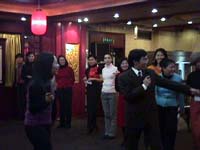
of the 21st. A lavish buffet dinner was to be punctuated with performances
from the staff - I was somehow volunteered to sing; I selected an easy
Faye ballad and spent several free hours working on the Chinese pronunciation
instead of planning classes, reflecting how most of the Chinese staff performing
spent the week.
Classes were
quiet, for the mostpart I didn't tell the kids I was leaving. Cecily broke
the news to my final two classes, to my surprise they had prepared presents
and cards for me when I arrived. I had convinced one girl, Hua Fei Fei,
to sing in class a few weeks beforehand, she presented me with a small
bag of cuttings and pictures she'd drawn for me; I was touched and later
in an odd mood as the staff taxied together to the function room in a nearby
restaurant.
I largely didn't
enjoy the dinner; I managed a small plate of entrées before the
MCs began their evening-long stream of entertainment, the Chinese staff
were obliged to enjoy themselves and complicated rivalries of face were
working between the headmasters of the various schools, who all wanted
to make sure they had prepared the most interesting performances from amongst
their staff. It was impolite to get up to fetch more food; I was stuck
in a pen of formality and manners, and was able to decipher very little
of the proceedings. I sat with Hu Ping, Lawrence and Peter, whose antics
provided some relief.
I was called
for my song, managed to lose and after some panic locate my lyric sheet;
delivered a bashful speech before the formally dressed three or four hundred
attendees, thanking my colleagues for their support in learning Chinese
and for their outright friendship. I sang hesitantly, but was warmly received;
Hu Ping walked up to the stage in the middle of the song to present me
with a fluffy sheep.
I circulated
and said my farewells before we were finally let out, the headmasters all
happy. A drink at a local nightclub marked my release from obligation to
the job. Which left me, once again, free in China with no formal plans
or duties, time to see what I could see, time to consider the next moves.
More pictures from the Guan Ya Spring Festival Party Train to Beijing The next night I found myself headed South for Beijing in another sleeper train. Being the night before Spring Festival, it was almost empty. I enjoyed the luxuries of the space, sitting at a thin side table with a beer and sesame seed nuts, writing and contemplating my regained freedom. Five months before I'd left a repetitive job with computers to come to China with no specific objectives save to explore and learn Chinese, now I found myself once again moving to see what I could find. This holiday was to last a month, taking in a few cities before returning to Shenyang, arranging appropriate visas, and then taking a second holiday in the South of China to see a close friend from New Zealand teaching in Hunan. My pillow backed onto a window again, so I checked the scenery whenever sufficiently awake; the environs seemed grubbier than they had up north on the Harbin line, thick woods, urban areas, farming settlements. I had the definite sense of moving inwards as I approached the centre of the culture, China's capital for centuries, once thought to be the centre of the entire universe. After sunrise the loudspeakers were turned on with pleasant music and a 'be awoken, friends' - hardly the rude awakenings of ten years beforehand. The music, however, annoyingly continued throughout the morning; a phenomenon which has remained consistent. My mood was exceptional as the train entered the official outskirts of Beijing. The train lines began thickening into a twisting vena cava, snow laden paddocks gave way to roadways, squat brick houses accumulating height and proximity as they surrendered to unbroken lines of tall apartment blocks. The city was under grey cloud, the central station at Beijing misty and cold. Journey to Zhang Jia Kou
The nature of travel has recently changed much for several reasons. Firstly, business has awoken to the fact that people like to go to different places more than it had noticed previously; tourism has become a game of working out where is interesting and transforming it so that travellers are obliged to make use of the expensive creature comforts prepared for them. Many tourists make no bones about this - if a travelator was fixed on to the Great Wall to eliminate the effort of walking along the more scenic areas of its length, I'm sure it would receive many millions more visitors than it does already. Beijing is a prime example of a city that has had its international face refigured within the past ten years, once a thick maze of raw culture, now it is host to grand shopping malls and cafés, fashion stores, the KFC in the historic park. Foreign faces are everywhere, self-important businessmen and loaded holidaymakers in the main, their hotels and restaurants of choice staffed by underpaid English-speaking attendants. Secondly, the Information Revolution has meant that nowhere is far away anymore as long as it's online in some respect. I had three friends in Beijing whom I intended to visit, mostly accumulated from the time spent in online chat rooms during periods between calls when working for Xtra Internet last year. As a consequence, I had some idea of what to expect from the capital, and had arranged an excursion to a nearby small town with one friend who was studying in Beijing; she had invited me to spend the Spring Festival with her family in a remote and primitive town called Zhang Jia Kou. Zhang Na met
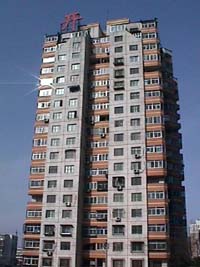
me at the station and assisted me in finding the apartment where I was
to stay, in the Hua Jia Di apartment complex in Beijing's North East. I
was to stay near the ground floor of an enormous block, crowned with a
gigantic Chinese character, kai, meaning 'open'. With the character
on the neighbouring block, their meaning was 'explore'.
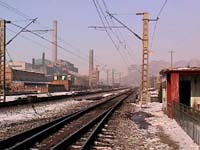
We were short of time, an expensive taxi ride across town to the South station left no opportunity for orientation in Beijing before I had to leave. We arrived with seconds to spare, forcing ourselves into little seats for the three hour's journey deep into Northern Hebei province. I amused myself by speaking with my fellow passengers as Zhang Na slept, one a PLA (People's Liberation Army) officer who was delighted to meet a foreigner who could speak some Chinese, a chubby bespectacled girl who had studied English and spoke with me about her tastes in music. Outside, we were passing through a mountainous terrain broken with small rocky villages; I spotted caves, possibly still host to some of China's troglodyte population, even still not having made it to houses in this the 21st Century AD. The soil was poor and sparsely vegetated in winter, a feeble river made several understated appearances on its casually majestic stage. We finally arrived, it was a cold, filthy afternoon and Zhang Jia Kou squatted unpromisingly on a rare flatland amidst the mountain ranges. The city is an industrial pit for its hardened population of some 12,000 inhabitants at the centre; the city spans several distinct locations around the plain, however, and the total population of these and their satellites numbers close to a million. Centuries before, the region was an important caravan stop for trade routes headed North into Mongolia and Russia, being relatively close to the Great Wall. It has changed hands between the Chinese and Mongols a couple of times owing to its strategic location; the Japanese took it in 1937 and attempted to strengthen their own ties with Mongolia, discouraging Chinese colonisation with a few indiscriminate slaughters. The communists took it back in a friendlier fashion before their victory over the Kuo Ming Tang in Beijing. Known to the outside world as the inglorious city of Kalgan, meaning 'gate' in Mongolian, its Chinese name preserves this meaning in the word 'kou' which also means 'gate' or 'mouth'; the 'Zhang Jia' part means 'Zhang family', and it is likely that Zhang Na is a direct descendant of the pioneers that gave the town its more recent name in Chinese. Her grandfather, who met us with 12 other family members at their stationside home, was too young when his parents died to remember them, but he is certain his grandparents were also born in this area. Their family history spans a long, important period of modern development in a town that is still far behind the times; outhouses are a recent invention and a long drop proudly awaited us on the opposite side of the train tracks for our regular evening visits in the cold. The family lived
in a concrete bunker, the fifteen of us were to share three broad table
beds. Zhang Na's parents were there, visiting from their home in Tang Shan
to the East of Beijing; several uncles, aunts and cousins huddled around
a table of party dishes. The tradition is to stay up all night; eat until
midnight, celebrate with a further meal of dumplings, one of which contains
a lucky coin; play until morning when a warm breakfast gives the family
to a late morning sleep. All of this is punctuated by constant fireworks
and crackers - we all wandered outside onto the tracks at midnight to see
the town count in the Chinese New Year of the Snake. It was snowing lightly,
all around the apartment blocks were afire in a display of coloured lights,
bright explosions, glowing red globe lanterns; for miles around sky lotuses
flamed in sporadic intervals. In a remote town, the reaches of a national
culture touched on short bare villas of stone, Grandparents huddled around
the old furnace, unshowered brothers drinking spirits and their children
watching Hongkongese pop stars sing in the new spring on CCTV1. A century
still behind Beijing, it was a warm company of faces not seen by most visitors,
it was a privilege to be a foreign witness and to be accepted immediately
as kin.
|