  |
|
|
Just before
the first snow, our university organised a 'Chinese Experience' field trip
for the foreign students. Many such adventures have involved visits to
remote and interesting places, small villages in Liao Ning or Inner Mongolia,
sites of historical interest, territories with raw, open scenery and of
profound cultural significance. This time we were less spectacularly privileged
to experience the flour and beer factories of Shenyang.
Class excursions
are justified by opportunities to use or enrich one's subject of study.
Supposedly, our purpose was to ameliorate our Chinese through contact with
locals and via deeper insight into Chinese industry. However, in this particular
instance the reputation of the university was an important consideration;
therefore, when speaking with the various managers and guides at the factories
we visited, only the most advanced students were called upon to comment.
All presentations made to the classes were in rapid, fluent Chinese, so
as not to lose face in the presence of local businessmen. This exercise
in false prestige was fine to a point; however, when I managed to catch
the words 'when you something something something it is very dangerous
to something something so don't something' I began to wonder at the practicality
of this method.
The factories
were spartan; fantastic modern machinery processed materials fed to them
through shoddy old tubes in vast dirty warehouses, superfluous bored workers
sat brushing the occasional imperfection aside or back into line, if they
were watching at all, groups of others squatted hunched over exposed wires
and components making patchy fixit jobs with ancient gadgetry. Higher executives
presented broadly overestimated evaluations of their business, other guides
steered students away from views of the shocking living quarters for workers
backing on to the factory grounds.
We wandered
about the sites to the amusement of the factory workers - if one foreigner
was enough to generate surprise in Shenyang, a busload was even more curious
a spectacle. For the students, it was mostly an opportunity to socialise.
I met many Japanese and Koreans, a Mongol (whose camel racing exploits
proved too difficult to translate), a Dane, an Italian, two Germans, and
a few Malian African students. Chinese necessarily served as the lingua
franca, and in this respect it was good practice.
Shenyang in the Snow
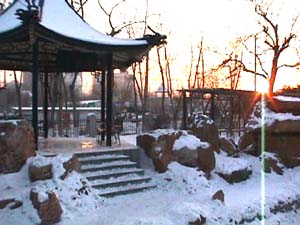
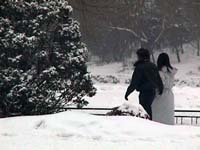
The first snow in Shenyang is a much anticipated event, and the first flakes are met with a host of excited childlike faces who rush to photograph each other by snow whitened trees and throw snowballs. I was on my way to Zhongshan school as it began to fall, and before too long the old dirtied streets were sheeted brightly; and for a moment the city took on a thin skein of beauty. The magic is quick to fade. Snow is perfect white, it descends upon the dust and veils the dark and dirt. Soon, however, it acquires its own layers of decay, grime from shoes and tires, soot settling from factory chimneys, thrown packets, the unceasing ejection of spittle, smoke, churned with mud and coaly pavements. It acquires a grey blush and the gloss of white disappears, becomes another feature of the industrial plain. There is a curious mood about the place at the heralding of the snow. Summer is long and sweaty, it ends sharply in a month of cold winds which give way to the winter snows. The season is warmly and festively welcomed, yet behind the smile of greeting lies the tired recognition of invasion without hope of resistance; for the snow is an old visitor of catharsis and trial, it cloaks without cleaning, it freezes dangerously on footways and tiles, it is the bride of sickness and makes fearful any venture out into the frost. This is the season of little sun, the cold is a powerful curfew and daylight lasts less than 10 hours. Life in Shenyang has always been this way, an acquiescence of annual defeat to the inhospitable weather, forced inside, schoolchildren and labourers decreed to scrape ice off the roadways with shovels and to dump great, dirty, bacteria-laden piles of slush on the roadsides, only to have the beautiful snow descend again the next night, an indefatigable army of gorgeous hexagons. There has never
been any glory in victory in this region; Shenyang has been taken decisively
by every armed force of might that has come to the city. The soil is bleak,
the air itself is muddy, the only appeal the place holds in military terms
is a strategic one - it is the capital of Liao Ning province; any force
occupying the city controls the rail access to the satellite centres throughout
the state; they similarly control all industry in the area. Russia, Japan
and the Communist Army itself used it to fuel other missives, as the locals
necessarily bent as they do now, beneath this falling snow.
Guided Through Liao Da
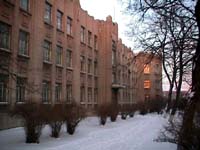
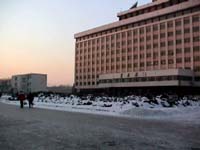
One night at Lan Ting hotel, I received a phone call from one of the Chinese lecturers at Liao Da, Professor Liu, who had learned that a native English speaker was enrolled at the college and who was seeking a language exchange partner. Her English was exceptional, her organisational skills were not and for nearly three weeks we played phone tag in an attempt to arrange lessons. We did manage a couple of extended lunches at restaurants close to the university, however, during which I was treated to many interesting revelations into the university's life, history, and grounds. Professor Liu also gave me insight into her own experiences there, which provided me with some understanding of the figure of the Academic in China's educational system. Liu is a graduate of the Shenyang College of Teaching who completed a Master's at Liao Da whilst teaching Chinese part time. Since then she has flirted with the papers necessary to attempt a Doctorate and has moved to teaching Mandarin more or less full time for the past year. A position at Liao Da is not without its benefits - all of the teachers of the Chinese language here receive regular opportunities to teach overseas for two year periods, a foreign excursion denied to most in other professions. She is also a Party Member, a status hard to come by and which is accompanied by its own perks. To become a formal member of the Communist Party requires a complicated series of examinations and assessments of character, it involves a responsibility to the politics of the country and an outward show of support for the country's leaders. Many Party Members I have met confessed privately that the label is one of opportunity only and not in any way an indication of their acceptance of government policy. It is difficult to gauge just how many Party Members are hard-line Communists and how many are frankly kissing ass. Liu herself conscientiously avoided discussing such matters with a foreigner. The university itself is more a testament to the Manchurian region's relationship with Russia than it is a statement of the Chinese traditions of education. Before extensive contact with European powers, Chinese schools were far more specialised, and the concept of a campus housing a variety of faculties was mostly unheard of. In the last century, universities such as Liao Ning Da Xue followed a trend which saw the amalgamation of established schools and the development of systems of accreditation which paralleled international degrees. The present campus is a mixture of the original university, a teacher's college and Shenyang's school of the Russian language, the only foreign language taught in schools before the invasion of the Japanese in the years leading up to the Second World War. After the war, the Russians regained a firm stronghold in Shenyang, and contributed to the construction of many of the buildings now remaining as the majority of faculty offices and lecture halls. Many grand structures were put up in the late 1950's, sturdy soviet blocks adorned with central red stars; a statue of Marx dominates the foyer of the administration building. However, the ties with Russia were becoming less healthy during this period of Shenyang's history. Local products and large sums of gold bullion were taken to Russia indiscriminately and under severe terms; Russia was a strict and unforgiving market to local merchants who struggled to meet the precise demands of Russian consumers. Mao's lot finally forced them out during the Cultural Revolution; and Manchuria was definitively and solely China's after centuries of Qing rule. When the Manchus took China all those years ago, they had little idea that they were beginning a process which would see their region and culture totally submitted to the Chinese; the Manchu language survives in textbooks and with scholars only, and merely vestiges remain in the phrases of the ethnic Manchu whose first language is and must be Mandarin. Universities throughout the country became the responsibility of local government, and it was during this period that the modern form of Liao Ning Da Xue took shape. The Northern regions of China were slower to respond to new methods, Liao Da only really came together in the early 90's. The process is not complete, there has always been talk of the future merging of all the universities in the region, and Liao Da also features in the government's 21-1 Project, which plans to advance 100 universities significantly in this the 21st Century. Liao Ning Da Xue has therefore received a certain amount of central government funding as of late, which has seen the erection of fine modern edifices, of which the library is a prominent example. Liu herself spent much of her postgraduate hours in the Liao Da library in the Master's student's complex at the top, where she concentrated on Chinese literature. Most of the hours there were spent seated on the sill of one particular window reading classic modern Chinese feminist literature, looking out over the steadily rising Shenyang skyline, as the city moves into its new role as the centre of foreign investment in Liao Ning Province (perhaps another invasion, this time of foreign businesses as opposed to armies). After having treated me to a tour of the centres of historic interest on campus, she concluded with the window; we talked our way past an incompetent and pointless guard to ascend to the top to watch the wan sunlight disappear behind the dark clouds and dirty office towers beyond the university grounds. Amidst the turbulence
of factional history, the university here has survived as a convergence
of the lives of individuals seeking academic goals, the enrichment of knowledge
to stand in contrast to dumb plays of force for the region outside. Here
on campus is Manchuria and China and Russia; here is also a window where
one student used to enjoy great prose. It struck me that the window was
really exactly what I came to China to see.
|