  |
|
ancient tablet and in this A-Mei pop karaoke video Before leaving
New Zealand, I had asked my friend Leon, who had spent a year abroad in
Honduras in 1994, how long it had taken him to learn Spanish. Given that
my own Mandarin was at the time barely existent, I was keen to know how
long it would be before the incomprehensible banter of Chinese people started
to make sense. According to Leon, most students abroad found it took about
three months to make a breakthrough - he, on the other hand, had only taken
one before he started getting the gist of things and began the more agreeable
task of vocabulary acquisition. He assured me that the reason behind his
rapid progress was the exercises he had set himself, and the Hispanic comic
books he'd read at the rear of his Honduran classroom instead of doing
work.
Leon's a clever
boy, and I fancied myself to be bright enough to follow suit, as far as
getting on with language acquisition went. I already had a basic idea about
how Chinese would probably work, had listened to numerous Chinese VCDs,
and was fairly optimistic about doing my best to get Mandarin down pat
as quickly as possible. When I arrived in Shenyang, I discovered I had
a lot of time on my hands, and devoted quite a reasonable amount of hours
to the Teach Yourself Chinese book my sister had given me for Christmas,
which was pretty helpful. I spoke with Xiao Yun's family, I listened to
the TV and attempted to work out what people were saying, I queried and
questioned and did as much as was necessary to improve.
A month later,
I knew close to nothing at all.
The first problem
was my rediscovery that language acquisition sucks. Having spent years
learning French, I should have remembered that there is nothing more boring
than poring over those lines of little clocks, trying to nut out what time
it was in French. The fact that I am in China makes little difference,
it's still a pain in the proverbial having to learn to tell the time again,
amongst having to learn how to say everything again.
I'm grieved
at not being able to speak. What's more, I am now illiterate. Every street
sign, food packet and machine operating directions are absolutely impenetrable,
offering no clue as to their verbal referent, which I wouldn't be able
to understand anyway. Without a phonetic alphabet, I'm even further back
than I was when I began to learn English. I remember an episode of the
Twilight Zone where a man woke up to discover everyone he knew now spoke
some other language totally incomprehensible to him. I'm that guy.
Here's the second
problem: learning a language is like learning the violin. Until you're
really good, you stink. There's no in between. There's no victory in ascending
any single phrase, because after you say it with all the correct tones
and inflections, you need to say something else, so you're lost again.
Plus, there is no guarantee that anyone who uses that phrase when speaking
with you will speak in precisely the manner you learned. Which means that
you can be lost when people use words you already know in unfamiliar ways.
Add all this
to the sheer complexities of Chinese. For a speaker of a European language
like myself, Mandarin has to be one of the least yielding tongues on the
playing field.
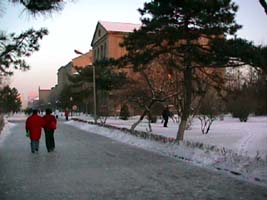
Mandarin Chinese literary culture got itself together a long time before Chaucer wrote the Canterbury Tales and set English to page. Centuries beforehand, a rigid system of Chinese characters was devised by scholars to formalise the evolving hieroglyphics already extant, thus standardising a grammar that would remain relatively consistent for generations. Poetry written many centuries ago still rhymes thanks to this: Even Shakespeare's rhymes don't all work now after just a few of them. Any old language gathers density as words take on new contexts. Chinese is so rich now that even the most casual of utterances seem to have layers of subtext that might account for the uncanny ability of Chinese people to demonstrate an air of glory in the most strained of circumstances. The toothiest and dirtiest peasant, squatting selling seeds on the roadside every day of his life spits out sounds that might as well be embroidered in gold thread on a banner of red silk, and what's more, he knows it. Chinese pride, in this respect, is practically genetic. Chinese is complicated to learn for many reasons. The most obvious of these is the fact that the spoken language employs tones which are not used in English. A word that is said in a high pitched voice is different to the same word said in a falling or rising tone; in fact, it won't be the same word at all. Tang means 'soup' if you say it straight and high, 'sugar' if you say it going up, and 'heat' if you say it sliding down. If you start low and dip down and then up again, Tang means 'drip'. Mastering this system is hard enough, but first you need to actually figure out how to recognise what tones people are saying when they speak. I found I could never be sure at first, and even now I am still often in error. That's only one order of complexity, though. Actually, most words are used for more than one signified meaning. So Tang in the high tone only means 'soup' in certain contexts - in another context, it means 'wade', and has a totally different character in the written language. This means that if you can only identify some of the words in a sentence, you might already be on the wrong track, because what you hear correctly might be a different character than you think it is. It works the other way around, too - some characters have more than one meaning or pronunciation. The word 'De' can also be pronounced 'Dee' in certain contexts. In Shenyang, it's pronounced as 'Dee' almost all the time, which brings us to the problem of regional variation. The Chinese language is more accurately a language family, and standard pronunciation is an afterthought imposed by the government which needed to establish some sort of continuity when the Empire became a country. Standard Chinese is known as Pu Tong Hua, and almost no-one speaks this as a native dialect - even in Beijing, the pure tones taught in universities and delivered in parliament are slurred into buzzing r's on the streets outside. Recently I discovered that the only place which speaks a dialect close to Pu Tong Hua is a small city called Harbin a day's drive north of Shenyang, famous for severe soviet attitudes, ice carving and alcoholism. Harbin has an interesting enough history of its own which we shall come to at another time. It should finally be said that most words in Chinese are two or more characters long - making a semantic unit that can be divided into packets of distinct meaning within itself. A decision, therefore, to learn Chinese, is one with a lot of ground to cover. To be precise, a few thousand years of culture imposing itself on patterns of sound. Chinese Characters Characters are, in part, what makes the whole trip worthwhile. They're frustrating, but they're also gorgeous. The Chinese character set consists of around 3,500 related patterns, each designed to sit inside a square without too much squeezing. There's nothing random about them, each character is a combination of a standard alphabet of simple patterns, each with their own individual meaning. The character which first captured poet Ezra Pound, and, coincidentally, me, is the character Ming which means 'bright'. The pictograph features a sun shape on the left and a moon on the right, and so there is a kind of sense there. Not all characters are so easily deconstructed, though, usually they are laid out in sections, some of which imply the character's semantic meaning, some of which recall other characters to provide a clue on the sound, some of which mark the character as belonging to a certain family set of characters. All of this makes for an extremely rich written language. This is the reason why most external observers find it difficult to forgive Mao ZeDong's administration for chucking out the hard ones and replacing them with simpler, vastly inferior ones. It was well meaning enough, there's a literacy problem in China that a pantheon of deeply complicated picture words are not conducive to. But the Taiwanese manage well enough nowadays, and they kept the older, more elegant ones. So do the Hongkongese. Simplified Chinese characters, as they are known, are admittedly much easier to learn, but Mao's crowd just plain went too far. Some of the most beautiful characters have pictorial elements to them that are crucial to their meaning; they were slashed without remorse. The language cops took the heart out of the character for 'love', they took the rising sun away from the East and took the legs off the Horse. The characters which replace them are clearly uglier, and one can't help but feel some irritation at the arrogance with which the noblest product of Chinese culture was repackaged for the masses much in the same way as Disney compromises rich folklore. Mainland Chinese people, however, don't care. Most people can read most traditional characters anyway, even if they can't write them from memory, and there's something austere about the functionalism of the modern script. Even still, this is the same austerity that saw Mao's red guard knock over temples in an overstatement of practicality over sentimentality during that unmentionable period of China's recent history. Liao Ning University
A couple of months in, and I still knew very little Chinese, or at least I thought I didn't. People were always kind, and occasionally I surprised myself, but in no way would I have classed myself as progressing well. Other foreign teachers at Guan Ya who had been here for a longer period were starting to speak well, and so they were a good source of advice. I'd considered trying to organise tutorship with one of the Chinese teachers, but for various reasons such an arrangement turned out to be impractical. Finally, it was Khang who put it to me straight: you need to go to school. You might think that going to another country where everybody speaks the language is a kind of alternative to dry class study. In some ways it can be, it's the so-called 'immersion' technique. But in order for that to work, you really need to be fully immersed, and when you're using English every day as my job requires, that's not it. So, it was time to push Guan Ya to fulfill their contractual obligation to provide Chinese lessons at the local university. It's difficult to push Guan Ya, for some reason their staff tend to deflect any important questions in the hope that they'll solve themselves. Fortunately, on this occasion they deflected me on to Peter, the American teacher who also studies Chinese at Varsity, who agreed to help me get started. In his words, 'Just start going to class, let them sort out the mess later'. Classes at Liao Ning University start at 8.00am, so getting up early for them was a stretch, given that I teach in the evenings. I got up on the morning of Friday the 17th, my third attempt to make an early start in time to catch Peter before he went to class. This time I managed it, and we headed out into a brisk Shenyang morning. It was terribly cold, the gutters had started to ice over, meaning the snow was coming within just a few days now. We caught a bus to the campus, which was just a half-hour's walk along the road anyway, but a walk which should certainly not be attempted in these temperatures. Soon we passed the large iron gates and serious-looking guard and were on the grounds. Campus and Classes
I rather suspect that university campuses the world over have the same open, relaxed feeling to them. Liao Ning Da Xue, or Liao Da as it is abbreviated, is no exception. The campus spreads over several blocks, all closed in behind a tall fence like a military institution. Within, however, there are spacious walkways and rest areas amongst the student buildings where many young faces can be seen sauntering quietly between classes, on bicycles, sitting on benches with books (albeit briefly in this cold), rows of girls with satchels holding hands and smiling at groups of handsome boys skipping classes. It was somewhat of a relief to be in such a familiar atmosphere, as if the easy intellectualism was a safety zone which bubbled the university grounds unto itself. People still looked curiously at the foreigners, but at least they didn't look uncomprehendingly. We passed the tennis courts and administrative buildings, and Peter pointed out several items of interest, places where the students dormed and the boiler house where they all had to come to collect their hot water. The foreign student's complex is towards the rear of the university. Here, the foreign dorms (mostly serving Japanese and Korean students of Chinese) are slightly higher in standard than those the locals enjoy, but not by far. The classrooms are in the same building, and so as we ascended the stairs towards class, the corridor air was damp with shower steam and hanging laundry. I tried three classes over the course of the morning, which covers four periods from 8.00am to 12.00pm. Peter's class is 'Beginners Top Level' - I eventually settled on the third level beginner's class, which at least put me a rung up from the dummies. I found I did OK, one of the classes I tried was a very advanced class which I found I could follow reasonably well, so I managed to find some hope that my progress had not been totally zero over the past months. My classmates were without exception Korean and Japanese, so even amongst these foreigners I was an unusual specimen. The main limitation with this arrangement, however, was that people in Japan and Korea use Chinese characters (or close equivalents) extensively, making me the only student in class who couldn't understand the meaning of a new word by having it written on the board. 'Hou means this', the teacher would say, and would draw an unfamiliar shape on the blackboard, and everyone would nod while I leafed through my little red dictionary in hope of matching the word and the picture. In general, I found the teaching itself to be only of marginal value to a student such as myself. A course engineered to instruct writing at the same time as understanding seems to me to be out of order, given that Chinese children can already speak Chinese fluently before they tackle their first glyph. What was useful, however, was the advantage that the classes were naturally conducted entirely in Chinese. A total of four hours every morning spent within the confines of the Chinese spoken language was really the immersion experience I was looking for. I tended to ignore the exercises in handwriting in favour of sitting and listening quietly to the teacher's voice. As she spoke, and described her language to the students, I listened to the inflections and patterns of her speech. I would frequently make the smallest of discoveries and grammatical implications. Soon, I found that I was speaking the small amount of Chinese I did know more naturally than the other students, even though their progress with the written language and their vocabularies far surpassed mine. It was at the three month mark that I finally discovered a vein of fluency in Mandarin within myself that appeared to have hardened overnight like the iced gutters. The famed three month breakthrough turned out to be an accurate measure, and it is a fascinating experience, owing to its suddenness. Without warning, the fog of foreign speech lifted a little way, so that if I ducked a tad I could make out shapes of meaning where nothing was there before. Real fluency is still far away, but it was a relief to find evidence that it was finally coming.
|