  |
|
|
In the city, we found our way to Nan
Hu park, one of the larger public parks in the area. Shenyang is built,
like all respectable inland cities, on the banks of a river, this one is
appropriately called 'Cloudy River', due to the fact that it's far from
clean. Nan Hu spans the part of the river that is closest to what could
be thought of as Shenyang central.
This park seemed less densely populated
that the last, or perhaps it merely seemed that way because of its size.
It's a beautiful park - I regretted characterising Shenyang as thoroughly
dirty, because Nan Hu at 7.30 am is bright and as gorgeous as any other
of its like. I saw people weeding traffic islands here - perhaps to make
up for the attention which it is impossible to give the rest of the city.
Wang Jian Hua and I walked quietly
around the river. The aerobics and traditional dancing groups were still
there - I noticed more people dressed in traditional costumes, leading
me to wonder if the Nan Hu crowd were a little more elite than the others.
Still, the concept of dressing in patterned silks to practice swordplay
in a public park at dawn was fascinating - Even if this were a mere method
of distraction from the inevitable boredom of disadvantaged city living,
it was an elegant escape. What made it a little sad was the awareness that
this was the whole extent of it - after the martial-arts fantasy ritual
was done, these people would make their way back to the apartment for another
day's mahjong.
I remembered the crowds around Eden
park after the rugby match. I remember getting to work at 8am, checking
my email. Reading a newspaper at a café with a bowl of latte steaming
into the mid-morning cool. I watched the fishermen at the edge of the river,
wondering what they were hoping to catch.
At the gates, a man dressed in a doctor's
uniform had set up a computer terminal, a long extension cord trailing
to the ticket hut. There was a traditional medical diagram of the human
body, with marks and lines to indicate the points which accorded with each
other in their interpretation of the body's bus-route organisation. Some
cardboard boxes were filled with printer paper. A few passers had stopped
for an unscheduled check-up, one man with sleeves rolled to his elbows
proferred his wrist to the doctor who was comparing it with figures on
the screen.
Several fine examples of modern office
tower architecture rose above the water - Shenyang is following the trend
of modern Asian cities to incorporate more and more exciting and ambitious
designs into its developing business districts. It's a shame the builders
always look up and never down - the TV tower which crowns Shenyang descends
into dirty wooden shacks at its base, the whitewash notably leaving off
casually at the bottom.
Zhong Shan Park On Wednesday I was once again in the city with Wang Jian Hua - shopping for a new pair of glasses. Business in China is conducted largely on the basis of 'you have to know someone to get a good deal', and, knowing someone who sold prescription glasses, I was able to select a fashionable pair of sunglasses which also corrected my vision for a mere NZ$75. After shopping here I had the opportunity to visit another central park - Zhong Shan (Centre Mountain). At this time of day there was an entry charge - a mere one Yuan (NZ25c) and we were allowed to walk through the beautiful grounds where people seemed to be comfortably relaxing with mahjong, picnics on the grass, even couples ventured to kiss beneath trees.
The park featured a beautiful ferris wheel, and we decided to take the chance to see Shenyang from a height. In this bright weather, Shenyang is grand from the air, although the numerous smokestacks in the distance give away the secret of the city's smog. Night Markets
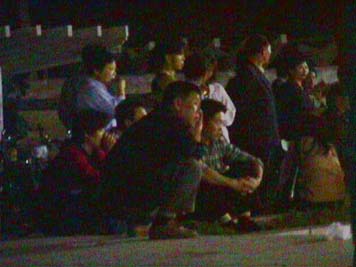
Tonight I decided to go out to watch the dancing behind the night markets with Xiao's parents. I had been told that they frequently chose to go out to watch 'the dancing', and was curious to find out why. The night markets assemble themselves every evening. Small carts and trucks arrive, park, unload poles which are used to erect large boxy tents within which are hung items of clothing, bags, toys, etc. There are regularly crowds - I wondered how so many people could be attracted to the same merchandise night after night, and then reflected that the population density in apartment block districts like this one is deceptively high - there are suburbs-worth of people crammed into this one street. Even if individual locals elected to come merely once each fortnight, the streets would still be packed. The markets are fun and lively, I guess, but I am generally unattracted to lines of stores which are selling stuff I don't need. Behind the stores is a broad empty square. It's the size of two football fields, is separated by long shallow sets of stairs, and seems to have been constructed to provide some relief from the monotony of apartment blocks and restaurants. On the left, one group practice dragon dancing. An ensemble of around four musicians play a continuous scalar melody that is improvised to an agreed-upon form. One plays a two-headed reed instrument that sounds like a nasal clarinet, one plays a large beat drum, others play small cymbals. The dancers dress traditionally or in slacks depending on their enthusiasm, and seem to be comprised of locals who have come out just for something to do. And, they come every night, waving fans and marching around the pavement in synchronised patterns. We moved to the right of the platform which was far more modest. There, locals danced in their own bunker of a ballroom, pairs in casual attire step like swans to the music of a small tape recorder playing old-style chinese pop. What struck me most was the scores
of people who had come merely to watch, like myself, and who similarly
come every night. Were the locals really that desperate for entertainment?
Was this yet another example of the unfathomable boredom that I had been
stunned with recently? I couldn't really know until I joined them.
I sat in the midst of the crowd. It was between numbers, children ran across the pavement as their parents chose partners. One small child, in crotchless pants, squatted to urinate in the middle of the square before 500 people. There was no snickering or cooing, because children know no better. The pee spread between the stone tiles like a maltese cross. His mother collected him as the music began. The courtyard was lit by five or six spotlights lined along the footpath. Grecian columns rose along one side, and the other backed on to a wire fence, on the other side of which were the towering grotesque constructions of Hua Xiang park. Slowly, the dancers began to make their elegant turns across the square. Beside the square, innumerous stained stacks of tiny soily flats stood like soviet goliaths. The crisp night air was thick with dust and fumes, passers-by hoicked up gummy spitballs on the footpath like cowboys. I sat amongst a tired crowd who were enthralled by the refined passage of the dancers. It seemed that this was a show performed for no reason other than to defy the shadow of depression and boredom. It was a practiced and disciplined spectacle that deserved its nightly following, and something I fancied I could understand. Here, in the midst of the dirty suburbs of Shenyang, this small platform was a capsule of grace. Now, the reason why people would get up at 4.30am to dance in the park seemed a touch clearer.
|