  |
|
|
There are two
opposing states of mind which are given to humanity: engagement, and boredom.
Engagement represents the sensation of employment, the satisfaction that
you are spending your time actively getting on with your life and the activities
you have determined to undertake whilst you live. Boredom is the numbing
sickness which besieges those disengaged from any kind of enriching activity.
Between the
two lies an instrument known as distraction. Distraction is really boredom
in the disguise of engagement; it masks the uncomfortable awareness of
the inner void which is the symptom of boredom. It is the panadol of spiritual
remedies, applying temporary relief without removing the problem.
One thing that
has become much clearer to me since arriving in China actually concerns
my own culture rather than theirs: New Zealanders, or perhaps Westerners
in general, are extremely good at distracting themselves, or, in other
words, pretending that they are not deeply bored with the whole performance.
This is only obvious because the Chinese are particularly bad at disguising
theirs. Many visitors to China find the country very serious and stiff
and inward-looking, in fact, I find the people to be open and candid, and
just plainly bored.
It's difficult
not to project an interpretation on what I see here. China is historically
a superstitious and remote nation with an enormous territory and an economy
thick in agriculture and domestic trade. Now it is increasingly atheistic
and an industrial slave to the interests of international business. It's
possible that this is a culture which is too old, or has seen too much
to pretend it's happy any more.
That generalisation
may be trite and oversimplified, but there are many others equally unspecific
in their appeal - perhaps the culture has always been this way. Perhaps
this was what Mao saw through his Marxist understanding, assuming that
the sedating influence of religion was the enemy of mental clarity, and
that under enlightened leadership China could shed the millstones of its
culture and build a socialist utopia. Now, having had the wind kicked out
of their spirituality, the people here still have nothing better to do.
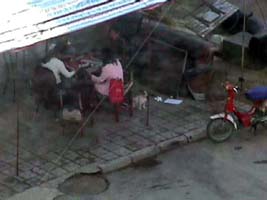
In the apartments adjoining mine, older people live a comfortable but disengaged
lifestyle. They are always coming out of their apartments to sit in the
courtyard downstairs. Some sit for hours watching other people, some gather
in groups to chat, or play mahjong or Chinese chess. Not only the elderly
but the young too seem to be similarly occupied - although this may be
becoming less obvious as more families become rich enough to own television
sets, and so can apply themselves with distraction in their private rooms.
Personally,
I suspect that boredom afflicts the majority of our race. My co-workers
in the computer industry back home in New Zealand, chatting in the lunch
room about the latest technological improvements and the staggering stupidity
of those computer owners who require their expert help, these have more
in common with the mahjong players downstairs than they may care to realise.
And the mahjong players are there every day, all day, and they point when
I walk past, exchanging theories about what the waiguoren is doing in China
and what tastes in food and girls I probably have.
All this being
said, local culture has this advantage - in the fact that because they
are more overt in their boredom than are those whom I knew in New Zealand,
they are more equipped to make the subtle leap from the activity of distraction
to that of genuine engagement with their lives. The distinction between
distraction and engagement is often difficult to pick, and I'm still not
sure I can tell the difference - but it is one that I could have easily
missed.
Mornings in the Park
I was awoken at 5am in order that we might visit the local small public park, Hua Xiang Gong Yuanr. It wasn't as difficult to get up as I'd anticipated - the NZ equivalent time is 9am, and even after a few weeks the local time zone hasn't quite taken effect on me. Admission to the park is free before 8.30, and I was surprised to discover that my hosts frequently visited the park at this hour. It was a warm morning, and the Shenyang streets were sparsely populated. It was interesting to see the streets devoid of people; in general I only see these pavements dizzy with activity, a host of pedestrians, the squatting watermelon and grape merchants, elderly people sitting, watching. This morning, under a grey-blue cover of cloud, I imagined that we were almost solitary witnesses of the dawn. I was mistaken. As we approached the park, the density of passers-by thickened. It seemed that at least a few hundred locals had had the same idea as we'd had. At the entrance to the park, there was a spontaneous street market which had self-organised, selling fruit, soft-drinks and cellphone covers. Inside, I was surprised again. There were thousands within. I was immediately disconcerted by the idea that so many people might have gotten up at this hour for a stroll in the park. On closer inspection, I realised that lots of them were not walking, but standing under trees, sitting by the sidewalk. Forgive me if I seem patronising, but I was quite uncomfortable at that point, watching the vacant expressions and complacent stares of quiet, tired Chinese people who seemed to expect that the entertainment of standing stationary in a park would far surpass any other early-morning activity. There was a sudden association with these faces and those of home, wandering and shopping aimlessly in central Auckland. It was for this reason that I found it difficult to enjoy the walk. Most people were actually, upon reflection, quite busy in the park, there were physical classes and interest groups of numerous kinds, small prides of people practicing Tai Chi, Ballroom Dancing, Fan Dancing, Swordfighting, and plain Aerobics. Curiously, every group was arranged in a core of central direct participants, and then in small intermittent queues of auxiliary enthusiasts, practicing away from the crowd on the side of a nearby path. I was moved by a suspicion of a cloud of emptiness overhanging the park, and couldn't be sure if this was a perception or something that just came from me, an interpretation I was involuntarily forcing on what I saw. In Auckland, a young woman was standing watching a cashflow machine, waiting for it to respond. On the screen was clearly displayed, 'press OK to accept this transaction'. The park itself was an eerie perversion of an amusement park, still under construction. Buildings were deliberately a parody of straight lines and architectural stability. There were swings with grinning animal faces and empty fairground rides. Wang Jian Hua remarked on how children would enjoy a particular hideous playground that was near completion - I rather expected that the bars would be used by exercising adults - for everything in the park that could be leaned against, swung from or jogged around was in use for precisely this. One small hut carved into the sandstone was employed for its acoustic properties by a young man practicing the saxophone. I couldn't but help imagine that children would find the whole place terrifying. Outside the park, activity was beginning to increase. Dirty green and mauve busses circulated scores of shrink-wrapped passengers to the central city. Buggies and three-wheeler trucks parped bird-remarks at each other and at the cock-sure pedestrians in their path. My host parents asked if I'd like to go home. I considered returning to bed, or sitting in the lounge reading a book... and decided against the idea. My other option was to visit a larger park closer to town. I decided to accord with the locals and go see the other park to see how widespread this park-at-sunrise habit really was. With this in mind, we headed into the inner city. (continued) |