  |
|
|
In preparation
for coming to China, I had decided to find out as much as I could about
popular culture, and music seemed a fairly important avenue of investigation,
seeing as most people will readily converse on the subject. China has a
well developed music scene, with its own pop stars, divas and pop standards
going back for decades.
From the perspective
of an ignorant foreigner, I can safely say that most of it is awful.
This is no exaggeration:
almost all of the pop music that is composed in the Chinese language (most
of it from Hong Kong) is in the style of the kind of awful love ballad
that should only win an audience with young girls: the Chinese popular
media have seemed to promote the emulation of the worst of Western music.
Go back thirty years or so and this isn't the case - the music was still
confined to agreeable tune-mongering, but the singers were usually trained
in traditional Chinese techniques and so the singing itself was disciplined
and powerful. Nowadays, gusto, the ability to hold a tune, and a spectacular
pair of breasts is all you need to make it to the top of the Canto-pop
charts.
It was of some
surprise to me to learn that one of the most notable exceptions is possibly
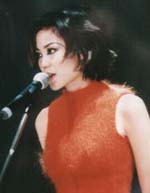
the most famous woman in Asia. Beijing born Wang Fei is a classically trained
singer (modelling herself somewhat on renowned old-style talent Teresa
Teng) who pursued a singing career in Hong Kong in her late teens. She
was then dubbed 'Shirley Wong' and released several soppy records in the
mid to late eighties, which scored her a large popular following back on
the mainland, although she generally only sang in the southern dialect
of Cantonese spoken in Hong Kong.
In the early
nineties, things began to change. In open defiance of the mainstream, she
dumped the sweet-oriental-girl decorum, invested in some highly unusual
eye makeup and bizarre fashions, and began singing less conventional material
- still ballads, nonetheless, but close enough to the edge to stick out
somewhat. She also began to release recordings in Mandarin under the name
of Faye Wong.
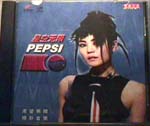
The changes only seemed to incense her following. She became impossibly famous (there are a billion people in China alone and they all know her) and equally commercialised. In Hong Kong, shampoo commercials and gameshow appearances are essential to a musical career - she became a highly sought after celebrity, and recently joined the ranks of famous people who have been purchased by Pepsi. There's no shame about this in China - most stars who sing for commercials release these tracks in their own right, and the popularity of the VCD medium ensures that product video commercials can appear bundled between MTV items and karaoke tracks on commercially released albums. She's even established a following outside of China, particularly in Japan, and recently held a series of concerts in Australia of all places. She's recorded with the Cocteau Twins and the Cranberries - all of this practically unthinkable for a Chinese star.
Having become a curiosity in the public eye, she was in a perfect place to win the sympathy of the Chinese people during a highly publicised separation from her adulterous songwriter spouse. Apparently, he had become jealous - his pride was unable to suffer being only known as 'Wang Fei's husband'. Faye escaped with a cute kid and more appearances in magazines. She went on to score a gorgeous 19-year-old boyfriend, Fellow singer Nic Tse, which sent the notoriety meter off the scale. This all, of course, lends nothing to an explanation of why Wang Fei's music has anything going for it. Indeed, when I first encountered it a couple of years ago, it was still basic pap, with nothing at all to distinguish it from the rest of the chewing-gum music that regularly comes out of Hong Kong. Something else seems to be changing in Faye's career, and it's probably to do with the musicians that she works with now in addition to increasingly exploratory vocal work on her own part. I have studied classical music enough to be able to spot a genuine voice - I found that in the music she has released in the last couple of years, Wang Fei's style has enabled her to display an unusual resonance. I am reminded of Karen Carpenter, whose over-sweet ballads of the seventies are only made good by the fact that when she crossed her tessatura to sing in her lower register, the resulting maturity in tone was uncommonly rich. Another example of this kind would be Freddie Mercury, who brought operatic control to thrashy guitar rock. Regardless of whether or not one is a fan of either of the above, a discerning listener cannot but concede that these were exceptional singers. Faye is the same. I'm tired already of the nasal schoolgirl voices that typify Asian pop. Faye seems to have attained a control over her voice which allows her to bring out different vocal characteristics in different pieces. Add this to the fact that the songs themselves are starting to break away from conventional pop, and Faye's music becomes even more of an enigma, and subsequently, more interesting. In fact, she has finally reached the point where people are starting to dislike her music. Chinese press reviews are less favourable; Faye seems to be gradually declining in popularity for being too unclassifiable. Ironically, it's at precisely this point where her music has become more worthy of being singled out.
All in all, most Chinese pop is pretty thin. For the sake of musical creativity, this needs to change, and if the Hong Kong hit machine would hold off for just a few moments, it's clear that Chinese music would have more to offer. It's starting to happen: I watch the music shows on CCTV when I can, and I'm interested to see that some of the younger talents, as well as some of the more established, are starting to introduce more unconventional musical elements into their work. I saw Andy Lau singing with a mixture of rock and traditional Chinese instruments, and just yesterday I saw Shenyang born singer Na Ying accompanied by outlandish breakbeat rhythm. Fortunately for popular culture, in all respects, the rigid prescriptions of the past are beginning to show signs of strain. Concert in Shenyang
Having developed an appreciation for Wang Fei, I was more than surprised to hear that Shenyang was to be the venue for her concert just two weeks after my arrival. Tickets ranged in price from 120 to 880 RMB (divide by four for NZ equivalent, by eight for American) which basically saw patrons seated either extremely distant to the stage or just moderately distant. Sadly, but sensibly, we elected for super-distant. Posters had been up for weeks; this was a fairly major event for Shenyang. I anticipated high-tech asian lighting and flash stage effects, merchandising galore, T-shirts and screaming teenage fans. Nothing could have been further from the actual event itself. I arrived at the dusty carpark before the stadium, which was very slowly filling with people, most dressed in casual earthy coloured slacks and skirts. It was a smoky, gritty warm afternoon and people seemed relatively unenthused. I scanned the lot for advertising regarding the concert, and found absolutely nothing with Wang Fei's name, let alone picture. A long red banner over the entrance to the stadium told of a long-passed exhibition. Others promoted the sponsor of the event, a cigarette company (I think) without revealing what the event actually was. No T-shirts in sight - in fact, marketeers seem to have missed grand opportunities all round. Perhaps it was something to do with the volume of police which constituted at least 10% of all present (and the stadium was fairly packed by the start time) - almost anything was banned, anything that might be thrown or scattered or make your evening remotely comfortable was confiscated: I lost a can of almond milk which I didn't care much for anyway... anything that might want to be passed out later I tried to avoid - the only toilets in the stadium were on a specially fitted bus, the sole purpose of which seemed to be to drive away from the queue at a predetermined moment, complete with those people who were lucky enough to make it still inside! The only thing that could be bought was binoculars - and boy, were they necessary. It was pretty obvious that Faye, when she appeared, would be pea-sized - even the projection monitors were tiny, so in the end we needed to use binoculars to seem them. Even more important was the fact that there was a good two hour wait once we sat down and looking at other people was about all you could do. I found one other waiguoren in the crowd, with a small group of twenty-somethings that might have been students. No snack shops, sweet stalls, no CDs on sale, no posters, no cover band, no covers for the filthy seating (people instinctively brought newspapers), the only thing that was there was a continuous stream of Mandarin over the loudspeakers: a lady with a very pleasant voice was apparently instructing the crowd as to what they weren't allowed to do. The moon quickly rose above the stadium; apartment blocks nearby lit themselves and their windows slowly populated with freeloading onlookers. Then: the band appeared. The floodlights went on, and they began to play the 'Faye Wong 98-99 Concert Tour Opening Theme'. This, and the video footage, strongly reminded me of the commercially released VCD. Could Faye still be doing the same concert? A closer look revealed that it was the VCD. I checked to see if the musicians were actually playing - they did appear to be. A familiar bass riff... the opening to one of Faye's moodier hits, Gan Qing Sheng Huo. This was certainly the same concert as I'd seen on VCD a few months before: Faye emerged, rising in the middle of a huge transparent column, glam hair and blushing cheeks. I waited for the haunting opening punchline - Ni Hen Ai Wo - you love me so - sung as an accusation rather than an endearment. Sadly, the power was lost in a mixing mistake - you could hardly make out the first line at all. I was disappointed, and remembered hearing exactly the same error in the mix of another live concert I'd been given to hear - at this point, I didn't realise that this was a significant clue to the most disappointing aspect of the whole concert: Faye wasn't actually singing. The secret, dear Faye, is not take take the microphone away from your mouth before you've finished the line. By the time four or five songs were through, my initial creeping suspicions were confirmed - she was miming. The Chinese call this Jia Cheng and there's little more insulting trick a performer can use on an audience. Shenyang, I was told, had waited 13 years to see Faye, and weren't even given the chance to hear her. Midway through the concert was the most blatant example of Jia Cheng: Faye, at this point right in front of the premium-ticket row, was struck by a few tossed items: those luminous sticks which were distributed at the door. She seemed to laugh off the first one, but when they kept pelting her, the expression changed and she stopped singing - I felt I could read the look on her face very clearly through my binoculars. Inwardly, in her native Mandarin, Faye was saying: I don't want to be here tonight. I felt for her at that moment. Her voice, disembodied, continued cheerily from the speakers. A few lines later, she shook herself out of it and set her lips moving and smiling again. The crowd seemed happy enough - those guys at the front managed to keep their arms suspended, waving the little glowing sticks for two hours. Maybe they had superhuman circulation - mine were tiring just from holding the binoculars to my face. I was waiting for one song in particular - Kai Dao Tu Mi - one relatively unpopular song that I'd recognised to be right on the edge of Chinese rock. I wasn't disappointed. They gave the song a new introduction, rescored backing vocals, and the guitarists came out the front especially for a showcase - which gave me to think that someone should tell Faye's guitarist that he's really got it. For some reason, Westerners imagine Chinese people can't navigate an electric guitar with the right spirit. They are mistaken. There were classics too - one very, very old Chinese traditional song (the lyrics are from an ancient poem scribed by some empress) called Dan Yuan Ren Chang Jiu. Faye's (prerecorded) rendition was flawless: the moon, now high and exceptionally clear given local pollution levels, was taken by some bright cameraman and projected behind Faye. In no way was the heritage of the piece at all disrespected. And then, it was over, and several thousand Chinese (plus me) walked out, scaling the curiously locked gates and walking out into streets devoid of bars or after-events (nightclubs having been for the most part closed down last year by local authorities - too much drugs, drunken behaviour, and sexual licentiousness...). Faye had failed to capture the crowd - I later found that she was dropped from the nearby Dalian international festival in favour of Andy Lau thanks to poor reviews of this concert. In all, I had the impression that Faye is a little tired of this career - she has a nice private life now, a sizeable bank account, some film roles... I get the feeling that performing demands are a little away from her interests right now. Fair enough, too. Concert Review (If you can read Chinese) |