  |
|
|
At home, things
are very relaxed and I am managing to get on with a lot of work. Xiao's
mother, Wang Jian Hua is an excellent teacher. As we sit at the table,
she constantly points at various objects around the room and queries my
stock of Mandarin. I understand that it is difficult for her not to be
able to tell me what she is thinking, and she is thus insistently teaching
me as much as possible. I am also being spoiled rotten, not having spent
a cent in the time I have stayed here. They are treating me like a son,
an experience they have not been allowed to have. Chinese families
are only allowed one child, and boys are certainly favoured. It is understandable
that parents devote so much to their children, and I am becoming used to
encountering the triumverate family units, the parents and their 'end product'
single offspring. I have heard apocryphal accounts of children turning
on their parents for not pleasing them enough - there have been stories
of teenage boys beating their mothers to death for not taking them to McDonald's.
There are fears that tomorrow's China is a nation of spoiled only-children.
Outside, there
is constant motion. Kids play in the sun all day, running and shouting.
Sweaty men in tee shirts and shorts and girls in minis cross the courtyard
ceaselessly. Construction workers, too - there is a tent of workers
downstairs who are living here for a month or two whilst they renovate
this building - I see them lying in their sleeping bags reading in the
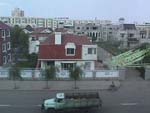
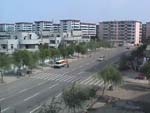
evenings when I take walks with Xiao's family. From the window of my room
I see a straight block of apartments which stretches along the entire street.
There is a grubby restaurant downstairs (I know, I have seen the way they
store their vegetables on boxes at our back door, sweltering under a cloud
of fruit flies) which is lit by a string of stereotypical red plum-shaped
lanterns.
Foreigners are an enigma and the Chinese here are unashamedly curious. People do point, and everywhere I hear Wai Guo Ren, Wai Guo Ren, which means 'outlander'. Mind you, their interest has its limits - I was in the city taking photos when a large group of people gathered around to watch me and I felt quite conspicuous, however, when I handed the digital camera to Xiao's father, the crowd followed the camera rather than me. Karaoke We were on our way to yet another restaurant where again I would meet with family friends, demonstrate my feeble Chinese (which amuses all - the monkey can speak) and sing yet another rendition of The Heart Will Go On on Karaoke. On this particular occasion I was to meet a young lady, Zhang Fan, who has elected to study in Belgium this coming September and who was interested in learning a little French from me before her departure. However, she was so shy that she could hardly use the little English she knew to talk about her plans. I tried to break the atmosphere by discouraging her from using the English name she had tentatively chosen for herself - Fanny - and giving her some alternative French names. From a short list she selected Sophie, and was delighted. I told her that the two most important phrases in French are I love you and I'm hungry - and warned her about the amorous intentions of European boys who would be following her everywhere - she smiled gleefully right in front of her parents who didn't understand a word. There was a particularly potent liquor on offer which was distilled from some kind of grain - a foul, poisonous concoction which I politely bore for the duration of a whole half-glass. The father of the young boy I was sitting near to had guzzled three or four glasses and was ready to discuss politics. I took the opportunity to ask after the communist government: M: Can you give
me your opinion of Deng Xiao Ping?
I asked about the cultural revolution, but he merely nodded his head as a self-evident demonstration of what he'd just said. M: Do you think
China is a communist country?
It was at about
this point in conversation that a microphone was thrust into my hands and
the Titanic began to list on the Karaoke screen... my heart sank...
Beiling Park
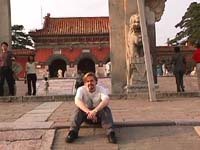
I was moody today after a drawn-out session at a family friend's residence singing My Heart Will Go On, and so the visit to Shenyang's North Tomb (Bei Ling) was not appreciated as much as it could have been. It was hot and I was wandering around the complex (built 1643) trying to decide on what I could say about the place that held any interest. There seemed only two alternatives - to openly acclaim the architecture as a monument to the glorious history of China, or to be cynical about the obvious commercialism that operated at its base. Both seemed well-worn paths, and so I resolved to attempt to enjoy the weather and the bronze sun colours reflected off the orange rooves. I inspected the stretched leather taut over thick wooden doors - between the crumbling flakes I could make out the impressions of roughly drawn Chinese characters. I marvelled at them momentarily until I realised that they were graffiti - then reflected that it hardly made any differerence when in the building's history they were drawn and so marvelled at them anyway. The Emperor's tomb is to the rear, which looks like a concrete cistern with a tree on top. It's a shame: This Emperor completed his father's conquest of China, and established the Qing dynasty, moving the Manchu empire to its new base in Beijing. The Manchus ruled China until early last century when the celebrated Last Emperor Pu Yi was deposed by the Chinese Kuo Ming Tang political party. Pu Yi ended the glorious Manchurian empire as a gardener in Tianjin, after having been imprisoned by the communists after the Second World War for treason. He'd come back to Shenyang to side with the Japanese against China and set up the Manchukuo state: a feeble attempt to reclaim his birthright. Now, Manchuria is merely a region of Northern China, and Shenyang an aggregation of merchants and labourers making their way through the rubble of old apartment blocks. |