  |
|
|
After such a
long trip, I was tired and irritated: Xiao was plain grumpy. Fortunately
the mood lightened significantly upon meeting Xiao's parents, who were
quick to swoop upon us complete with several family members. It was a relief
to have our baggage removed from our shoulders and there was little need
to understand any Mandarin at all to comprehend the emotions of Xiao's
family in meeting us. We were handed flowers and ushered into a minivan,
whereupon we were driven from the airport.
Shenyang is
a dirty, dusty city and is almost uniformly the ochre colour of Chinese
skin. It persists under a permanent haze of dust from the constant reconstruction
of almost every bulding in sight. I wondered how the inhabitants could
still determinedly profess the glory of their culture from within a grotto
the size of a state: however, the answer came very quickly. The people
who live here are persistently improving the city without thought of stopping
- what at first seemed a metropolis of neglect turned out to be merely
an unthinkable amount of work to be done. Expansion is needed to cushion
the growing population, as well as the removal of old clay brick blocks
and their rebuilding anew.
We enjoyed a
brief stop at Xiao's grandmother's where we were treated to a traditional
welcome-back noodle dinner. I reflected that I have spent at least $2000
on Chinese food in the past two years: I now regard that money as entirely
wasted, mere gruel in comparison with the genuine product.
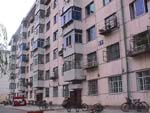
Finally we arrived
at the apartment block. It is another reflection on the practical local
character that the building was drab and unwashed on the outside, and yet
the apartment inside was stylish and extremely well-kept.
Shenyang at Night A dinner with the whole family welcomed us to the City and gave me an opportunity to see the locale at night. The streets were warm and lantern-lit, swimming with locals unsatisfied with staying indoors. We walked to a local restaurant past carts of watermelons, which were sliced into portions for the buyers who squatted on the sidewalk over drains to eat and spit the seeds. From top storey windows karaoke enthusiasts sang unashamedly out of key in heavy reverb, their tuneless vibrato spilling out into the evening heat. The sidewalks seemed to extend a lane or two onto the road, which itself was divided by an ambiguous centre line. Pedestrians distractedly dodged bikes and vehicles honking happily as an announcement moreso than a warning. I met Xiao's family and was treated to numerous exotic dishes - the best of which was a generous heap of taro pieces drenched in thick golden syrup. The pieces were dipped in cold water to freeze the caramel, forming a crust of hokey-pokey. The recipe apparently dates to the Qing dynasty, which arose from the Manchurian kingdom based in Shenyang. Curiously, the locals seem to be more informed about the Qing period of Shenyang's history than they are of more recent matters - Noone at the dinner table could tell me the location of the city of Mukden, the name by which Shenyang was known until merely 50 years ago, when the Chinese wrested control of the region from the then-occupying Japanese forces. The Inner City In the first couple of days, I had several opportunities to explore central Shenyang with Xiao and her parents. Shenyang is almost impossible to photograph - there are so many discrete scenes of character that no one shot seemed to capture the feeling of the place. It is busy and dusty, teeming with bicyclists, chubby shirtless mahjong players and heavily made-up young women grimly ignoring the dirt. On every doorstep is a wizened old woman or a smoking, stubbly youth - there seemed no point in photographing any of them owing to their weary regularity. We visited the
huge statue of Chairman Mao Zedong, one of the remaining memorials of this
now criticised leader whose distorted communism was only superceded by
his venereal disease. Mao was worshipped in his life; now the red book
of thoughts is no longer read before meals as a grace, and the fervent,
muscled men and women carved in the base of the statue have been relieved
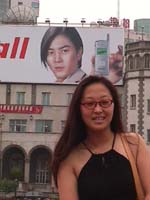
of their copies by disillusioned vandals. Opposite is a huge photograph
of the pop star Ekin, overshadowing the statue - his arm is extended presenting
not a red book of thoughts, but a mobile phone. Mao appears to be reaching
for it greedily.
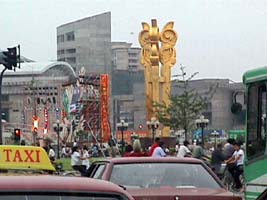
We drove throughout
central Shenyang, weaving through streets and streets of specialist stores.
I searched for the 'Soviet architecture' of which I'd read in relation
to Shenyang, all I could positively identify as such was the grim administrative
building near the government square, which itself was decorated with central
golden sunbird pillars. There is a skytower too - there are several new
buildings which proudly extend stories above the more pedestrian older
high-rises - these appeared to be luxuries for the economy of the city,
vacation projects for the construction workers usually engaged in renovating
hovels.
Back home, I am taking the opportunity to relax after a hectic month. I have been studying Chinese, watching Chinese TV dramas (mostly kung-fu fantasy pieces) and socialising with Xiao's family and friends. I'm spoiled and enjoying the sense of freedom in a country where strict government controls seem far away from the man I passed this evening resting peacefully on his cart where he will sleep tonight, smoking under his blanket in the warm air.
|