

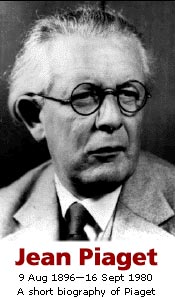
 Piaget’s Theory of Cognitive Development
Basic Assumptions
1) Children are active and motivated learners.
Children are naturally curious and are actively learning about their surroundings. They seem to be natural learners. Children invent new games to play, talk to imaginary friends and are constantly questioning the world that is around them. This is active learning. They are storing those experiences in their brain for recollection in later years.
2) Children construct knowledge from their experiences.
Children use this process to construct the world around them. The questions they ask are stored for later use and help to construct their own view of the world around them. This theory is also known as the Constructivist Theory. Piaget believed that Children organized things they learned in to schemes. Schemes are similar thoughts or actions. Over time these schemes have more experiences organized together, thus the child makes assumptions about the life in which he/she lives in. Some examples of schemes could be and are not limited to: fashion, favorite toys, identifying objects and classifications (dorks, jocks).
3)Children Learn through the two complementary process of assimilation and accommodation
Although over time a child’s scheme may change the process in which schemes are formed remain the same. Piaget believed that learning was a result of two processes, assimilation and accommodation. Assimilation is a process of dealing with an object or an event in a way that is consistent with an existing scheme. As an example a child with a classification scheme may put a new classmate in an existing classification like “dorks”. If a child can not put a new object into an existing scheme than one of two accommodations may occur: They will modify their existing scheme to allow the object to fit or for an entirely new scheme for this object.
4) Interaction with physical and social enviorments is essential for cognitive development.
Piaget believed that new experiences where essential for learning. He stress the importance of interaction and manipulation of the physical world. Piaget also believed in the importance of social interaction. Though social interaction children can form schemes about people and relize that people have different view points. They form better interpersonal relationships though this process
5) The process of equilibration promotes progression towards increasingly more complex levels of thought.
Piaget thought that children where sometimes in a state of equilibrium-they can comfortably explain new events in terms of existing schemes. Equilibrium does not last all the time though. Sometimes a child can not explain new things in existing schemes or their current understanding of the world. This may create disequilibrium a short of mental discomfort.
Basic Assumtions Overview: Piaget's Theory of Cognitive Learning
Piaget believed children where active learners always making new schemes and challenging the world around them. As a child progressed the schemes found new boundaries and the child formed new schemes. The schemes may change but the way in which the child forms the scheme stays the same.
As schemes become increasingly more complex (i.e., responsible for more complex behaviors) they are termed structures. As one's structures become more complex, they are organized in a hierarchical manner (i.e., from general to specific).
There are a two key Piagetian principles for teaching and learning:
Learning is an active process:
Direct experience, making errors, and looking for solutions are vital for the assimilation and accommodation of information. How information is presented is important. When information is introduced as an aid to problem solving, it functions as a tool rather than an isolated arbitrary fact.
Learning should be whole, authentic, and "real":
Piaget helps us to understand that meaning is constructed as children interact in meaningful ways with the world around them. Thus, That means less emphasis on isolated "skill" exercises that try to teach something like long division or end of sentence punctuation. Students still learn these things in Piagetian classrooms, but they are more likely to learn them if they are engaged in meaningful activities (such as operating a class "store" or "bank" or writing and editing a class newspaper). Whole activities, as opposed to isolated skill exercises, authentic activities which are inherently interesting and meaningful to the student, and real activities that result in something other than a grade on a test or a "Great, you did well" from the computer lesson software, are emphasized in Piagetian classrooms.
Piaget Formed stages he believed all children went through.
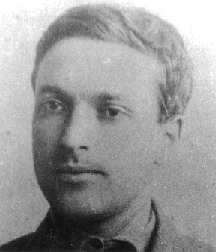 Vygotsky’s Theory of Cognitive
Vygotsky’s Theory of Cognitive
Vygotsky’s Theory of Cognitive
Basic Assumptions
1)Complex mental process begin as social activities
Vygotsky believed that children a developing child learn though social interaction with adults. When a child is first learning they discuss objects and information with other adults or knowledgeable individuals. They then learn how those people feel about the subject helping them to shape their own views in that area. Vygotsky believed that dialogue with others help a child in promoting cognitive development. He thought this to be essential to the development. Without interaction this most development would not progress. Even though he believed heavily in this he also thought that not all mental processes emerge from interaction with adults. Peers also have great influence on a child. An example of this is in an argument with another child. They may be arguing about how to something the "right" way or who said what to whom but Vygotsky thought this helped children realize that there are different viewpoints in every matter.
2)Thought and language initially develop independently of each other; the two become interdependent when children are about two years old
Vygotsky expressed that thought and language where separate functions for infants and toddlers even though in adults the two are closely related. This seems logical because infants can not talk. They can think and express feeling but they have not formulated their language skills. As language does come into play in the first few years of life, it is primarily used to communicate not to think. Only after rational thought comes into play do children start to understand and link the two together. Once we see the two process start to merge a lot of self-talk will begin to happen. Children begin to work problems out with them selves out loud. This is a guide to their behaviors.
3)Children can perform more challenging task when assisted by more advanced and competent individuals
Vygotsky distinguished between two kinds of abilities that children are likely to have at any given time in their development. A child’s acual developmental level is the extent in which a child can perform task without help from anyone else. A child’s level of potential development is the extent to which a child can perform a task with help from a more competent individual.
4)Challenging task promote maximum conitive growth
The zone of proximal development (ZPD) is the range of task a child can perform with help from a skilled individual and not on their own. This includes problem solving and learning that is immature or "embryonic" in a child. The ZPD will naturally change over time as a child become efficient in a skill. Vygotsky believed that this promoted cognitive growth because a child has to work out a problem oral and in turn stored better in a child’s memory.
Basic Assumtions Overview:Vygotsky's Theory of Cognitive Learning
Vygotsky's Beleived that cognitive learning was a social event. That through lanuage and interaction with children, children would begin to learn and challange their suroundings. He also belived that our interpretation of skills and object influce Children.Vygotsky proposed that social interaction profoundly influences cognitive development. Central to Vygotsky's theory is his belief that biological and cultural development do not occur in isolation (Driscoll, 1994).The major theme of Vygotsky's theoretical framework is that social interaction plays a fundamental role in the development of cognition. Vygotsky (1978) states: "Every function in the child's cultural development appears twice: first, on the social level, and later, on the individual level; first, between people (interpsychological) and then inside the child (intrapsychological). This applies equally to voluntary attention, to logical memory, and to the formation of concepts. All the higher functions originate as actual relationships between individuals." (p57). (http://tip.psychology.org/piaget.html)
Compare and Contrast of Piaget and Vygotsky's Theories
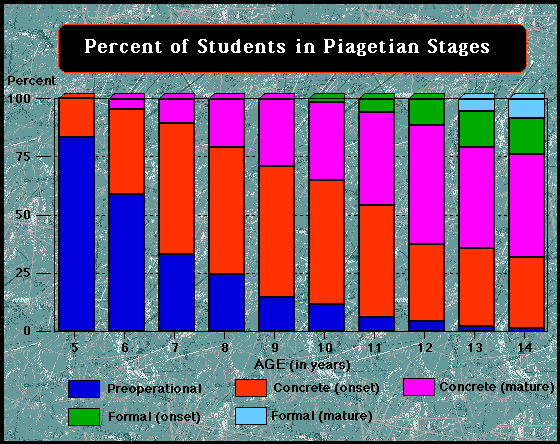
Vygotsky approached development differently from Piaget. Piaget believed that cognitive development consists of four main periods of cognitive growth: sensorimotor, preoperational, concrete operations, and formal operations (Saettler, 331). Piaget's theory suggests that development has an endpoint in goal. Vygotsky, in contrast, believed that development is a process that should be analyzed, instead of a product to be obtained. According to Vygotsky, the development process that begins at birth and continues until death is too complex to to be defined by stages (Driscoll, 1994; Hausfather,1996).(http://chd.gse.gmu.edu/immersion/knowledgebase/theorists/constructivism/vygotsky.htm)
Web Pages Used as Research
Educational Psychology Interactive: Cognitive Development
Cognitive Constructivist Theories
Genetic Epistemology
Social Development Theory
Cognitive development and intelligence
Lev Vygotsky’s Social Development Theory
Book used for research was: Educational Psychology - Developing Learners 3 ed. By Jeanne Ellis Ormrod