

Members of 17.Feld Division (Lw) along the Atlantik Wall
Our impression begins in the Fall of 1942 with the formation of the Luftwaffe field divisions. At the time of their original formation, the ranks of these divisions were drawn strictly from the Luftwaffe. Therefore, the initial members of Flieger Ausbildung Regiment 52 (the unit used to form 18. Luftwaffen Feld Division) would be primarily kitted in Luftwaffe gear.
The impression of a jäger within a Luftwaffe field division can be daunting in putting your kit together. You must really research your impression and know what type of persona that you are trying to develop. In the field divisions, the kit that was issued varied significantly and someone that you might expect to be actually in the Heer might actually be in the Luftwaffe. This started in late 1943, when the overall control of the Luftwaffe field divisions was shifted from the Luftwaffe to the Heer.
If your impression is one of a jäger that was originally with Fl. Ausb. Rgt. 52 in September of 1942 when the division was formed, then your impression will be one in which all of your gear is that which you might expect to be found on any other member of the Luftwaffe. Your basic uniform will be made up of a fliegerbluse, straight leg trousers, overseas cap, jackboots and a Luftwaffe buckle. The fliegerbluse and trousers were produced in the distinctive feldblaü of the Luftwaffe and stood out from the Heer and Waffen SS divisions fighting on the Eastern Front. The Russians were well aware of the Luftwaffe field divisions inadequacies and would purposefully target their formations when attacking. The very items that set them apart from other units would ultimately cause them to suffer the brunt of many Russian assaults. When you step into the field, you should look something like this jäger:
|
|
By the Fall of 1943, the supply of the divisions had changed to the Heer. Alte hase or old hares within the division retained their Luftwaffe gear, but slowly started receiving replacement field gear and uniforms from Heer depots. As such, whereas the Luftwaffe jäger was once uniquely identifiable by his gear, his appearance slowly began to transform into that of a Heer infantryman. In these two photos, you will see two photos from what I believe to be 20.Feld Division (Lw). In the first photo, the first jäger wears a Heer decaled helmet. In the second photo, the jäger wears a Heer feldbluse with his Luftwaffe M43 cap.
|
|
|
By 1944, replacement troops for the field divisions were coming from the Heer. So, original issue of uniform and equipment was no longer Luftwaffe and the uniform and kit that they received became uniquely Heer in appearance. In June of 1944, these members of 16.Feld Division (Lw) were captured by the British along the beaches of Normandy:
) |
) |
) |
Even in 1944 though, there was still quite a bit of Luftwaffe gear used by the field divisions. It was simply mixed in with the replacement gear and troops that were supplied by the Heer. As this photo of 17.Feld Division (Lw) illustrates, by D Day the transformation from a strictly Luftwaffe to Heer appearance was far from complete.
|
|
Matters are even further complicated by the mix of insignia on the tunics. In the below three photos, you will see prisoners of a Luftwaffe field division after the capitulation of German forces in 1945. In these, the Luftwaffe fliegerbluse retains its Luftwaffe adler, but the collartabs have been replaced by the collar litzen found on Heer tunics.
) |
) |
) |
Another photo showing the wear of mixed insignia. Also, the awards on the tunic are the Heer versions of the Ground Assault Badge and Close Combat Clasp.
) |
The uniform and equipment guidelines for 18.Feld Division (Lw) outlined herein are meant to reflect the motley nature of the typical Luftwaffe jäger found in the field divisions after their takeover by the Heer. You as a member of 18.Feld Division (Lw) are encouraged to develop your own persona. However, prior to going outside of these parameters, do your research and discuss your intentions with those more knowledgeable of the topics. Final decisions with regard to authenticity rest with the unit commander.
When you join 18.Feld Division (Lw), your first concern should be the accumulation of your basic kit. Prior to purchasing any item, you should seek advice from a member of the unit as to whether its usage or wear is permitted in the unit. Descriptions of the basic and advanced kits are below. Click on the below photos to link to pages with photos and descriptions of a standard field division impression.
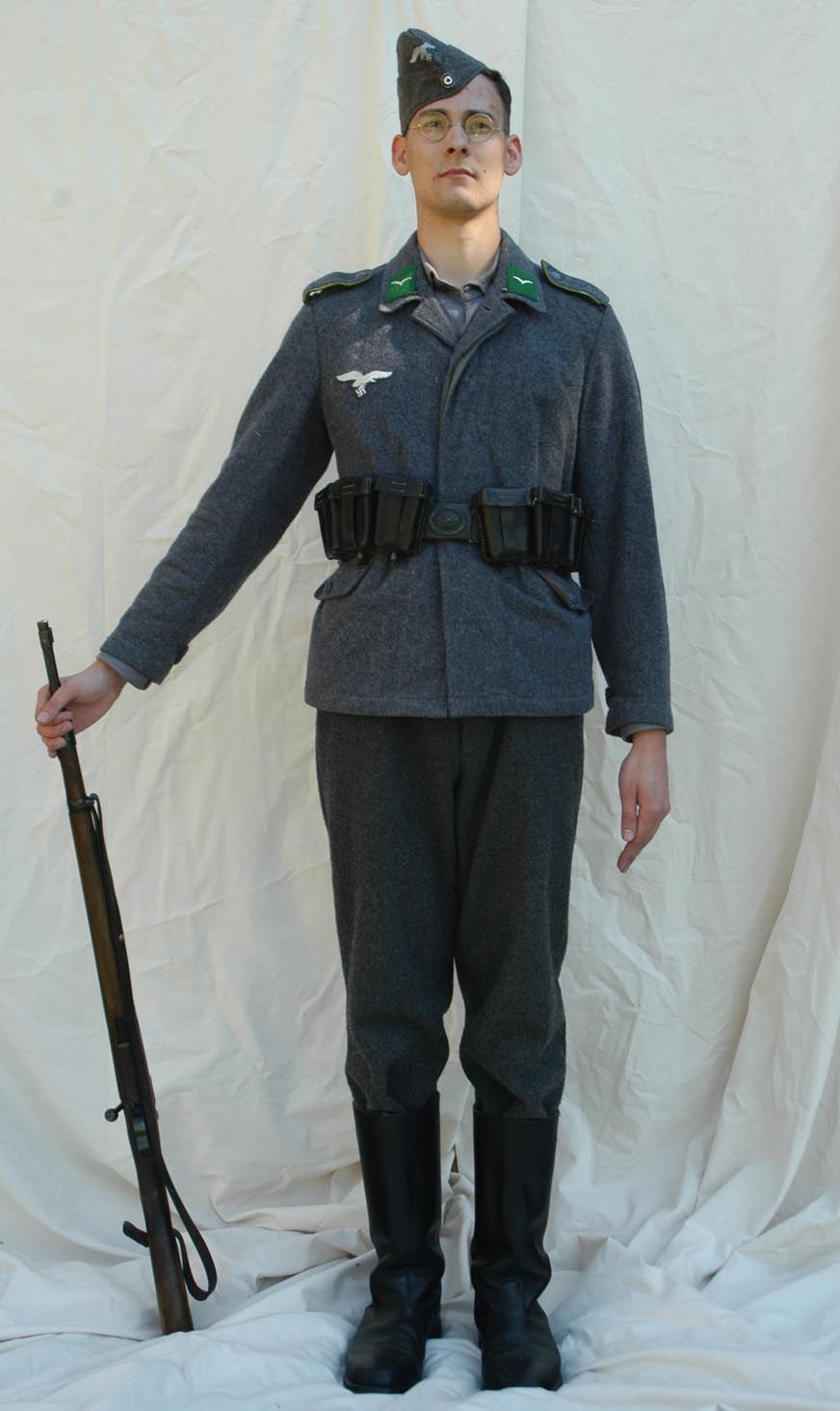
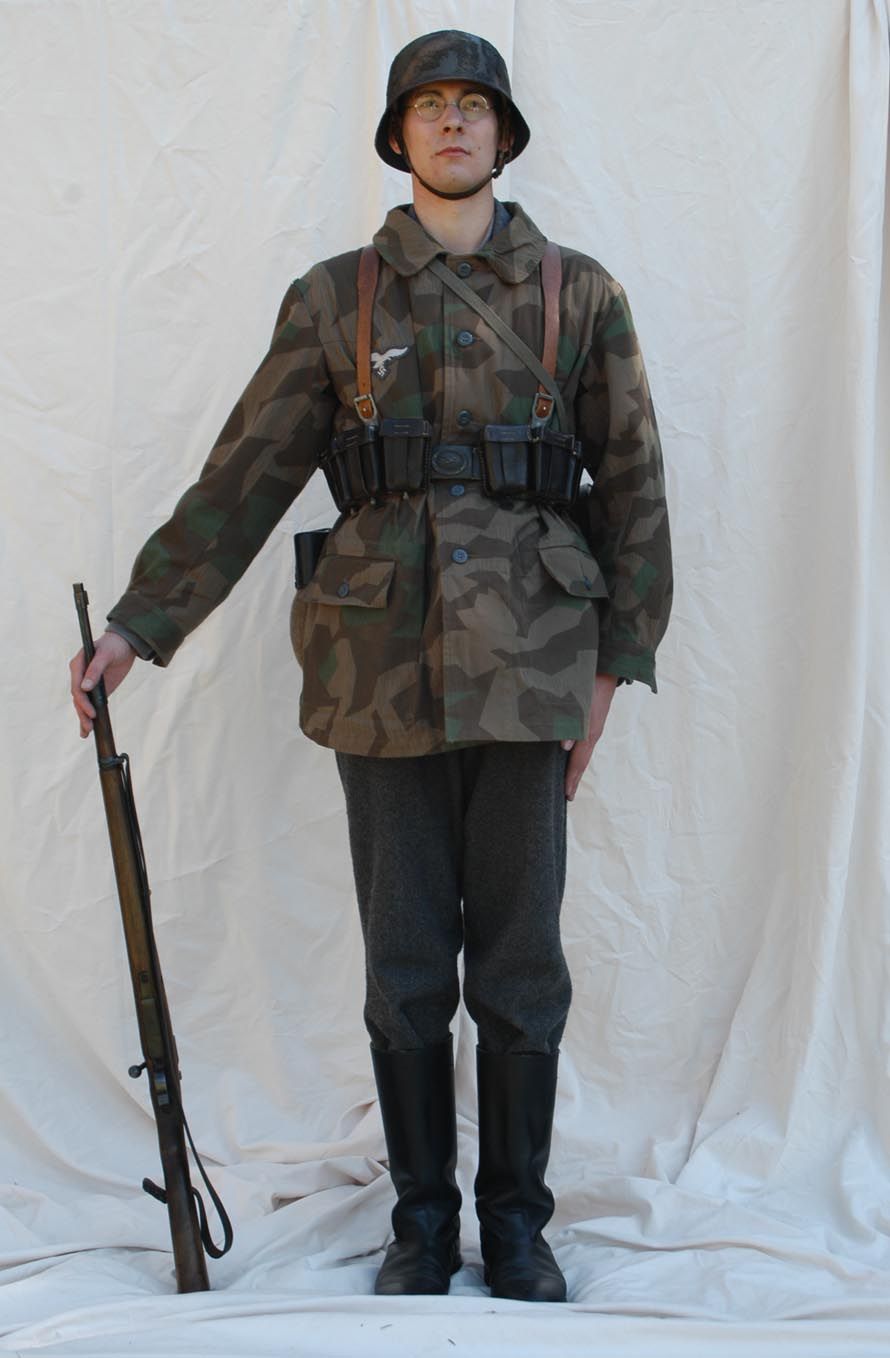
In order to become a full member of the unit, you must have the following kit items:
The basic uniform required of all members of 18.Feld Division (Luftwaffe) is composed of the following:
1. A woolen tunic in any Heer feldgraü feldbuse or a Luftwaffe feldblaü fliegerbluse. Although all models of the Heer feldbluse may be worn, wear of the M36 and M40 models are discouraged among all members except NCOs. In wear, the fliegerbluse should be worn open-collared while the Heer model tunics may be worn either open- or close-collared.
2. Trousers may be either the woolen straight leg M36 pattern in feldblaü or the M43 kielhosen style of the Heer in feldgraü.
3. The undershirt in either gray or late war brown should be worn since the tunics will most often be worn open collared. A woolen turtleneck sweater may be worn in lieu of the undershirt.
4. Socks should be gray woolen.
5. Jackboots, low boots with gemaschen or mountain boots may be worn. In the event low boots are worn, the gemaschen may be either Heer issue in green or Luftwaffe issue in blue. Socks with size rings may be worn in lieu of gemaschen when wearing the M43 trousers. The socks will be worn outside of the trousers and rolled down over the tops of the low boots in such instances. When wearing mountain boots, the proper leggings should also be worn. Otherwise, socks should be worn in the same style as with the low boots. Unconverted postwar gemaschen are not authorized. Postwar manufactured boots should be converted so as to incorporate leather soles, hobnails, toe taps and heel irons.
Every member of 18.Feld division should have a helmet and soft cap for wear. In choosing which ones to purchase, you should concentrate on the following:
1. The steel helmet may be in any pattern (M35, M40 or M42). The helmet may be either Luftwaffe blue or Heer green. It may be either single decaled (Luftwaffe or Heer eagle), double decaled if an M35 (Luftwaffe eagle and national shield) or no decaled. The helmet may be properly camouflaged as well taking advantage of splinter helmet covers, camo paints, European-style chickenwire, inner tubes, bailing wire, breadbag straps and other means of affixing foliage to the crown.
2. The Luftwaffe fliegermutze (overseas cap) in feldblaü or M43 cap in either feldblaü or feldgraü are authorized for wear. Heer insignia may be worn on the feldgraü M43 cap. Because of the period of time in which we are portraying a Luftwaffe field unit, the wear of the enlisted peaked cap in camp or with walking out dress is discouraged.
Understanding your impression is vital in determining what insignia is proper for your tunic and headgear. Our unit is representing a rifle squad in a Luftwaffe field division. Under the guidelines established by the Luftwaffe in 1942 for its forming divisions, jäger regiments wore jäger green collartabs and piped shoulderstraps. By late 1943, with the incorporation of the Luftwaffe field divisions into the Heer command structure, the color of shoulderstrap piping was changed to white in order to conform with existing Heer standards for infantry. The following guidelines should be used when adding insignia to your uniform:
1. Shoulderstraps may be piped in either white or jäger green. When wearing the fliegerbluse, preference should be given to the wear of jäger green as it will reflect that the tunic was issued to you prior to the incorporation of the Luftwaffe field divisions into the Heer. Either white or green piped shoulderstraps may be worn with the Heer tunic styles.
2. Luftwaffe collartabs are to be worn only with the fliegerbluse. In lieu of collartabs, gulls may be pinned directly to the collar of either the fliegerbluse or the feldbluse.
3. The Luftwaffe breasteagle backed in feldblaü may be worn on either the fliegerbluse or feldbluse. Heer insignia may be worn on the feldgraü feldbluse. By wearing a feldbluse with Heer insignia, your impression will be of a Luftwaffe jäger joining the division after its incorporation in the Heer command structure or of an "old hare" reissued uniform components from the Heer stocks during the same time period. Although it was not uncommon in tropical areas, collartabs and breasteagles of different branches should not be mixed on continental uniforms.
Although Heer pattern smocks were issued in very limited quantities to the Luftwaffe field divisions, the wear of camouflage in other forms was more common among the jägers. In most instances, camouflage was provided by the Wehrmacht splinter pattern zeltbahn. However, the Luftwaffe field jacket in splinter pattern was also uniquely identified with these units. Preference in wear should be given to either the zeltbahn or field jacket over a smock. If you choose a smock., then preference should be to splinter pattern as tan and water never appeared in any quantities in the field. The combat jacket should only be worn in splinter pattern as tan and water jackets were issued in the Luftwaffe after the assimilation of the field divisions into the Heer command and supply structures.
The basic field equipment of a jäger in a Luftwaffe rifle regiment was essentially the same as that found with an infantryman in the Heer. The most significant difference, however, was the mixture of Luftwaffe blue canvas and brown leather equipment with Heer green canvas and black leather equipment. The mixing of Heer style equipment with Luftwaffe style is encouraged. In doing so, your basic equipment required for unit membership is:
1. Breadbag in either Luftwaffe blue or Heer green.
2. Canteen in either Heer brown wool or pressed wood. No blue wool covers.
3. Load bearing equipment including belt, with Luftwaffe buckle and Y straps. The belt and Y straps may be in black leather, brown leather or webbing. The Y straps may be either heavy or light weights. The wear of an A frame is optional.
3. Bayonet, scabbard and frog in either brown leather, black leather or webbing.
4. Ammo pouches appropriate for your weapon. Mauser pouches may be in either brown or black leather. G43 pouches may be in either leather or canvas. Otherwise, pouches should be in canvas.
5. Messtin in Heer issue green or unpainted aluminum. No blue messtins.
6. Gasmask canister in either Heer green or Luftwaffe blue.
7. Splinter pattern zeltbahn for use as shelter and camouflage.
Depending upon scenario, not all of the equipment may be carried in the field. However, you are expected to have the above items as your basic equipment kit. Remember, these are only guidelines. Needless to say, we all know what we can do to improve our impressions. The finishing touches are up to you.
As a late war unit, the weapons issued to Luftwaffe field divisions were often the same as found among those of the Volksgrenadier divisions. Shortages in manpower were compensated for by increases in firepower. Therefore, unlike early war squads that were often armed only with K98 rifles, the Luftwaffe squads often possessed more semi-automatic and fully automatic weapons. Therefore, any of the following weapons are authorized for carry:
1. K98, G98/40, G33/40 or any other wartime produced German rifle.
2. MP38 or MP40 submachinegun.
3. G41 or G43 semi-automatic rifle.
4. MG15, MG34 or MG42 machinegun.
Pistols may be carried by squad leaders, heavy machinegunners and medics. No captured weapons are permitted at anytime.
After you have acquired your basic kit and are a full member of 18.Feld Division (Luftwaffe), you may wish to add other uniform and equipment components to your impression in order to be more flexible in time frame and location. Some other items that you may consider adding are:
1. A summer or tropical uniform for warm weather wear. Should you wish to purchase such a uniform, check with the unit commander prior to doing so as to what styles are permitted to wear. These uniforms should not be worn in lieu of your continental uniforms at events where such wear would be historically inappropriate.
2. Mouse gray, Luftwaffe blue, tan and water or splinter pattern parka sets for winter wear. Greatcoats in either feldblaü or feldgraü may also be used. Winter headgear may also be worn during colder months.

)
)
)
)