By David Willis in Los Angeles
An inquiry has heard that if the crew of an American nuclear
submarine that sank a Japanese fishing vessel had spent 90 more
seconds tracking the boat's position, disaster could have been
avoided.
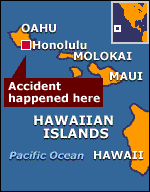
Nine people died when the USS Greeneville collided with the
Japanese craft Ehime Maru last month.
One of the crew on board the USS Greeneville told the US
Navy's court of inquiry that lack of time to perform a proper
sonar analysis contributed to the sinking of the Japanese
trawler.
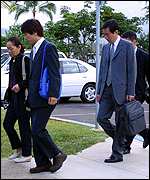
The Japanese relatives want some explanations
|
Petty Officer Edward McGiboney, a
sonar supervisor, said the submarine had previously been
performing a series of high speed manoeuvres for the benefit of 16
civilians on board.
It then conducted two turns intended to allow the sonar system
to re-set itself, a procedure which typically requires 10 minutes.
More time needed
But Petty Officer McGiboney said the Greeneville performed the
manoeuvre for six minutes before coming up beneath the Japanese
ship, tearing into its stern and sending the vessel plunging to
the ocean floor.
Asked if he would have been able to locate the fishing vessel
had the submarine spent another minute and a half on manoeuvres,
he replied that he would.
The court of inquiry will decide
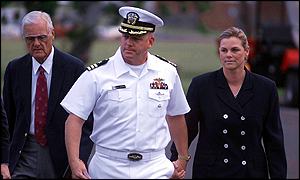
the fate of the submarine's captain, Scott Waddle, and two other
senior officers who could face anything from a reprimand or
discharge to a court marshal.
Now ending its second week of proceedings, the inquiry has
heard a number of witnesses testify that procedures aboard the
submarine were rushed, possibly to avoid inconveniencing the
civilian guests.
The USS Greeneville had taken to sea purely for their benefit
after a planned training exercise was cancelled.
A retired navy admiral had requested the excursion as a reward
for a group of people who had helped to organise a golf
tournament.